Tim Stephens, University of Sydney
In the lead-up to this year’s United Nations climate conference in Glasgow, the Morrison government is inching towards adopting a net-zero emissions target for 2050. If Prime Minister Scott Morrison can resist internal party pressure to exempt some sectors from the commitment, the target would be welcome.
It would also bring Australia into line with its international peers. More than 120 other governments have made similar pledges, including China, the European Union and the United States.
However, Morrison is reportedly considering making the target voluntary, rather than legally binding. That would mean the policy could circumvent parliament and Coalition backbenchers averse to climate action could not vote against it.
But if that happens, the commitment is likely to be meaningless. As recent political history shows, emissions reduction targets must be enshrined in law if we’re to have any hope of reaching them.

The value of a good law
A well-designed climate law can achieve two main goals: ensuring Australia meets and beats its emissions targets, and that those targets are consistent with the best available science.
In 2012, the Gillard Labor government passed a comprehensive climate law known as the Clean Energy Act. The legislation underpinned Labor’s carbon price scheme, which was famously repealed by the Abbott government in 2014. The law was unusual in setting a fixed carbon price rather than an emissions target, but over time the policy would have met the goals set out above.


The laws were only in place for a few years, but quickly began working to bring down emissions. This is because businesses, in particular the electricity sector, faced mandatory financial costs if they failed to comply.
When the law was abolished, Australia also lost much of the institutional infrastructure needed to drive emissions down. For example, the Climate Change Authority – while surviving the Abbott government’s effort to scrap it – lost its central role in advising on carbon budgets and emissions targets.
Australia now has no national mechanism to put a legally binding cap on emissions. Instead, we have a hodgepodge of voluntary schemes and incentive mechanisms. These include the Climate Solutions Fund (formerly the Emissions Reduction Fund), under which the government pays polluters to cut their emissions, and the Technology Investment Roadmap.
The Emissions Reduction Fund has had modest impact. But as Australian National University environmental economist Frank Jotzo has noted, it’s “vastly less effective and efficient” than the carbon pricing mechanism it replaced.
Without a legally binding target, climate action becomes voluntary. The federal government cannot compel industry and others to reduce their emissions, and itself is not held to account.
As the Australian experience over the past 15 years has shown, the lack of a legal imperative means climate policy goes nowhere. Arguments about emissions reduction become mired in internal party bickering and parliamentary paralysis, and vested fossil fuel interests continue to profit while damaging the planet.
Steggall on the right track
Independent Warringah MP Zali Steggall recently stepped into the climate policy vacuum. Her Climate Change Bill, currently the subject of a parliamentary inquiry, is supported by both the business sector and environment groups.
Both Steggall’s bill and the Gillard government’s legislation draw inspiration from the UK Climate Change Act. That law passed in 2008 with bipartisan support, and has done much to decarbonise Britain’s economy.
The UK’s CO₂ emissions reportedly fell by 2.9% in 2019. Over the decade to 2020, as the economy grew by one-fifth, emissions fell by 29%.
Key features of both the UK legislation and Steggall’s bill include:
- a legally binding, economy-wide, 2050 net zero emissions target
- an independent expert body to advise the government on emissions targets and emissions budgets
- a requirement for the government to set five-year emissions “budgets” and adopt emissions-reduction plans to meet them.
This approach is not policy-prescriptive. Unlike the Gillard government’s law, it does not mandate the adoption of an emissions trading scheme. Instead, the government determines how to stay within the carbon budget.
Nonetheless, such a law imposes a legal obligation on the government to follow it.
Why this matters
The Morrison government’s own projections show Australia is not on track to meet its 2030 emissions target.
And even if it did hit the target – a 26% emissions reduction between 2005 and 2030 – the goal is widely regarded as inadequate. Most recently, an expert panel last week concluded a target of 50% below 2005 levels would be consistent with limiting global warming to well below 2℃ this century.
As for the target of net-zero by 2050, the Labor opposition says government projections show it will take Australia 146 years to reach that goal.
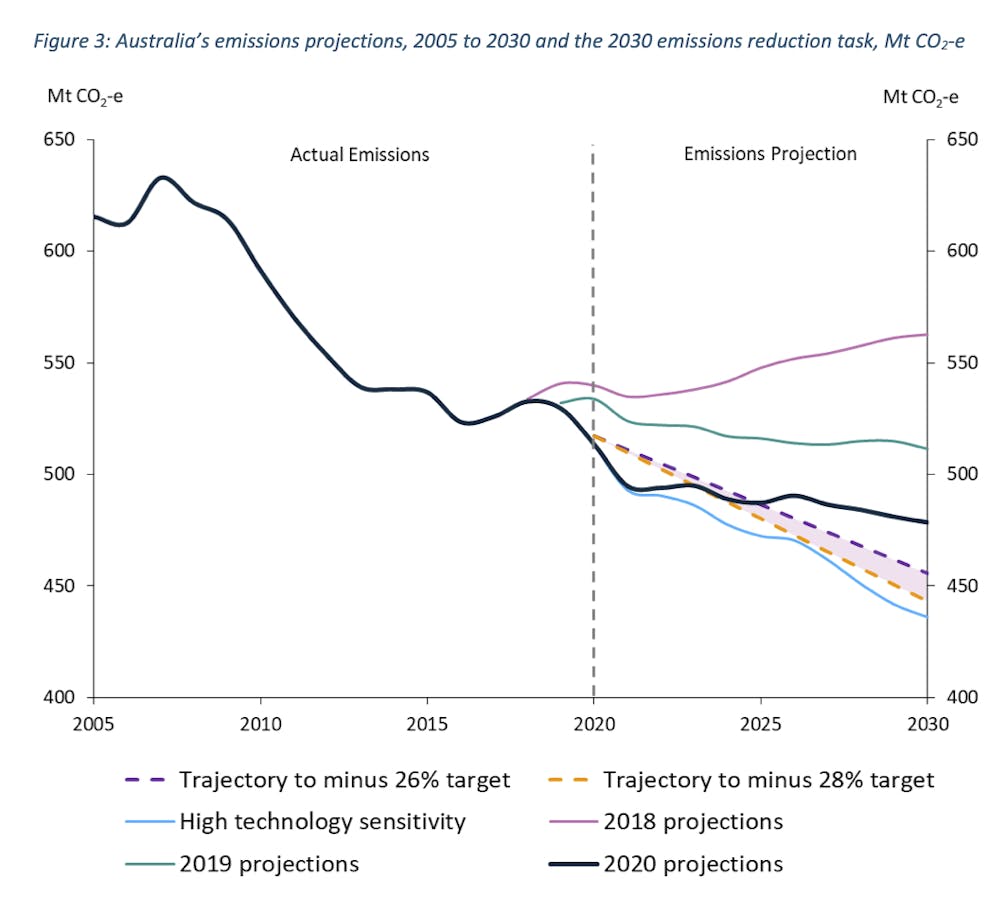
Clearly, Australia is off track, and legally binding targets are needed.
National legislation exists to tackle other environmental and pollution issues. For example, laws have successfully reduced ozone-depleting substances and synthetic greenhouse gases.
This shows the value of mandatory regulation, set in law, to address a global pollution challenge.
Learn from the past
Under the Paris Agreement, Australia must scale up emissions-reduction targets every five years. Unless our national commitment is backed by legislation, it will not be seen as credible in the eyes of the international community.
While states and territories such as Victoria and the ACT have enacted strong climate change laws, this is no substitute for a national approach.
In Australia and internationally, climate lawmaking has been going on for more than a decade. The evidence is clear: well designed, binding climate laws do effectively tackle the climate crisis. Anything less may well turn out be an empty promise.
Tim Stephens, Professor of International Law, University of Sydney
This article is republished from The Conversation under a Creative Commons license. Read the original article.