


Jamie Pittock, Australian National University; Bruce Thom, University of Sydney; Celine Steinfeld; Eytan Rocheta, UCLA School of Medicine, and Nicholas Harvey, University of Adelaide
A major independent review has confirmed freshwater flows are vital to maintaining the health of the Murray River’s lower lakes, striking a blow to demands by New South Wales that seawater flow in.
The review, released today, was led by the CSIRO and commissioned by the Murray Darling Basin Authority. It examined hundreds of scientific studies into the lower lakes region of South Australia, through which the Murray River flows before reaching the ocean.
The review recommends managing the lakes with freshwater, not seawater. More importantly, it highlights how climate change and upstream farming is reducing the flow of water for the environment in the lower lakes.
These findings are critically important. They show the severe health threat still facing the river system and its internationally important wetlands. They also cast doubt on whether the A$13 billion basin plan can achieve all its aims.
A barrage of criticism
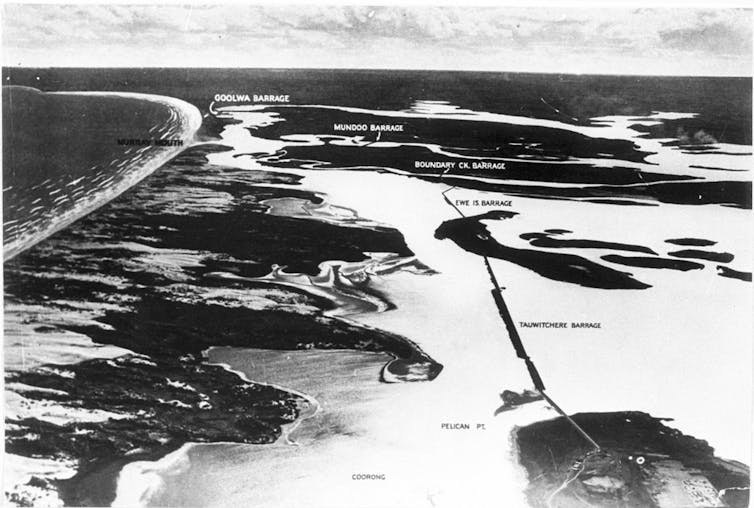
The Murray Darling river system runs from Queensland, through NSW, the ACT and Victoria. In South Australia the River Murray discharges into two large lakes, Alexandrina and Albert, before flowing into the 130 kilometre-long Coorong lagoon, through the Murray Mouth and into the ocean.
Since 1940 five low dams, or barrages, have stopped seawater flowing into the lakes from the Murray Mouth and Coorong, and raised the lakes’ water level.


NSW wants the barrages lifted to allow seawater back into Lake Alexandrina, to free up freshwater for agriculture upstream.
In December 2019, NSW Nationals John Barilaro said: “I refuse to let regional communities die while we wash productive water into the Great Australian Bite (sic), 1000km away”. Irrigation advocates have backed his calls.
Victoria has also questioned whether the lower lakes can continue to be kept fresh, given the water scarcity plaguing the entire river system.
But today’s review confirmed the lower lakes were largely a freshwater ecosystem prior to European occupation. It said removing the barrages would cause significant ecological and socioeconomic harm, and would not lead to water savings if the basin plan targets are to be met.
The Murray Mouth is choking
The review cited research we published this month, which concluded it was impossible to achieve the basin plan target to keep the Murray Mouth open 95% of the time.
This is because Murray Darling Basin Authority modelling did not factor in the power of the Southern Ocean to move sand into the Murray Mouth, which is now choked. Dredging will be required most of the time to keep the Murray Mouth open and maintain the ecology of the Coorong.
The Coorong and Lakes Alexandrina and Albert are a wetland of international importance under the Ramsar Convention.
The review found removing the barrages would significantly change the freshwater character of the site, which we have an international obligation to maintain for the sake of waterbirds, fisheries and threatened species.
This is becoming harder during periods when freshwater inflows are scarce. In the Millennium Drought for example, lake levels fell exposing highly acidic mudflats. In other areas, the waters became more salty.
After the basin plan was adopted in 2012, the condition of the lower lakes improved when the Millennium Drought broke and environmental flows were delivered, sustaining the system in the current drought. But very little of those flows enter the sea, except during floods.
The system of barrages in the lower lakes consist of 593 gates. Using official data, we calculate that for 70% of the time since 2007, fewer than ten gates have been open to the sea. For one-third of the time, none were open, indicating there is insufficient water to sustain fisheries and flush salt to the ocean.
Our research concludes that without the barrages the sand banks will reduce the volume of water flowing through the Murray Mouth. The tides would not be strong enough to keep the lakes flushed so water quality would decline. No barrages means lower lake levels and exposed mudflats, generating sulphuric acid.
An uncertain future
The review reinforces the South Australian government’s position that the lakes should be maintained with freshwater. It also obliges the federal government to implement the basin plan in its current form, despite NSW’s demands for changes.
The final report also highlighted how climate change will make management of the Coorong, Lower Lakes and Murray Mouth “increasingly challenging” and said adaptation options were needed for the entire river system.
By the end of this century, rising seas may flow over the barrages. Maintaining freshwater inflows and the barrages buys us time, but we need a serious national conversation about how to manage this challenge.
The federal and South Australian governments recently announced a Coorong Partnership to enable local communities and groups participate in programs to improve management of the lagoon. This is timely and should be expanded to cover the broader Lower Lakes and Murray Mouth regions.
Freshwater flowing from the headwaters to the sea is vital for the health of the Murray-Darling Basin as a whole. Today’s report should be the start of the national discussion on shoring up the health of Australia’s most important river system in the face of an uncertain future.
Jamie Pittock, Professor, Fenner School of Environment & Society, Australian National University; Bruce Thom, Emeritus Professor, University of Sydney; Celine Steinfeld, Acting Director, Wentworth Group of Concerned Scientists & Adjunct Lecturer at UNSW Sydney; Eytan Rocheta, Policy Analyst, Wentworth Group of Concerned Scientists & Adjunct Associate Lecturer at UNSW Sydney, UCLA School of Medicine, and Nicholas Harvey, , University of Adelaide
This article is republished from The Conversation under a Creative Commons license. Read the original article.







