

• Advertise
  • About us
  • Terms and Conditions
  • Contact us
Sunday, December 7, 2025
Australian Times News
  • News
    • Weather
    • Sport
    • Technology
    • Business & Finance
      • Currency Zone
    • Lotto Results
      • The Lott
  • Lifestyle
    • Entertainment
    • Horoscopes
    • Health & Wellness
    • Recipes
  • Travel
  • Expat Life
  • Move to Australia
No Result
View All Result
  • News
    • Weather
    • Sport
    • Technology
    • Business & Finance
      • Currency Zone
    • Lotto Results
      • The Lott
  • Lifestyle
    • Entertainment
    • Horoscopes
    • Health & Wellness
    • Recipes
  • Travel
  • Expat Life
  • Move to Australia
No Result
View All Result
Australian Times News
No Result
View All Result
Home News

Israel’s vaccine rollout has been fast, so why is it controversial and what can other countries learn?

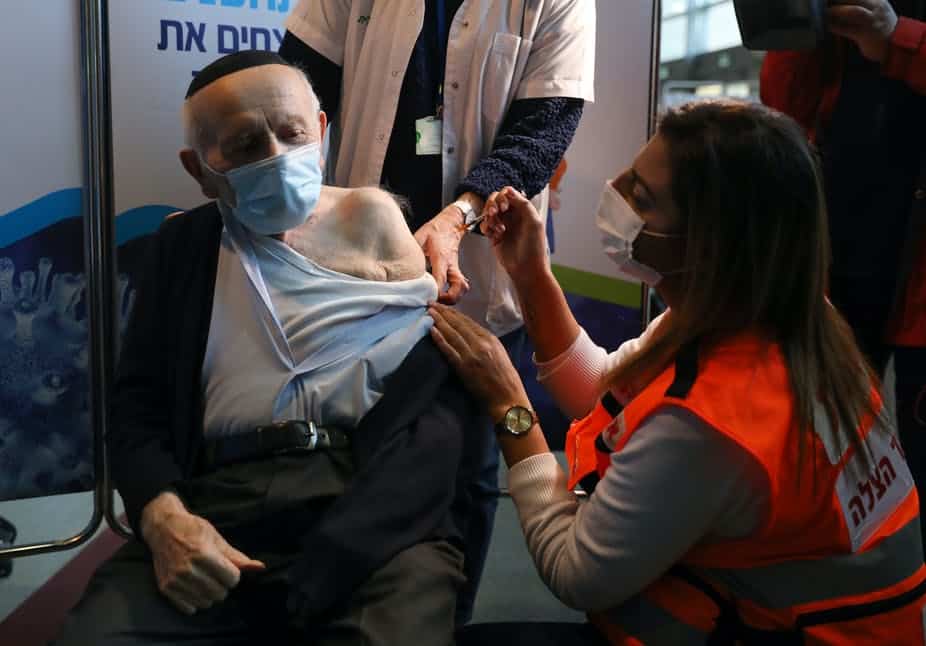
Israel is rolling out a fast-tracked COVID-19 vaccine programme, giving a first dose to 48% of its population of 9 million in five weeks. The country’s aim is to vaccinate 80% of the population by the end of May 2021.

The Conversation by The Conversation
28-01-2021 22:29
in News
Israel’s fast-track vaccination programme is providing data for the world on efficacy. Abir Sultan/EPA

Israel’s fast-track vaccination programme is providing data for the world on efficacy. Abir Sultan/EPA

Aditya Goenka, University of Birmingham

Israel is rolling out a fast-tracked COVID-19 vaccine programme, giving a first dose to 48% of its population of 9 million in five weeks. The country’s aim is to vaccinate 80% of the population by the end of May 2021.

But questions have also been raised about the way the programme has been carried out. So what can be learned from Israel’s experience?

A deal with Pfizer

The Israeli government struck a deal with Pfizer for accelerated access to the Pfizer/BioNTech vaccine, in return for providing the anonymised age, sex and demographic data of vaccinated people. This is made possible by the fact that Israel has a universal healthcare system and each person has a digitised health record.

The country also has the health infrastructure and logistics to deliver the vaccines. The occupied territories, meanwhile, have a different healthcare system.

Preliminary evidence from the rollout is giving us an insight into how effective the vaccine is in the real world. After 14 days, a group of people who had received one dose of the vaccine reportedly showed 33% fewer infections than an unvaccinated group. This was a disappointingly low level of protection, although the Israeli Ministry of Health later said that the full protective impact of the vaccine had not yet been seen.

Much more encouraging are recent reports that, of 428,000 Israelis who received a second dose of the vaccine, only 0.014% went on to contract the virus.


AlsoRead...

Ryan: Building real freedom through e-commerce

Ryan: Building real freedom through e-commerce

27 November 2025
Design Australia Group: Redefining Drafting as the engine of housing growth

Design Australia Group: Redefining Drafting as the engine of housing growth

26 November 2025

It is important to note that this data is preliminary and has not been peer-reviewed by other scientists. We will require more than figures released in the press to properly understand the efficacy of this vaccine in real-world conditions.

Privacy issues

The deal with Pfizer has also raised privacy issues. There are safeguards in the agreement and, in a public health emergency, collecting demographic data is essential to seeing what works and what does not. But whether individual data should be shared with profit-making companies without explicit consent remains an important question, especially as information on 140,000 COVID patients has already been shared with Shin Bet, Israel’s security agency, without due approval and authorisation.

Cost of vaccines

The other aspect of the deal to consider is the price paid. The full details of the deal are not available but reports suggest that priority access to the vaccine has come at a high premium to what the EU and US are paying.

Israel’s position is that the total price paid for the vaccines is the cost of just two days’ lockdown, and so worth paying. Paying the premium may change the priority of delivery within Israel itself but, given the size of the country, it will not necessarily affect the global market. However, if other countries start breaking ranks as well, then the global market for vaccines will be severely affected.
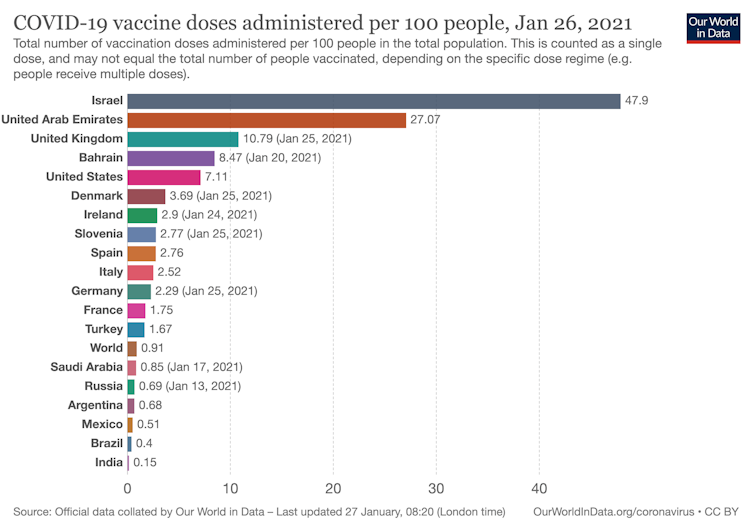
Chart showing COVID vaccine doses per capita.
OurWorldInData

As a number of countries have placed enough orders to vaccinate their citizens several times over, other countries, especially lower income ones, may find it a challenge to access the minimum number of doses they need. In this context, whether the vaccines should go to the highest bidder, or be distributed based on ethical criteria protecting the most vulnerable, is something to think about.

Occupied territories miss out

What happens to the people living in the West Bank and Gaza Strip is perhaps the most controversial aspect of the vaccination scheme. While Jewish settlers are receiving the vaccine, Palestinians in occupied territories are not.

The position of Israel is that this is the responsibility of the Palestinian Authority. But the Fourth Geneva Convention, which covers control of epidemics and contagious disease, arguably means that this duty falls on Israel as the occupying country.

It is an enormous challenge for the Palestinian Authority to acquire and deploy the Pfizer/BioNTech or Moderna vaccines given their cost and the cold-storage technology they require. The Palestinian Authority has placed orders for the Russian Sputnik V vaccine but there is not currently enough supply of it for a full rollout.

Domestic politics

There is also a domestic political dimension to the vaccine policy. Israel has had one of the highest infection rates in the world. During the second wave of the pandemic, after protests against the government’s handling of the pandemic, a national unity government was formed in May 2020.

However, there were continued protests and the government collapsed on December 22 2020 with another general election called for March 2021. The agreement with Pfizer was signed on January 6 2021.

From a political economy perspective, the responsibility of a government is to protect lives and livelihoods, and so Israel’s efforts to fast-track vaccination are certainly to be commended. The data provided to Pfizer is a public service to other countries as it will provide information on the efficacy of the vaccine aiding more realistic assessments of vaccination strategies.

As we wait to find out more, the lessons drawn from Israel’s ambitious vaccination programme should be balanced with understanding its institutional, political, and economic context.

Aditya Goenka, Professor of Economics, University of Birmingham

This article is republished from The Conversation under a Creative Commons license. Read the original article.


Tags: SB001
DMCA.com Protection Status

SUBSCRIBE to our NEWSLETTER

[mc4wp_form id=”2384248″]

Don't Miss

The evolution of Aesthetic Surgery through the lens of Dr Kourosh Tavakoli

by Pauline Torongo
4 December 2025
The evolution of Aesthetic Surgery through the lens of Dr. Kourosh Tavakoli
Health & Wellness

As global interest in Australian cosmetic surgery continues to grow, the combination of regulation, research and emerging digital tools is...

Read moreDetails

Ryan: Building real freedom through e-commerce

by Pauline Torongo
27 November 2025
Ryan: Building real freedom through e-commerce
Business & Finance

Ryan’s greatest achievement isn’t any single business or revenue milestone — it’s the ecosystem he’s built through the Change community.

Read moreDetails

Design Australia Group: Redefining Drafting as the engine of housing growth

by Pauline Torongo
26 November 2025
Design Australia Group: Redefining Drafting as the engine of housing growth
Business & Finance

Australia is under pressure to build homes faster, but design bottlenecks slow progress. Design Australia Group is fixing this by...

Read moreDetails

Louis Guy Detata builds Global Trading Empires through autonomous systems and disciplined leadership

by Pauline Torongo
25 November 2025
Louis Guy Detata builds Global Trading Empires through autonomous systems and disciplined leadership
Business & Finance

The path from investment banking to leading a global trading platform has taught Louis Detata that sustainable success requires more...

Read moreDetails

Burning Eucalyptus Wood: Tips, Advantages, Disadvantages & Alternatives

by Fazila Olla-Logday
20 November 2025
Image Supplied
Enviroment

Learn about burning eucalyptus wood for stoves and fireplaces. Discover benefits, drawbacks, harvesting tips, and better alternative firewood options for...

Read moreDetails

Everything Parents Need to Know About Baby Soft Play and Why It’s a Game Changer

by Fazila Olla-Logday
11 November 2025
Everything Parents Need to Know About Baby Soft Play
Health & Wellness

Baby soft play is a fun, safe, and educational way for little ones to explore and grow. Discover the benefits...

Read moreDetails

WOMAD Sets Up a New Camp in Wiltshire – Australian festival fans take note!

by Kris Griffiths
11 November 2025
Kumbia Boruka brought their reggae and dancehall flavour to the Taste the World Stage at WOMAD 2024 - Credit - Mike Massaro
Entertainment

With its 2026 edition moving to Neston Park in England, WOMAD offers Aussie music lovers a chance to reconnect with global...

Read moreDetails
Load More

Copyright © Blue Sky Publications Ltd. All Rights Reserved.
australiantimes.co.uk is a division of Blue Sky Publications Ltd. Reproduction without permission prohibited. DMCA.com Protection Status

  • About us
  • Write for Us
  • Advertise
  • Contact us
  • T&Cs, Privacy and GDPR
No Result
View All Result
  • News
    • Weather
    • Sport
    • Technology
    • Business & Finance
      • Currency Zone
    • Lotto Results
      • The Lott
  • Lifestyle
    • Entertainment
    • Horoscopes
    • Health & Wellness
    • Recipes
  • Travel
  • Expat Life
  • Move to Australia

Copyright © Blue Sky Publications Ltd. All Rights Reserved.
australiantimes.co.uk is a division of Blue Sky Publications Ltd. Reproduction without permission prohibited. DMCA.com Protection Status

No Result
View All Result
  • News
    • Weather
    • Sport
    • Technology
    • Business & Finance
      • Currency Zone
    • Lotto Results
      • The Lott
  • Lifestyle
    • Entertainment
    • Horoscopes
    • Health & Wellness
    • Recipes
  • Travel
  • Expat Life
  • Move to Australia

Copyright © Blue Sky Publications Ltd. All Rights Reserved.
australiantimes.co.uk is a division of Blue Sky Publications Ltd. Reproduction without permission prohibited. DMCA.com Protection Status





