



Claire Field, University of Stirling
On Sunday May 2, only one person in the UK died from COVID-19. It’s a remarkable achievement after a terrifying winter spike in the disease which saw the UK rack up one of the highest per-capita death tolls in the world. Now, after a long lockdown, even previously cautious epidemiologists are feeling encouraged.
So, with the death rate so low, why isn’t life back to normal yet? With deaths and cases at their lowest since September, many people are frustrated with the ongoing regulations.
Care home residents still face restrictions, despite many of them having received the vaccine. Indoor dining and drinking remain closed until May 17, a decision that prompted a legal challenge from Greater Manchester’s night-time economy adviser, Sacha Lord, on behalf of the hospitality sector. The High Court has ruled in favour of the government’s decision.
If measuring risk was purely about numbers of cases and deaths, then the decision might seem a little extreme. Cases are low, so the chances of catching COVID-19 or overwhelming the NHS by reopening restaurants also seems low.
Of course, current cases and deaths do not tell us much about what would happen after further reopening – which is a counterfactual question. Extrapolating from current low case numbers also glosses over the various specific factors such as ethnicity, social disadvantage, age and occupation that increase the probability of severe illness from COVID-19 for some. This is one reason to be wary of reopening too soon: low numbers of cases at the moment do not give us a complete picture of how risky reopening would be.
There are additional reasons for caution.


Risk is traditionally understood in terms of probability: the likelier an event is, the riskier it is. But some philosophers think there are more varieties of risk than this. Broadly speaking, there are alternative understandings of risk according to which the more far-fetched a possibility is, the less we need to worry about it.
For example, the so-called modal account of risk, developed by philosopher Duncan Pritchard, characterises risk in terms of how “close” the possible world is in which an event happens. If not much would have to change for the event to happen, then it occurs in a close possible world, and so the modal risk is high.
The normic account of risk, developed by philosopher Martin Smith, understands risk in terms of how strange or unusual the occurrence of an event would be. If nothing strange or unusual would need to happen to explain the event’s occurring, the normic risk is high.
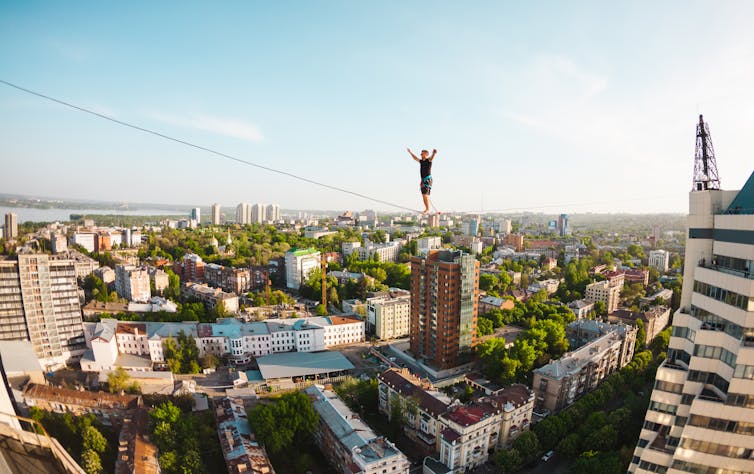
So something can be very modally or normically risky without being particularly likely. Imagine an expert tightrope walker crossing a tightrope between two high buildings. They are an expert, so the likelihood they will fall is low. Still, the modal risk is high because very little would need to be different for them to fall – they just need to put one foot wrong.
Or suppose I offer you a sweet from a jar that contains 100 sweets, one of which is poisoned. The probability of getting the poisoned sweet is low, but the action of picking it out is nevertheless normal: nothing unusual would be needed to explain how you got the posioned sweet rather than a regular one.
Should you take a sweet? Surely not! If the risk of COVID-19 is anything like the risk of getting a poisoned sweet, continued caution makes sense.
Even if catching COVID-19 is currently unlikely, it would not be particularly surprising. We know that simply by being in close contact with other people indoors we are exposing ourselves to the possibility of COVID-19. Even if the chances are low, catching it would not demand an extraordinary explanation.
This makes the risk a little different to other risks we are more used to. A typical year sees around 30,000 house fires in the UK. That is a significant number, but house fires are not normal – houses do not catch fire without explanation. Something needs to happen that isn’t part of our regular routine. Appliances need to malfunction, or cigarettes be left burning. Even if these things are in fact common, the normic risk of a house fire is low because these explanations are needed.
If the risk of catching COVID-19 is more like the risk of drawing the poisoned sweet from the jar than the risk of setting your house on fire, in that you don’t need an explanation of what you did differently to cause it, then catching COVID-19 has a much higher normic risk than house fires.
Another reason for caution might be the moral uncertainty surrounding whether the risks of reopening are justified, and how they are justified.
This question is easy in the case of the jar of sweets: the risk of getting a poisoned sweet is clearly not justified by the trivial benefit of a non-poisoned sweet. It is a little harder for the tightrope walker. The thrill of tightrope walking might justify the risk, but this depends on the individual’s personal values.
The potential benefits of reopening are significantly greater than the sweet, and much more complex than the tightrope. They involve people’s livelihoods, mental health and general wellbeing. In some cases, it is life or death.

Some will view this as a perverse question – surely none of the benefits of reopening indoor hospitality could be worth any risk of more death, regardless of how we understand risk. Others will say that the benefits of reopening are significant enough to be worth it.
The possibility of being mistaken introduces an extra layer of risk – that of doing something morally wrong. Philosophers disagree over whether it could be reckless to take moral risks – for example, they seem impossible to avoid given widespread disagreement about morality. If it is, this gives us another reason for caution.
So continued caution may be sensible despite low case numbers, because deciding when the risks of reopening are justified involves much more than simply looking at numbers of cases and deaths. Although some frustration is understandable, continued caution about reopening in the UK is not paranoia.
Claire Field, Postdoctoral Research Fellow, University of Stirling
This article is republished from The Conversation under a Creative Commons license. Read the original article.







