

• Advertise
  • About us
  • Terms and Conditions
  • Contact us
Sunday, December 7, 2025
Australian Times News
  • News
    • Weather
    • Sport
    • Technology
    • Business & Finance
      • Currency Zone
    • Lotto Results
      • The Lott
  • Lifestyle
    • Entertainment
    • Horoscopes
    • Health & Wellness
    • Recipes
  • Travel
  • Expat Life
  • Move to Australia
No Result
View All Result
  • News
    • Weather
    • Sport
    • Technology
    • Business & Finance
      • Currency Zone
    • Lotto Results
      • The Lott
  • Lifestyle
    • Entertainment
    • Horoscopes
    • Health & Wellness
    • Recipes
  • Travel
  • Expat Life
  • Move to Australia
No Result
View All Result
Australian Times News
No Result
View All Result
Home News

How to stay safe with a new fast-spreading coronavirus variant on the loose

The new variant has been estimated to be 50% more easily transmitted than common variants, though it appears to affect people’s health in the same way. The increased transmissibility is believed to arise from a change in the virus’s spike protein that can allow the virus to more easily enter cells. These and other studies on the new variant were released before peer review to share their findings quickly.

The Conversation by The Conversation
18-01-2021 22:09
in News
Airborne particles are still the biggest problem

Airborne particles are still the biggest problem Photo by Paweł Czerwiński on Unsplash

Suresh Dhaniyala, Clarkson University and Byron Erath, Clarkson University

A fast-spreading variant of the coronavirus that causes COVID-19 has been found in at least 10 states, and people are wondering: How do I protect myself now?
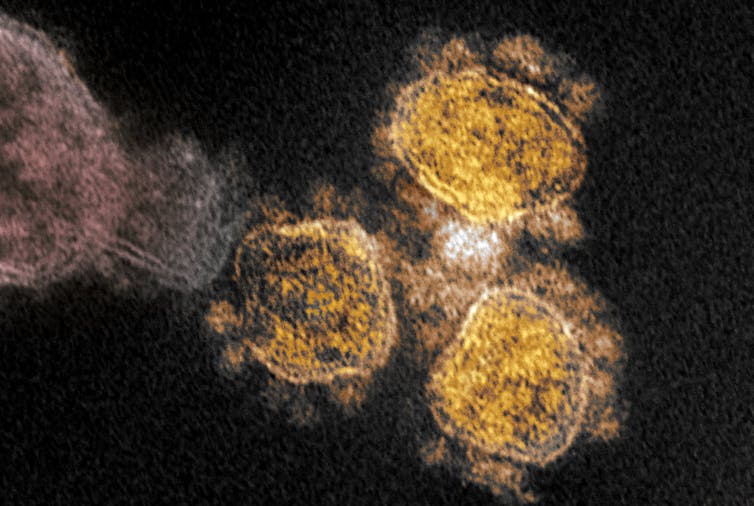
The new SARS-CoV-2 variant’s increased transmissibility is believed to come from a change in the spike protein, visible here in yellow under an electron microscope. National Institute of Allergies and Infectious Diseases

We saw what the new variant, known as B.1.1.7, can do as it spread quickly through southeastern England in December, causing case numbers to spike and triggering stricter lockdown measures.

The new variant has been estimated to be 50% more easily transmitted than common variants, though it appears to affect people’s health in the same way. The increased transmissibility is believed to arise from a change in the virus’s spike protein that can allow the virus to more easily enter cells. These and other studies on the new variant were released before peer review to share their findings quickly.

Additionally, there is some evidence that patients infected with the new B.1.1.7 variant may have a higher viral load. That means they may expel more virus-containing particles when they breathe, talk or sneeze.

As professors who study fluid dynamics and aerosols, we investigate how airborne particles carrying viruses spread. There is still a lot that scientists and doctors don’t know about the coronavirus and its mutations, but there are some clear strategies people can use to protect themselves.

Airborne particles are still the biggest problem

The SARS-CoV-2 variants are believed to spread primarily through the air rather than on surfaces.


AlsoRead...

Ryan: Building real freedom through e-commerce

Ryan: Building real freedom through e-commerce

27 November 2025
Design Australia Group: Redefining Drafting as the engine of housing growth

Design Australia Group: Redefining Drafting as the engine of housing growth

26 November 2025

When someone with the coronavirus in their respiratory tract coughs, talks, sings or even just breathes, infectious respiratory droplets can be expelled into the air. These droplets are tiny, predominantly in the range of 1-100 micrometers. For comparison, a human hair is about 70 micrometers in diameter.

The larger droplets fall to the ground quickly, rarely traveling farther than 6 feet from the source. The bigger problem for disease transmission is the tiniest droplets – those less than 10 micrometers in diameter – which can remain suspended in the air as aerosols for hours at a time.

With people possibly having more virus in their bodies and the virus being more infectious, everyone should take extra care and precautions. Wearing face masks and social distancing are essential.

Spaces and activities that were previously deemed “safe,” such as some indoor work environments, may present an elevated infection risk as the variant spreads.

The concentration of aerosol particles is usually highest right next to the individual emitting the particles and decreases with distance from the source. However, in indoor environments, aerosol concentration levels can quickly build up, similar to how cigarette smoke accumulates within enclosed spaces. This is particularly problematic in spaces that have poor ventilation.

With the new variant, aerosol concentration levels that might not have previously posed a risk could now lead to infection.

https://datawrapper.dwcdn.net/3H2K2/7/

What can you do to stay safe?

1) Pay attention to the type of face mask you use, and how it fits.

Most off-the-shelf face coverings are not 100% effective at preventing droplet emission. With the new variant spreading more easily and likely infectious at lower concentrations, it’s important to select coverings with materials that are most effective at stopping droplet spread.

When available, N95 and surgical masks consistently perform the best. Otherwise, face coverings that use multiple layers of material are preferable. Ideally, the material should be a tight weave. High thread count cotton sheets are an example. Proper fit is also crucial, as gaps around the nose and mouth can decrease the effectiveness by 50%.

2) Follow social distancing guidelines.

While the current social distancing guidelines are not perfect – 6 feet isn’t always enough – they do offer a useful starting point. Because aerosol concentrations levels and infectivity are highest in the space immediately surrounding anyone with the virus, increasing physical distancing can help reduce risk. Remember that people are infectious before they start showing symptoms, and they many never show symptoms, so don’t count on seeing signs of illness.

3) Think carefully about the environment when entering an enclosed area, both the ventilation and how people interact.

Limiting the size of gatherings helps reduce the potential for exposure. Controlling indoor environments in other ways can also be a highly effective strategy for reducing risk. This includes increasing ventilation rates to bring in fresh air and filtering existing air to dilute aerosol concentrations.

On a personal level, it is helpful to pay attention to the types of interactions that are taking place. For example, many individuals shouting can create a higher risk than one individual speaking. In all cases, it’s important to minimize the amount of time spent indoors with others.

The CDC has warned that B.1.1.7 could become the dominant SARS-CoV-2 variant in the U.S. by March. Other fast-spreading variants have also been found in Brazil and South Africa. Increased vigilance and complying with health guidelines should continue to be of highest priority.

Suresh Dhaniyala, Bayard D. Clarkson Distinguished Professor of Mechanical and Aeronautical Engineering, Clarkson University and Byron Erath, Associate Professor of Mechanical Engineering, Clarkson University

This article is republished from The Conversation under a Creative Commons license. Read the original article.


Tags: SB001
DMCA.com Protection Status

SUBSCRIBE to our NEWSLETTER

[mc4wp_form id=”2384248″]

Don't Miss

The evolution of Aesthetic Surgery through the lens of Dr Kourosh Tavakoli

by Pauline Torongo
4 December 2025
The evolution of Aesthetic Surgery through the lens of Dr. Kourosh Tavakoli
Health & Wellness

As global interest in Australian cosmetic surgery continues to grow, the combination of regulation, research and emerging digital tools is...

Read moreDetails

Ryan: Building real freedom through e-commerce

by Pauline Torongo
27 November 2025
Ryan: Building real freedom through e-commerce
Business & Finance

Ryan’s greatest achievement isn’t any single business or revenue milestone — it’s the ecosystem he’s built through the Change community.

Read moreDetails

Design Australia Group: Redefining Drafting as the engine of housing growth

by Pauline Torongo
26 November 2025
Design Australia Group: Redefining Drafting as the engine of housing growth
Business & Finance

Australia is under pressure to build homes faster, but design bottlenecks slow progress. Design Australia Group is fixing this by...

Read moreDetails

Louis Guy Detata builds Global Trading Empires through autonomous systems and disciplined leadership

by Pauline Torongo
25 November 2025
Louis Guy Detata builds Global Trading Empires through autonomous systems and disciplined leadership
Business & Finance

The path from investment banking to leading a global trading platform has taught Louis Detata that sustainable success requires more...

Read moreDetails

Burning Eucalyptus Wood: Tips, Advantages, Disadvantages & Alternatives

by Fazila Olla-Logday
20 November 2025
Image Supplied
Enviroment

Learn about burning eucalyptus wood for stoves and fireplaces. Discover benefits, drawbacks, harvesting tips, and better alternative firewood options for...

Read moreDetails

Everything Parents Need to Know About Baby Soft Play and Why It’s a Game Changer

by Fazila Olla-Logday
11 November 2025
Everything Parents Need to Know About Baby Soft Play
Health & Wellness

Baby soft play is a fun, safe, and educational way for little ones to explore and grow. Discover the benefits...

Read moreDetails

WOMAD Sets Up a New Camp in Wiltshire – Australian festival fans take note!

by Kris Griffiths
11 November 2025
Kumbia Boruka brought their reggae and dancehall flavour to the Taste the World Stage at WOMAD 2024 - Credit - Mike Massaro
Entertainment

With its 2026 edition moving to Neston Park in England, WOMAD offers Aussie music lovers a chance to reconnect with global...

Read moreDetails
Load More

Copyright © Blue Sky Publications Ltd. All Rights Reserved.
australiantimes.co.uk is a division of Blue Sky Publications Ltd. Reproduction without permission prohibited. DMCA.com Protection Status

  • About us
  • Write for Us
  • Advertise
  • Contact us
  • T&Cs, Privacy and GDPR
No Result
View All Result
  • News
    • Weather
    • Sport
    • Technology
    • Business & Finance
      • Currency Zone
    • Lotto Results
      • The Lott
  • Lifestyle
    • Entertainment
    • Horoscopes
    • Health & Wellness
    • Recipes
  • Travel
  • Expat Life
  • Move to Australia

Copyright © Blue Sky Publications Ltd. All Rights Reserved.
australiantimes.co.uk is a division of Blue Sky Publications Ltd. Reproduction without permission prohibited. DMCA.com Protection Status

No Result
View All Result
  • News
    • Weather
    • Sport
    • Technology
    • Business & Finance
      • Currency Zone
    • Lotto Results
      • The Lott
  • Lifestyle
    • Entertainment
    • Horoscopes
    • Health & Wellness
    • Recipes
  • Travel
  • Expat Life
  • Move to Australia

Copyright © Blue Sky Publications Ltd. All Rights Reserved.
australiantimes.co.uk is a division of Blue Sky Publications Ltd. Reproduction without permission prohibited. DMCA.com Protection Status





