



Magnus Course, University of Edinburgh and Alastair Cole, Newcastle University
Regulations brought in following the UK’s departure from the EU have delayed the export of live shellfish to Europe, causing entire lorry loads of lobsters and langoustines to expire in Scotland’s ports.
Fishing is a relatively small part of the UK’s economy, but fishing rights dominated much of the Brexit negotiations with the European Union. And with the UK free of the EU’s environmental protections, fishing is once more a battleground for competing ideas in marine conservation.
While these debates nearly always concern numbers – catch quotas, stock levels, prices and tariffs – focusing on these quantifiable aspects alone can lead us to overlook the values that keep people fishing in the first place.
Our research on inshore fishing in Scotland’s Outer Hebrides – a sparsely populated island chain off the west coast – took us from boats to processing plants and archives, revealing a commitment to sustainability that’s rooted in more than just legislation. We found that nurturing the culture and language of these islands is as important as protecting wildlife to preserve a thriving marine environment for generations to come.
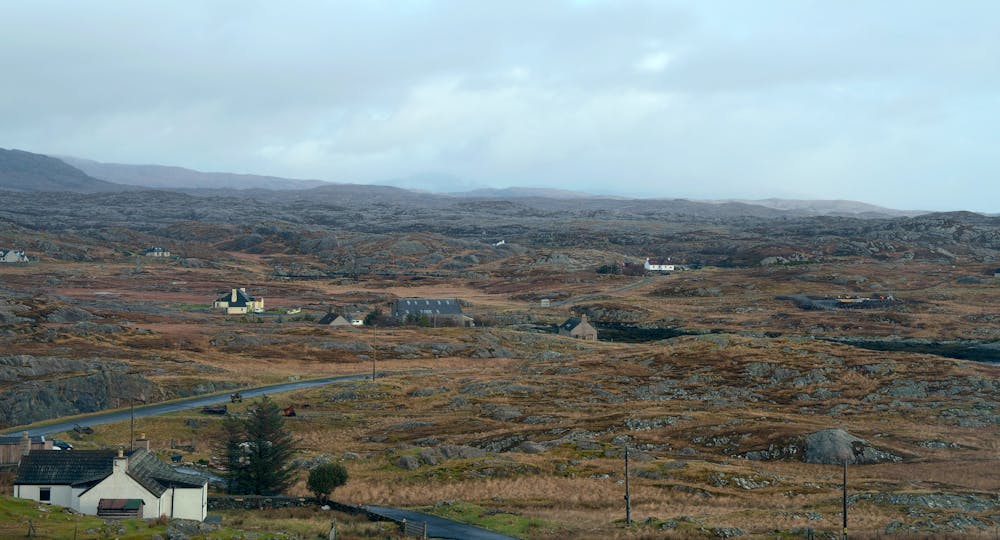
Navigating the past
Around 75% of fishermen in the Outer Hebrides are Gaelic speakers, far higher than the 61% of speakers for the islands’ population as a whole. Scottish Gaelic is a Celtic language – related to, but quite distinct from Irish Gaelic – once spoken across much of Scotland, yet now primarily confined to its westernmost isles. The language declined over the 20th century and now has around 60,000 speakers.
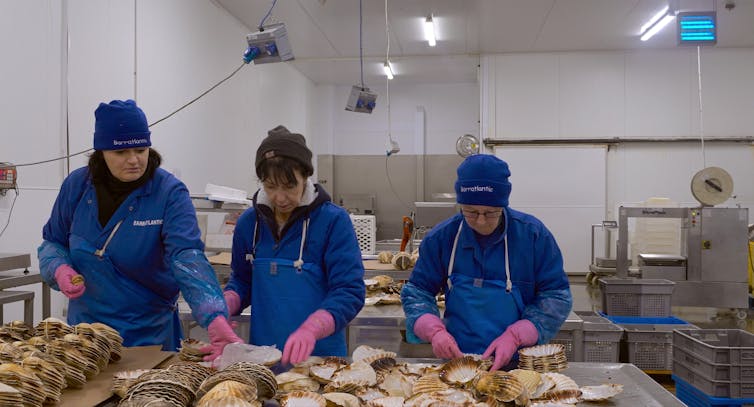
Fishermen’s daily use of the language at work helps pass it on to the next generation, as young people become immersed in Scottish Gaelic while out on the boats and in the processing plants where the catch is landed.


This story is part of Oceans 21
Our series on the global ocean opened with five in-depth profiles. Look out for new articles on the state of our oceans in the lead up to the UN’s next climate conference, COP26. The series is brought to you by The Conversation’s international network.
An entire system of comharran – Gaelic navigational marks – surrounds the islands. Most are known only to the fishermen. An Creagan Breac refers to a fishing ground that can be found by lining up a large, pale rock on the mountainside of South Uist with the end of a promontory on which stands a church.
“Nobody else has that knowledge,” said one Uist fisherman. “Even the old crofters don’t know those”.
A wealth of knowledge about the creatures which populate these fishing grounds is also encoded within the Gaelic language. A Benbecula fisherman explained:
My father would say to me, ‘You’ve got to go to this specific place at this specific time and there’ll be lobsters.’ And… that’s how it works. That’s what my grandfather and great-grandfather did, too.
This is what social scientists call traditional ecological knowledge – information about the environment that’s woven into culture and language and handed down from generation to generation.
Old ways, new challenges
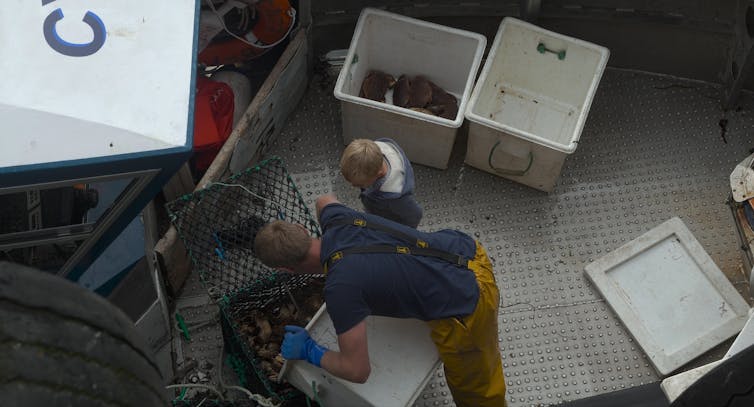
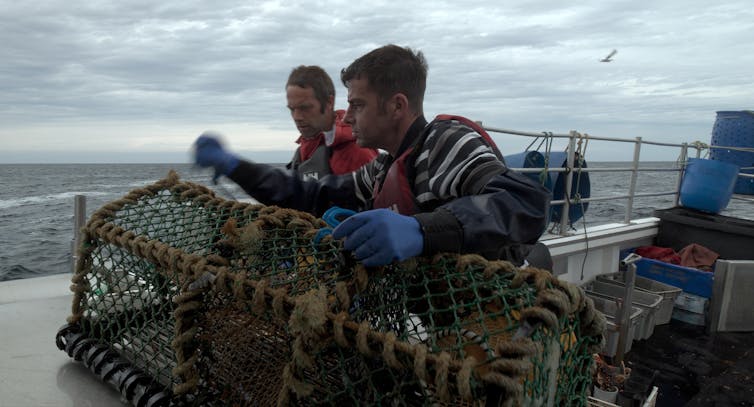
Scotland’s inshore fleet fishes within 12 miles of the coast and makes up around three-quarters of all Scottish fishing boats. Almost 90% of these are small, two-person creel boats. Our research revealed that in the Outer Hebrides, fishermen’s culturally-embedded knowledge informs a centuries-old commitment to sustainability. Certain grounds are left untouched during spawning season and undersized specimens and egg-bearing females are safely returned. This approach makes sense, as one Benbecula fisherman explained, because:
Fishermen aren’t going to cut their own throats for years and generations to come.
The knowledge of fishermen here encompasses not only the species they target – such as lobsters, prawns, and crabs – but the marine environment in general. The life stages of juvenile gulls, the myriad species of dolphins and whales, the various kinds of seaweed brought up with the creels are all captured in intricate detail in Scottish Gaelic words and phrases.
These centuries-old connections between language and the environment challenge dominant views of how best to protect habitats. Scottish Gaelic’s vitality as a living language would surely suffer if fishing were to be curtailed, and much of the knowledge bound up in it, which has helped keep fishing in Hebridean seas sustainable for generations, would be lost too.
When discussing the Scottish government’s rumoured extension of marine protected areas to reduce fishing across the Hebrides, one fishermen said:
The whole Gaelic structure of the place will go. The Gaelic language that we speak, through all our work, would no longer be there. The culture, the people, everything would disappear forever.
In our feature-length Gaelic language documentary, Iorram, (Boat Song in English), we explore the heritage of these islands through modern footage and previously untranslated stories and songs archived by the School of Scottish Studies at the University of Edinburgh during the 1950s, 60s, and 70s.
Set against the age-old picture of communities battling the sea in what continues to be one of Britain’s most dangerous professions, we hear the voices of Hebridean “herring girls” confronting the alienness of English food without a word of English to complain with. We learn of fishermen seized as indentured labourers and taken to the West Indies. We see prices plummeting, boats sinking, GPS arriving.
Through all of these changes, Scottish Gaelic binds the fishing communities together. Fierce debates over the future of Scotland’s fisheries, whether they will be managed by Holyrood or Westminster, and the extent to which fishing communities themselves will have a say in their own future, will surely rage on as the question of independence reemerges.
But it’s imperative the enduring value of language and culture on these islands is taken into account.
Iorram (Boat Song) premiered at the 2021 Glasgow Film Festival and is currently available to watch virtually in independent cinemas across the UK. For information on where to see it, visit https://iorramfilm.com.
Magnus Course, Senior Lecturer in Social Anthropology, University of Edinburgh and Alastair Cole, Lecturer in Film Practice, Newcastle University
This article is republished from The Conversation under a Creative Commons license. Read the original article.







