

• Advertise
  • About us
  • Terms and Conditions
  • Contact us
Sunday, December 7, 2025
Australian Times News
  • News
    • Weather
    • Sport
    • Technology
    • Business & Finance
      • Currency Zone
    • Lotto Results
      • The Lott
  • Lifestyle
    • Entertainment
    • Horoscopes
    • Health & Wellness
    • Recipes
  • Travel
  • Expat Life
  • Move to Australia
No Result
View All Result
  • News
    • Weather
    • Sport
    • Technology
    • Business & Finance
      • Currency Zone
    • Lotto Results
      • The Lott
  • Lifestyle
    • Entertainment
    • Horoscopes
    • Health & Wellness
    • Recipes
  • Travel
  • Expat Life
  • Move to Australia
No Result
View All Result
Australian Times News
No Result
View All Result
Home News

How heatwaves and drought combine to produce the perfect firestorm

Long heatwaves during entrenched drought often trigger fears of bushfire. It’s easy to imagine rolling days of hot, dry weather desiccating leaves, bark and twigs, transforming them into a potent fuel.

The Conversation by The Conversation
29-01-2021 18:05
in News
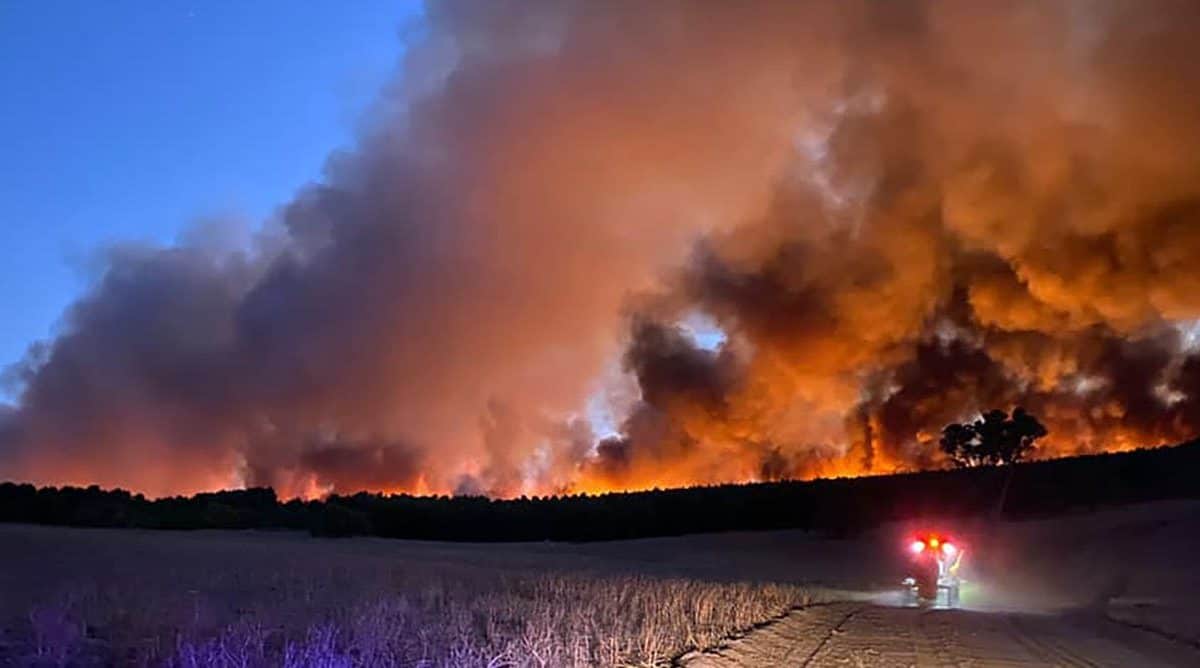
The Red Gully bushfire near Gingin, WA. AAP Image/Supplied by DFES, Nikki Woods

The Red Gully bushfire near Gingin, WA. AAP Image/Supplied by DFES, Nikki Woods

Jyoteeshkumar Reddy Papari, UNSW; Jason Sharples, UNSW, and Sarah Perkins-Kirkpatrick, UNSW

Long heatwaves during entrenched drought often trigger fears of bushfire. It’s easy to imagine rolling days of hot, dry weather desiccating leaves, bark and twigs, transforming them into a potent fuel.

Victoria’s heatwave in 2009, which reached a record temperature of 46.4℃, came during severe, enduring drought and culminated in the Black Saturday bushfire tragedy.

Likewise, the unprecedented Black Summer bushfires marked the end of 2019, Australia’s warmest and driest year on record. It unfolded in episodes of extreme heat combined with dry, windy conditions.

While we know heatwaves and drought make fires worse, the details are poorly understood. This is what our new research investigated.

We found drought and heatwaves intensify the drying of dead bushfire fuel, and can lead to “megafires” like those we saw last summer. However, we were surprised to find the effect varies in nature over different regions. Let’s look at why.

Fuelling a megafire

Megafires are mainly defined by their enormous size and the amount of resources required to bring them under control. They can burn for months, and consist of multiple “extreme” bushfires.


AlsoRead...

Ryan: Building real freedom through e-commerce

Ryan: Building real freedom through e-commerce

27 November 2025
Design Australia Group: Redefining Drafting as the engine of housing growth

Design Australia Group: Redefining Drafting as the engine of housing growth

26 November 2025

Extreme bushfires burn intensely in smaller areas, lasting up to a few hours. They’re also widely known to create their own weather, and in the very worst cases can develop into fire thunderstorms.

Most of the damage wrought by the Black Summer fires was due to recurring extreme bushfire events. These were extraordinarily powerful, with high rates of fire spread, high fire intensity and profuse “spotting” (when embers in the wind start new bushfires).

One of the most critical factors driving extreme bushfires is the moisture content of bushfire fuel — grass, leaves, sticks, shrubs, logs and trees.

Drier fuels not only burn more readily and with greater intensity, but are more susceptible to mass spotting, which can rapidly drive a fire across the landscape.

Our study quantified the combined influence of drought and heatwaves on the moisture content of bushfire fuels. We specifically looked at “dead fine fuels”, which consist of dead vegetation less than 25 millimetres in diameter.

Dead fine fuels are specifically considered in fire management due to their capacity to ignite fires and drive the initial spread. They also play an important role in spotting. In fact, when the moisture content of dead fine fuels is critically low, spotting can become the dominant way bushfires propagate.

Heatwaves and fuel moisture

We looked at peak heat and fire seasons in southeast Australia from 1971 to 2020, and investigated the statistical correlation between various heatwave characteristics — frequency, duration, average intensity, and amplitude — and the average dead fine fuel moisture content for this period.
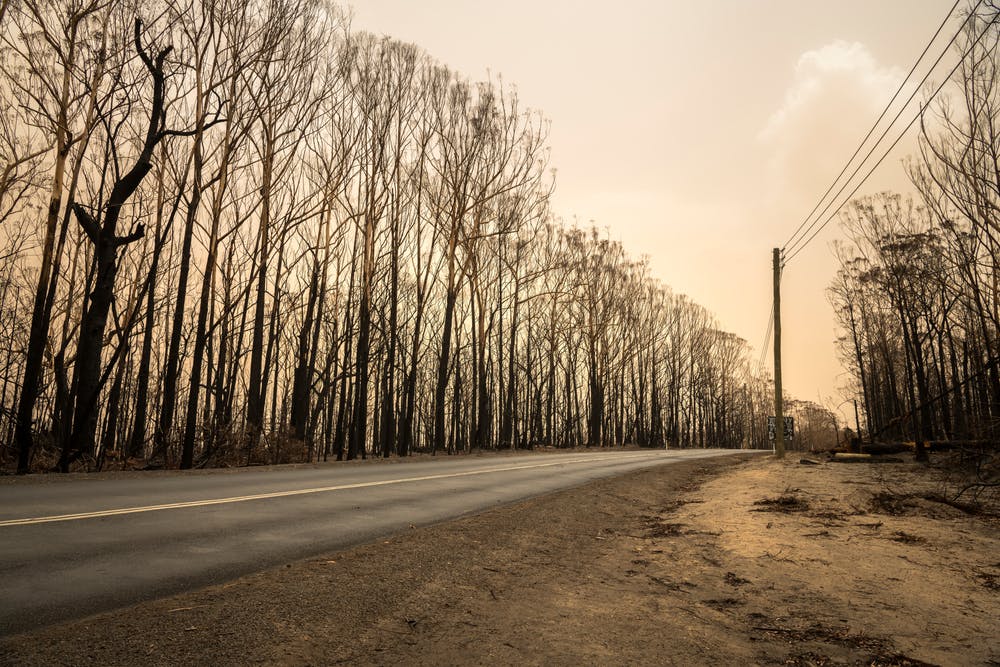
Burnt trees line a road
Dried vegetation is one of the most critical factors driving extreme bushfires. Shutterstock

We found the heatwave characteristics of duration and intensity (high average heatwave temperature) had a strong effect on dead fine fuel dryness. But surprisingly the effects were not the same across different regions.

In and around the Australian Capital Territory, lower fuel moisture was driven by long-lasting heatwaves.

Meanwhile, over northeastern New South Wales, southeast Queensland and central Victoria, fuel dryness was driven by heatwave intensity. A clear example of this is when Melbourne endured three consecutive days of temperatures over 43℃ prior to the 2009 Black Saturday bushfires, leading to critically dry fuels.

We found drought exacerbates the effect of heatwaves on fuel dryness. However, this also depends on the region.

In and around the ACT, a longer heatwave with drought produced critically low fuel moisture. But in central Victoria, extreme temperatures with drought led to the driest fuel.


While our research didn’t look at why these variations occurred, we can speculate that it may be due to the ways “climate drivers” influence the weather in different parts of Australia. These climate drivers are phenomena created by circulation patterns in the atmosphere and ocean, and include La Niña and El Niño (or “ENSO”), and the Southern Annular Mode (SAM).

La Niña or El Niño years are mostly felt in Queensland, northern NSW and the NT, and bring wetter or drier weather. And SAM influences the number of heatwaves in central Victoria.

Improving how we fight fires

Understanding what regions are vulnerable to particular conditions is important, because it can improve how fire danger is assessed.

It will also help better identify which parts of the landscape are most likely to experience catastrophic fires, and provide more detailed information for planning prescribed burning activities across the country.

Continuing research in this area is imperative as we face the challenge of managing the greater risk of bushfires under climate change.


Jyoteeshkumar Reddy Papari, PhD Candidate, UNSW; Jason Sharples, Professor of Bushfire Dynamics, School of Science, UNSW Canberra, UNSW, and Sarah Perkins-Kirkpatrick, ARC Future Fellow, UNSW

This article is republished from The Conversation under a Creative Commons license. Read the original article.


Tags: SB001
DMCA.com Protection Status

SUBSCRIBE to our NEWSLETTER

[mc4wp_form id=”2384248″]

Don't Miss

The evolution of Aesthetic Surgery through the lens of Dr Kourosh Tavakoli

by Pauline Torongo
4 December 2025
The evolution of Aesthetic Surgery through the lens of Dr. Kourosh Tavakoli
Health & Wellness

As global interest in Australian cosmetic surgery continues to grow, the combination of regulation, research and emerging digital tools is...

Read moreDetails

Ryan: Building real freedom through e-commerce

by Pauline Torongo
27 November 2025
Ryan: Building real freedom through e-commerce
Business & Finance

Ryan’s greatest achievement isn’t any single business or revenue milestone — it’s the ecosystem he’s built through the Change community.

Read moreDetails

Design Australia Group: Redefining Drafting as the engine of housing growth

by Pauline Torongo
26 November 2025
Design Australia Group: Redefining Drafting as the engine of housing growth
Business & Finance

Australia is under pressure to build homes faster, but design bottlenecks slow progress. Design Australia Group is fixing this by...

Read moreDetails

Louis Guy Detata builds Global Trading Empires through autonomous systems and disciplined leadership

by Pauline Torongo
25 November 2025
Louis Guy Detata builds Global Trading Empires through autonomous systems and disciplined leadership
Business & Finance

The path from investment banking to leading a global trading platform has taught Louis Detata that sustainable success requires more...

Read moreDetails

Burning Eucalyptus Wood: Tips, Advantages, Disadvantages & Alternatives

by Fazila Olla-Logday
20 November 2025
Image Supplied
Enviroment

Learn about burning eucalyptus wood for stoves and fireplaces. Discover benefits, drawbacks, harvesting tips, and better alternative firewood options for...

Read moreDetails

Everything Parents Need to Know About Baby Soft Play and Why It’s a Game Changer

by Fazila Olla-Logday
11 November 2025
Everything Parents Need to Know About Baby Soft Play
Health & Wellness

Baby soft play is a fun, safe, and educational way for little ones to explore and grow. Discover the benefits...

Read moreDetails

WOMAD Sets Up a New Camp in Wiltshire – Australian festival fans take note!

by Kris Griffiths
11 November 2025
Kumbia Boruka brought their reggae and dancehall flavour to the Taste the World Stage at WOMAD 2024 - Credit - Mike Massaro
Entertainment

With its 2026 edition moving to Neston Park in England, WOMAD offers Aussie music lovers a chance to reconnect with global...

Read moreDetails
Load More

Copyright © Blue Sky Publications Ltd. All Rights Reserved.
australiantimes.co.uk is a division of Blue Sky Publications Ltd. Reproduction without permission prohibited. DMCA.com Protection Status

  • About us
  • Write for Us
  • Advertise
  • Contact us
  • T&Cs, Privacy and GDPR
No Result
View All Result
  • News
    • Weather
    • Sport
    • Technology
    • Business & Finance
      • Currency Zone
    • Lotto Results
      • The Lott
  • Lifestyle
    • Entertainment
    • Horoscopes
    • Health & Wellness
    • Recipes
  • Travel
  • Expat Life
  • Move to Australia

Copyright © Blue Sky Publications Ltd. All Rights Reserved.
australiantimes.co.uk is a division of Blue Sky Publications Ltd. Reproduction without permission prohibited. DMCA.com Protection Status

No Result
View All Result
  • News
    • Weather
    • Sport
    • Technology
    • Business & Finance
      • Currency Zone
    • Lotto Results
      • The Lott
  • Lifestyle
    • Entertainment
    • Horoscopes
    • Health & Wellness
    • Recipes
  • Travel
  • Expat Life
  • Move to Australia

Copyright © Blue Sky Publications Ltd. All Rights Reserved.
australiantimes.co.uk is a division of Blue Sky Publications Ltd. Reproduction without permission prohibited. DMCA.com Protection Status





