



Miriamne Ara Krummel, University of Dayton
On Dec. 31, people from cultures all around the world will be raising a toast to welcome in A.D. 2022. Few of them will think about the fact that A.D. signals “anno Domini,” Latin for “in the year of our Lord.” In A.D. temporality – the one acknowledged by most societies today – next year marks 2023 years since the purported birth of Jesus Christ.
So why are we all toasting this new year, given that most of the world’s nearly 8 billion people aren’t Christians?
My fascination with time was nurtured by the millennium and the hype that surrounded its approach, as the globe anticipated traversing from 11:59 p.m., Dec. 31, 1999 to 12:00 a.m., Jan. 1, 2000.
Convinced that there was some truth to fears about technological disruptions caused by the Y2K bug, I stayed away from the ball drop in Times Square. Instead, I watched the celebration on my laptop and enjoyed trailing journalists’ reports abroad. I began to wonder: How did it come to be that people all over the Earth subscribed to – and were aware of – the temporal system followed by the Christian West? After all, cultures have historically experienced and documented time in a variety of ways.
These questions about time blossomed into a research project and book. Part of the phenomenon was caused by global capitalism, but I soon learned that another aspect involved the globalization of “anno Domini.” The A.D. system, often called “C.E.” or “Common Era” time today, was introduced in Europe during the Middle Ages. It joined the world’s other temporal systems like the Coptic, Seleucid, Egyptian, Jewish and the Zodiac calendars, along with calculations based on the years of rulers’ reigns and the founding of Rome.
Latin Christendom slowly but confidently came to dominate Europe, and its year dating system then came to dominate the world, so that most countries now take A.D. for granted, at least when it comes to globalized business and government. A.D.‘s ubiquity has almost silenced other ways of thinking about time. This began during the medieval era, under the influence of educated Christian monks – what historian Bernard Gueneé describes as “anno Domini’s” “conquest of time.”


My recent work as a medieval studies professor focuses on the demonization of Jewish communities in Europe at a time when the A.D. system was gaining prominence and marginalizing the Jewish calendar.
Counting backwards
Part of the story of “anno Domini” time takes us back to the fourth and fifth century, when Christian scholars like Eusebius of Caesarea and John Chrysostom were trying to calculate what they considered was the beginning of Christian time – in other words, the birth date of Jesus of Nazareth.
Eusebius and Chrysostom were working with the Gospel accounts of Jesus’ birth and death. According to the Gospels, Jesus was arrested around the time of the Jewish holiday of Passover, and the Gospel of John suggests that Jesus was about 33 when he died. Therefore, Eusebius and Chrysostom first tried to determine the date of his death based on Passover dates in the Jewish calendar. But both men failed in their calculations and blamed the Jews for their difficulty. In their twisted reasoning, the Jewish community had postponed Passover in order to make “anno Domini” time impossible to calculate. This accusation illustrates the intense antisemitism common in Europe at their time and which work like theirs helped continue.
But in many ways, the real author of the world’s modern sense of time, the one who decided to choose the date when Year One would begin, is the Venerable Bede, an English monk who lived circa 673-735.
Bede found himself with several calculations he did not approve of, and decided Christ must have actually been born on Dec. 25, 1 B.C.. By his reasoning, in other words, the A.D. system began a year after Jesus’ purported birth. Bede also determined that March 25, 34 A.D. marked Christ’s death.
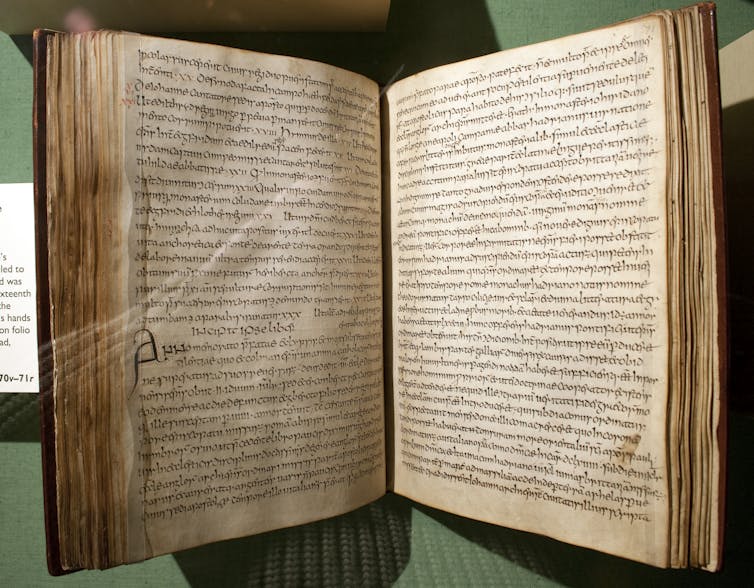
Bede, a monk in an important monastery in Northumbria, popularized the A.D. dating system by using it in his work “Ecclesiastical History of the People of England,” which made him the first historian to tell time by “anno Domini.” The “Ecclesiastical History” was dedicated to King Ceowulf of Northumbria, written in Latin in 731, and translated into Old English around the end of the ninth or the beginning of the 10th centuries. Still read by many today, it popularized “anno Domini” time by infusing A.D. time into events Bede told about the English people.
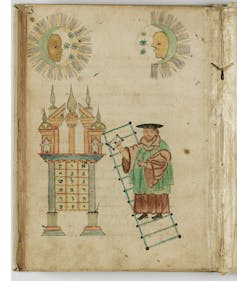
Taken together, these ingredients helped A.D. time become the norm. While the Christian calendar is built on and infused with other cultures’ time systems, A.D.‘s popularization contributed to sidelining these calendars to the margins – what postcolonial scholars call “temporal colonization.” For example, the date Bede set for Easter in his work “The Reckoning of Time” is based on a polytheistic celebration of Eostre, a German goddess. Eostre has, thus, disappeared into Easter.
Likewise, the fraught connections between the dates of Jesus’s Passion, Easter and Passover further fueled antisemitism at a time when Jewish communities were also trying to formalize a Jewish calendar.
Changing the name
Approximately 1,400 years ago, when Bede selected a date to begin “anno Domini” time, he perhaps unwittingly started the process of privileging Christian time, which is now near-universally recognized.
[Over 140,000 readers rely on The Conversation’s newsletters to understand the world. Sign up today.]
Today, many people use the expressions “common era” and “before the common era,” or C.E. and B.C.E., instead of A.D. and B.C. But despite what we call it now, the roots of this system are not “common” but Christian. As the medieval studies scholar Kathleen Davis writes, using C.E. “does little to diminish the effect of a globalized Christian calendar.”
Initially, I too had applauded C.E. as a less Christian replacement for A.D. But today, I’d argue it is just the equivalent of a yellow sticky note placed over it. There’s nothing naturally “common” about the “common era,” and it’s worth applauding all kinds of diversity – even in time – on planet Earth. This year, what will you be toasting at 11:59 p.m. on Dec. 31?
Miriamne Ara Krummel, Professor of English, University of Dayton
This article is republished from The Conversation under a Creative Commons license. Read the original article.







