



Sarah Joseph, Griffith University and Gregory Dore, UNSW
Despite assurances from Prime Minister Scott Morrison that Australia was at “the front of the queue” for COVID-19 vaccines, Australia’s rate of vaccination ranks last in the OECD.
Nevertheless, Australia is still ahead of scores of other nations when it comes to vaccination rates, with many countries in the developing world unlikely to be able to vaccinate significant numbers of their people before 2023.
Global vaccine inequity is a “catastrophic moral failure”, according to the director-general of the World Health Organization, Tedros Adhanom Ghebreyesus.
But we are too focused on our own situation in Australia to realise the damage our fickle approach to vaccines is doing to global vaccine equity. We are also forgetting our human rights obligations to help speed up access to vaccines for all.
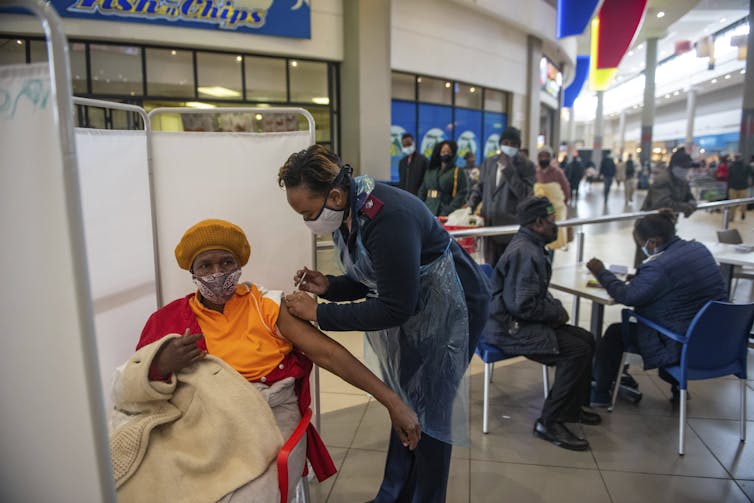
Vaccine access and international human rights law
Australia has international human rights obligations to protect the health and life of its own people. This means taking reasonable steps to prevent COVID-19 infections and mitigate the impact of the virus on Australians, including by acquiring and administering vaccines.
However, Australia also has obligations to the people of other nations to facilitate access to vaccines for all.


These duties are not only about global humanism — there is also a strong global health argument to ensure everyone around the world is vaccinated. As GAVI, one of the organisations leading the global COVAX vaccine initiative, has reminded us, “no one is safe until everyone is safe”.
While large populations remain unvaccinated, variants of concern such as Delta will continue to evolve and may compromise global vaccine protection. Furthermore, global economic and social activity cannot return to anything like normal without extensive COVID-19 vaccination in all nations.
Global vaccine equity makes public health and economic sense for all countries, both rich and poor. Thus, Australia has an obligation — both to those in poorer countries and to its own people — to do what it reasonably can to increase vaccine access all over the world.
Vaccine procurement and hoarding
One of the main reasons for vaccine inequity is the shortage of vaccines. Access is a zero-sum game where one nation’s vaccine supply reduces the availability of doses for others.
The COVAX initiative was established last year to enable global access to COVID-19 vaccines. COVAX’s role is to procure and allocate vaccines with an aim of vaccinating 20% of the people in participating countries by the end of 2021 — a target it is unlikely to reach due to lack of supply. Once the 20% threshold is reached, COVAX intends to distribute its vaccines according to need.
Despite COVAX, many nations have pursued their own procurement policies directly with vaccine manufacturers. In April, the UN Committee on Economic, Social and Cultural Rights suggested such “vaccine nationalism” breached countries’ human rights obligations by undermining equitable access to vaccines.
However, the terms of the COVAX facility do not ban such bilateral deals. It is difficult, therefore, to maintain that it must dictate worldwide procurement.
But the hoarding of scarce vaccines does constitute a breach of countries’ obligations to protect global human rights. Indeed, the rights of a country’s own people are harmed by hoarding, as this perpetuates vaccine scarcity and delays the end of the global pandemic for everyone.
In this respect, it is wrong for rich countries to negotiate deals for vaccine booster shots before poorer countries have achieved significant vaccination rates. Tedros, the WHO chief, has rightly condemned this.
Why AstraZeneca hesitancy has an impact beyond our borders
Australia has procured enough AstraZeneca doses to vaccinate the entire country. In addition, we have advance-purchased enough Pfizer and Moderna doses to cover the entire population again, and enough Novavax to do so yet again.
The only vaccine currently available in large amounts in Australia is AstraZeneca because the local biotech company CSL manufactures it, and the government failed to prioritise its other deals last year.
The shifting official advice on AstraZeneca, however, has fuelled hesitancy in Australia, and has had an unintended impact on global vaccine supply, further disadvantaging those in poorer countries.
The AstraZeneca vaccine is safe and highly effective, bearing in mind that almost all medicines entail risks. However, under advice from the Australian Technical Advisory Group on Immunisation (ATAGI), it is not the preferred vaccine for people under 60. Most Australians, including many over 60, are now waiting for Pfizer.
That is not surprising given the ATAGI advice, and the messaging from the federal government and some state governments, together with negative inputs from many medical professionals and the media.
This has induced an exaggerated perception of the risk of blood clots caused by the vaccine. The reputation of the AstraZeneca vaccine has been wrongly and perhaps irreparably tarnished here.
The ATAGI advice has been influenced by Australia’s low COVID infection rate. And it has now changed its advice for all adults in NSW, given the state’s large outbreak at the moment.
ATAGI has faithfully fulfilled its mandate of assessing risks on an individual basis, but that mandate is not entirely suitable for a pandemic affecting all of society. The advice does not seem to account for the societal benefits for all — health, social and economic — of a more rapid vaccination rollout with an overwhelmingly safe and effective vaccine.
Unsurprisingly, ATAGI took no account of the impact of Australia’s AstraZeneca hesitancy on global vaccine access. Yet, Australia is now rapidly commandeering more Pfizer doses as a result, which is pushing other nations further down the vaccine queue. And this is while we eschew our plentiful AstraZeneca supplies.
Addressing the zero-sum game
Beyond issues regarding the sharing of vaccines, a bigger imperative is to address the root of the problem: vaccine scarcity. All nations, including Australia, must do what they can to increase the production of vaccines so the supply can more swiftly meet the demand.
Hence, those countries with vaccine manufacturing capacity must utilise it more effectively. For example, Australia must ensure CSL continues to manufacture as much AstraZeneca as it can, at least until it switches production to another vaccine (possibly Novavax).
We are concerned over reports CSL has slowed its AstraZeneca manufactureing, though hopefully this is only temporary.
It is a major public policy failure that AstraZeneca has been perceived as “not good enough” for Australians. If we won’t take it, we must donate it to save lives elsewhere, especially while we queue-jump for more Pfizer doses.
Australia has human rights obligations to greatly enhance its support for global vaccine equity. Failure to do so not only harms global health, but also the reputation and safety of our country.
Sarah Joseph, Professor of Human Rights Law, Griffith University and Gregory Dore, Infectious Diseases Physician, St Vincent’s Hospital, Sydney; Scientia Professor, Kirby Institute, UNSW
This article is republished from The Conversation under a Creative Commons license. Read the original article.







