

• Advertise
  • About us
  • Terms and Conditions
  • Contact us
Saturday, December 6, 2025
Australian Times News
  • News
    • Weather
    • Sport
    • Technology
    • Business & Finance
      • Currency Zone
    • Lotto Results
      • The Lott
  • Lifestyle
    • Entertainment
    • Horoscopes
    • Health & Wellness
    • Recipes
  • Travel
  • Expat Life
  • Move to Australia
No Result
View All Result
  • News
    • Weather
    • Sport
    • Technology
    • Business & Finance
      • Currency Zone
    • Lotto Results
      • The Lott
  • Lifestyle
    • Entertainment
    • Horoscopes
    • Health & Wellness
    • Recipes
  • Travel
  • Expat Life
  • Move to Australia
No Result
View All Result
Australian Times News
No Result
View All Result
Home News

How Arctic warming can trigger cold waves in North America – a new study makes the connection

The freezing temperatures were associated with a dip southward in the jet stream, a band of strong winds about eight miles above Earth’s surface associated with the boundary between colder and warmer air.

The Conversation by The Conversation
04-09-2021 01:53
in News
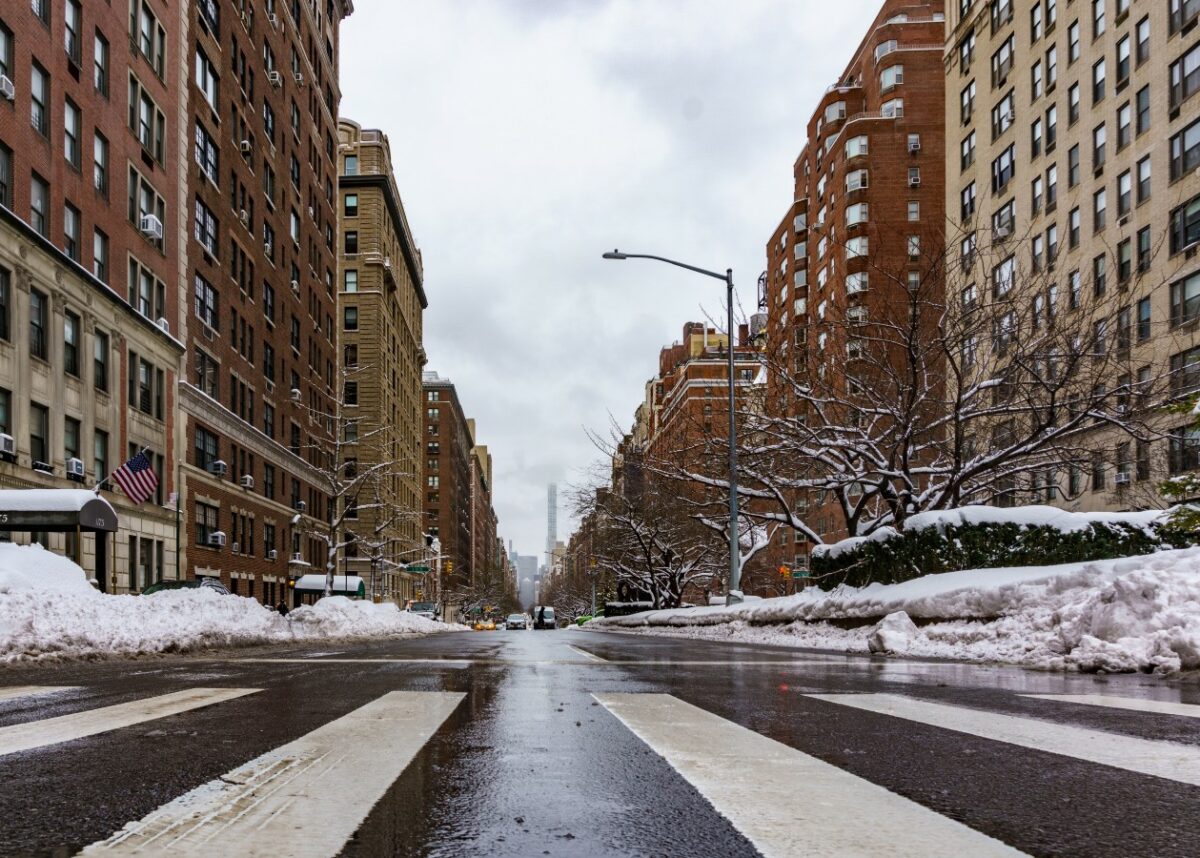
Photo by Clay LeConey on Unsplash

Photo by Clay LeConey on Unsplash

Mathew Barlow, University of Massachusetts Lowell and Judah Cohen, Massachusetts Institute of Technology (MIT)

In February 2021, in the midst of rapidly warming global temperatures, an exceptionally severe cold wave hit large parts of North America, from Canada to Northern Mexico. It left 10 million people without power. The impact was particularly severe in Texas, which alone had more than 125 deaths associated with the event.

In the U.S., it was the coldest February in more than 30 years. The cold wave became the nation’s costliest winter storm on record.

The freezing temperatures were associated with a dip southward in the jet stream, a band of strong winds about eight miles above Earth’s surface associated with the boundary between colder and warmer air.

The jet stream flows from west to east, but that’s not the only direction in which atmospheric waves can move – they can also move up and down over large distances, and that can link the weather and climate in one region, like the Arctic, with regions elsewhere, like Texas.
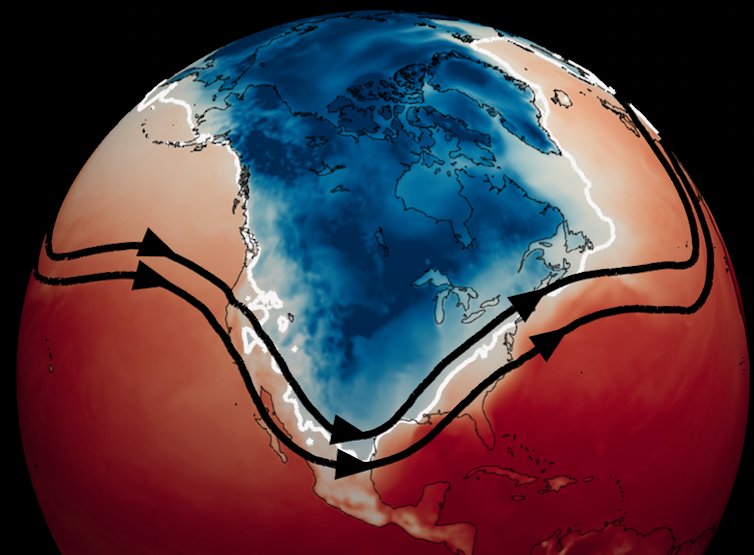
Images of the globe centered on North America shows a large cold blob over much of the continent.
Surface temperatures on Feb. 15, 2021, at 6 a.m. in Texas. The black lines show the jet stream, and the white line indicates the extent of freezing temperatures. Mathew Barlow/University of Massachusetts Lowell, CC BY-ND

When you throw a rock in a pond, you see ripples – waves – expand away from the initial disturbance. While ripples on a pond are a different type of wave than dips in the jet stream, both types of waves can transmit the effects of a disturbance to faraway areas.

Water ripples in response to a disturbance. Forance/Shutterstock.

In this case, the atmospheric waves transmitted the influence of climate change in the Arctic to parts of North America and Asia.


AlsoRead...

Ryan: Building real freedom through e-commerce

Ryan: Building real freedom through e-commerce

27 November 2025
Design Australia Group: Redefining Drafting as the engine of housing growth

Design Australia Group: Redefining Drafting as the engine of housing growth

26 November 2025

In a study released Sept. 2, 2021, in the journal Science, we show how that happened and how, counter to what one might expect, events like the February cold wave can actually become more likely with global warming.

What happens in the Arctic doesn’t stay there

The Arctic is warming more rapidly than any other region, at a rate more than twice the global average.

This is causing large changes in the region’s climate, including melting sea ice and, in the late fall, increasing snow cover over Siberia.

Ice and snow provide an insulating layer and are highly reflective, so their changes strongly alter the amount of energy and moisture moving between the surface of the Earth and the atmosphere. The atmosphere is sensitive to changes in energy and moisture, so substantial changes provide a “kick” to the atmosphere that results in upward moving waves rippling away from the area.

These waves move upward into the stratosphere and disrupt the stratospheric polar vortex, another band of fast winds that circles closer around the pole in the middle stratosphere, around 18 miles up. In response, the vortex weakens and stretches.
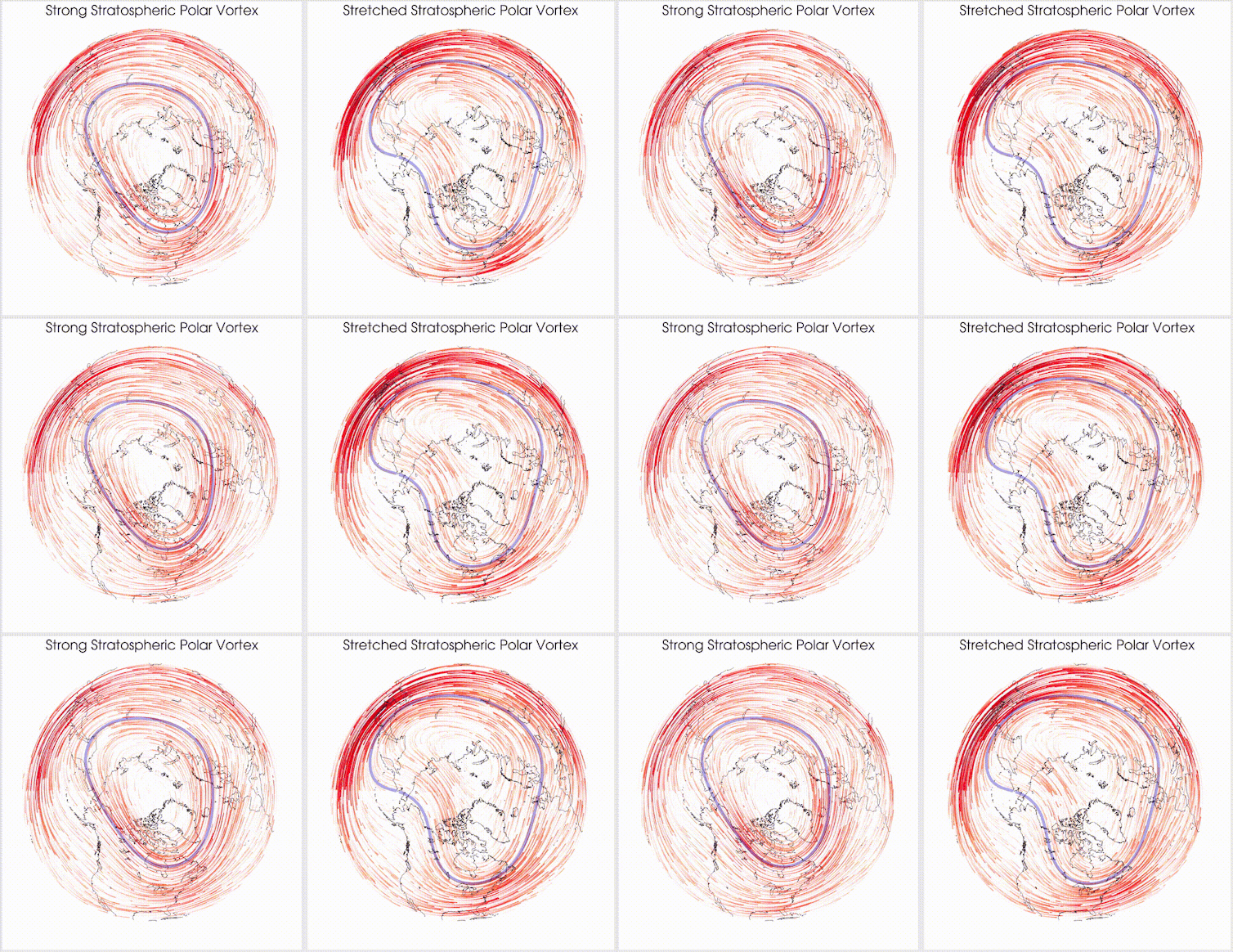
Two circulation patterns of the stratospheric polar vortex: strong (left) and stretched (right). Blue curves indicate approximate edge of the vortex; shown at about 9.3 miles, or 15 kilometers, above the surface. Mathew Barlow, University of Massachusetts Lowell

Not only can the stratospheric vortex be changed by the waves, but the vortex can also change how the waves move, because the waves are influenced by the wind and temperature fields they move through, and the vortex helps determine those winds and temperatures. What differentiates a vortex stretching event from larger vortex disruptions is that upward-moving waves are reflected back down to the surface, where they can influence lower-altitude weather patterns.
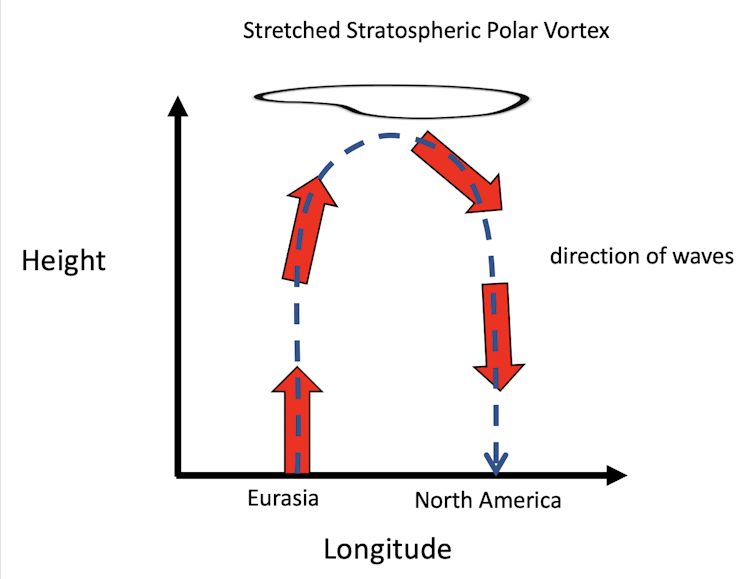
A schematic shows wave activity reflecting off the stretched stratospheric polar vortex. Mathew Barlow, University of Massachusetts Lowell

As these downward moving waves collect at lower altitudes over North America, they create a southward dip in the jet stream, bringing cold air farther south than usual. So, the upward and downward movement of atmospheric waves over long distances – like ripples moving across a pond – can link the Arctic to other regions.

Testing cause and effect

We took two different approaches to identifying and examining these relationships.

First, we used a machine learning, a technique in which a computer essentially trained itself to group similar events from the historical data. We then analyzed the stretched vortex events to show that, for those cases, there was a typical sequence of events: first surface temperature changes in the Arctic, then changes in the stratospheric polar vortex, followed by cold waves in North America and Asia – with vertically moving waves providing the connections over the span of a few months. The identified surface temperature changes in the Arctic are similar to those associated with the melting sea ice and increasing Siberian snow cover of Arctic climate change.

We then used a computer model of the atmosphere to evaluate cause and effect and directly test how the atmosphere responds to those Arctic changes. We found that the model reproduced the observed sequence of events.

The machine learning analysis of observations and the computer modeling experiments provide two independent lines of evidence supporting a pathway of influence – from Arctic climate change at the surface up to changes in the stratospheric winds, and finally back down to cold waves in North America and parts of Asia.

Three globes show the timeline of changes through the year.
A timeline shows the pathway from Arctic climate change to cold temperatures in North America. Red and blue in the third panel indicate differences from average conditions. Mathew Barlow/University of Massachusetts Lowell, CC BY-ND

Implications of these results

Our research reinforces two crucial lessons of climate change: First, the change doesn’t have to occur in your backyard to have a big effect on you. Second, the unexpected consequences can be quite severe.

In this case, large changes in the Arctic are not just a local concern – they also have wide-ranging impacts across North America and parts of Asia. And those impacts are not always what people are expecting. The results highlight another reason to rapidly reduce the greenhouse gas emissions that are driving global warming and at the same time the need to develop better strategies for managing extreme weather events, both hot and cold.

[Get our best science, health and technology stories. Sign up for The Conversation’s science newsletter.]

Mathew Barlow, Professor of Climate Science, University of Massachusetts Lowell and Judah Cohen, Climate scientist, Massachusetts Institute of Technology (MIT)

This article is republished from The Conversation under a Creative Commons license. Read the original article.


Tags: SB001
DMCA.com Protection Status

SUBSCRIBE to our NEWSLETTER

[mc4wp_form id=”2384248″]

Don't Miss

The evolution of Aesthetic Surgery through the lens of Dr Kourosh Tavakoli

by Pauline Torongo
4 December 2025
The evolution of Aesthetic Surgery through the lens of Dr. Kourosh Tavakoli
Health & Wellness

As global interest in Australian cosmetic surgery continues to grow, the combination of regulation, research and emerging digital tools is...

Read moreDetails

Ryan: Building real freedom through e-commerce

by Pauline Torongo
27 November 2025
Ryan: Building real freedom through e-commerce
Business & Finance

Ryan’s greatest achievement isn’t any single business or revenue milestone — it’s the ecosystem he’s built through the Change community.

Read moreDetails

Design Australia Group: Redefining Drafting as the engine of housing growth

by Pauline Torongo
26 November 2025
Design Australia Group: Redefining Drafting as the engine of housing growth
Business & Finance

Australia is under pressure to build homes faster, but design bottlenecks slow progress. Design Australia Group is fixing this by...

Read moreDetails

Louis Guy Detata builds Global Trading Empires through autonomous systems and disciplined leadership

by Pauline Torongo
25 November 2025
Louis Guy Detata builds Global Trading Empires through autonomous systems and disciplined leadership
Business & Finance

The path from investment banking to leading a global trading platform has taught Louis Detata that sustainable success requires more...

Read moreDetails

Burning Eucalyptus Wood: Tips, Advantages, Disadvantages & Alternatives

by Fazila Olla-Logday
20 November 2025
Image Supplied
Enviroment

Learn about burning eucalyptus wood for stoves and fireplaces. Discover benefits, drawbacks, harvesting tips, and better alternative firewood options for...

Read moreDetails

Everything Parents Need to Know About Baby Soft Play and Why It’s a Game Changer

by Fazila Olla-Logday
11 November 2025
Everything Parents Need to Know About Baby Soft Play
Health & Wellness

Baby soft play is a fun, safe, and educational way for little ones to explore and grow. Discover the benefits...

Read moreDetails

WOMAD Sets Up a New Camp in Wiltshire – Australian festival fans take note!

by Kris Griffiths
11 November 2025
Kumbia Boruka brought their reggae and dancehall flavour to the Taste the World Stage at WOMAD 2024 - Credit - Mike Massaro
Entertainment

With its 2026 edition moving to Neston Park in England, WOMAD offers Aussie music lovers a chance to reconnect with global...

Read moreDetails
Load More

Copyright © Blue Sky Publications Ltd. All Rights Reserved.
australiantimes.co.uk is a division of Blue Sky Publications Ltd. Reproduction without permission prohibited. DMCA.com Protection Status

  • About us
  • Write for Us
  • Advertise
  • Contact us
  • T&Cs, Privacy and GDPR
No Result
View All Result
  • News
    • Weather
    • Sport
    • Technology
    • Business & Finance
      • Currency Zone
    • Lotto Results
      • The Lott
  • Lifestyle
    • Entertainment
    • Horoscopes
    • Health & Wellness
    • Recipes
  • Travel
  • Expat Life
  • Move to Australia

Copyright © Blue Sky Publications Ltd. All Rights Reserved.
australiantimes.co.uk is a division of Blue Sky Publications Ltd. Reproduction without permission prohibited. DMCA.com Protection Status

No Result
View All Result
  • News
    • Weather
    • Sport
    • Technology
    • Business & Finance
      • Currency Zone
    • Lotto Results
      • The Lott
  • Lifestyle
    • Entertainment
    • Horoscopes
    • Health & Wellness
    • Recipes
  • Travel
  • Expat Life
  • Move to Australia

Copyright © Blue Sky Publications Ltd. All Rights Reserved.
australiantimes.co.uk is a division of Blue Sky Publications Ltd. Reproduction without permission prohibited. DMCA.com Protection Status





