• Advertise
  • About us
  • Terms and Conditions
  • Contact us
Saturday, December 6, 2025
Australian Times News
  • News
    • Weather
    • Sport
    • Technology
    • Business & Finance
      • Currency Zone
    • Lotto Results
      • The Lott
  • Lifestyle
    • Entertainment
    • Horoscopes
    • Health & Wellness
    • Recipes
  • Travel
  • Expat Life
  • Move to Australia
No Result
View All Result
  • News
    • Weather
    • Sport
    • Technology
    • Business & Finance
      • Currency Zone
    • Lotto Results
      • The Lott
  • Lifestyle
    • Entertainment
    • Horoscopes
    • Health & Wellness
    • Recipes
  • Travel
  • Expat Life
  • Move to Australia
No Result
View All Result
Australian Times News
No Result
View All Result
Home News

High-speed rail on Australia’s east coast would increase emissions for up to 36 years

Bullet trains are back on the political agenda

The Conversation by The Conversation
26-05-2020 02:05
in News
High-speed rail on Australia’s east coast

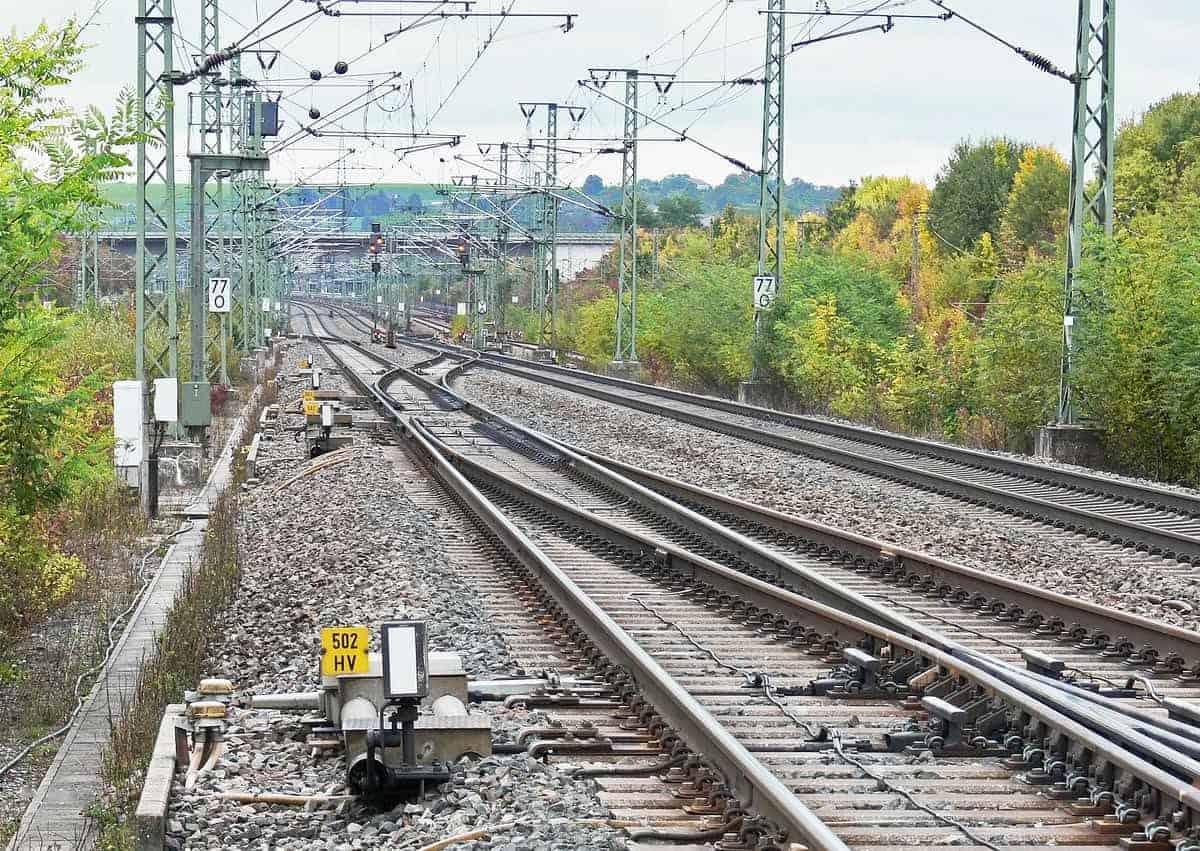
High-speed rail on Australia’s east coast Image by Erich Westendarp from Pixabay

Greg Moran, Grattan Institute

As the major parties look for ways to stimulate the economy after the COVID-19 crisis, Labor is again spruiking its vision of linking Melbourne, Sydney, Canberra and Brisbane with high-speed trains similar to the Eurostar, France’s TGV or Japan’s Shinkansen.
Piqsels

In 2013 when Labor was last in government, it released a detailed feasibility study of its plan. But a Grattan Institute report released today shows bullet trains are not a good idea for Australia. Among other shortcomings, we found an east coast bullet train would not be the climate saver many think it would be.
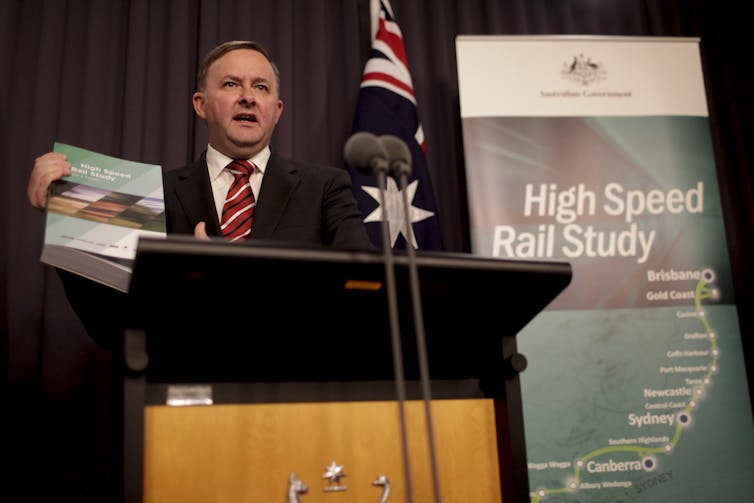
Anthony Albanese releasing a high-speed rail study in 2013. The idea has long been mooted. AAP/Lukas Coch

The logic seems simple enough

Building a bullet train to put a dent in our greenhouse gas emissions has been long touted. The logic seems simple – we can take a lot of planes and their carbon pollution out of the sky if we give people another way to get between our largest cities in just a few hours or less.

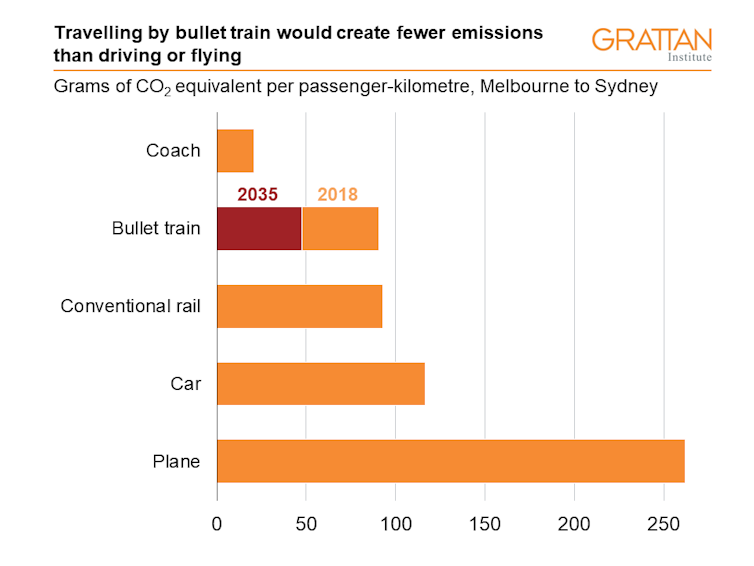
And this is all quite true, as the chart below shows. We estimate a bullet train’s emissions per passenger-kilometre on a trip from Melbourne to Sydney would be about one-third of those of a plane. We calculated this using average fuel consumption estimates from 2018 for various types of transport, as well as the average emissions intensity of electricity generated in Australia in 2018.

If we use the projected emissions intensity of electricity in 2035 – the first year trains were expected to run under Labor’s original plan – the fraction drops to less than one-fifth of a plane’s emissions in 2018.

It should be remembered that while coaches might be the most climate-friendly way to travel long distances, they can’t compete with bullet trains or planes for speed.


AlsoRead...

Ryan: Building real freedom through e-commerce

Ryan: Building real freedom through e-commerce

27 November 2025
Design Australia Group: Redefining Drafting as the engine of housing growth

Design Australia Group: Redefining Drafting as the engine of housing growth

26 November 2025
Notes: Average occupancy estimates are 38.5 (coach), 320 (bullet train), 119 (conventional rail), 2.26 (car), and 151.96 (plane). Plane emissions include radiative forcing. For more detail, see ‘Fast train fever: Why renovated rail might work but bullet trains won’t’.

There’s a catch

So, where’s the problem? It lies in construction. A bullet train along Australia’s east coast would take about 15 years of planning, then would be built in sections over about 30 years. This construction would generate huge emissions.

In particular, vast emissions would be released in the production of steel and concrete required to build a train line from Melbourne to Brisbane. These so-called “scope 3” emissions can account for 50-80% of total construction emissions.

Scope 3 emissions are sometimes not counted when assessing the emissions impact of a project, but they should be. There’s no guarantee the quantities of concrete and steel in question would have been produced and used elsewhere if not for the bullet train.

And the long construction time means it would be many years before the train actually starts to take planes out of the sky. This, combined with construction emissions, means a bullet train would be very slow to reduce emissions. In fact, we found it would first increase emissions for many years.

Slow emissions benefit

As the chart below shows, we estimate building the bullet train could lead to emissions being higher than they otherwise would’ve been for between 24 and 36 years.

This period would start at year 15 of the project, when planning ends and construction starts. At the earliest, it would end at year 39. This is the point at which some sections of the project would be complete, and at which enough trips have been taken (and enough plane or car trips foregone) that avoided emissions overtake emissions created.

This means the train might not actually create a net reduction in emissions until almost 40 years after the government commits to building it – and even this is under a generously low estimate of scope 3 emissions. If scope 3 emissions are on the high side, emission reductions may not start until just after the 50-year mark – 36 years after construction began.
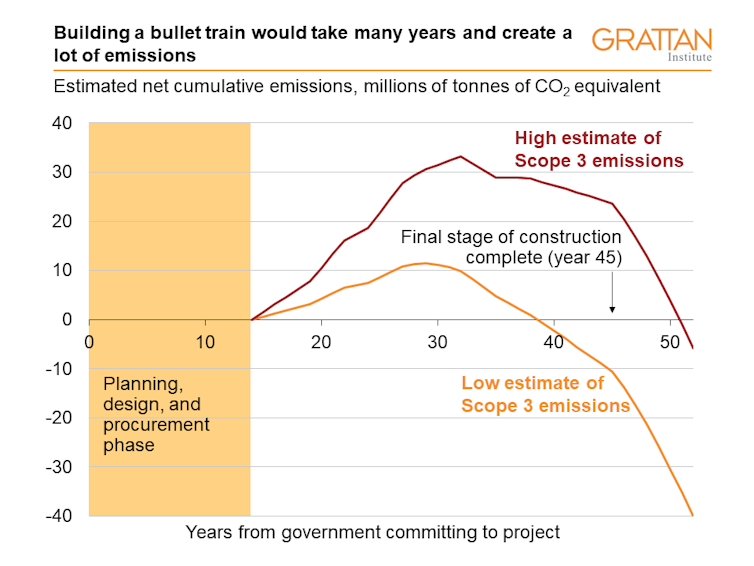
Notes: Estimates derived from the 2013 feasibility study of the Melbourne-to-Brisbane bullet train, and other sources. The feasibility study assumed that government would commit to the project in 2013. For more detail, see ‘Fast train fever: Why renovated rail might work but bullet trains won’t’.

The bullet train would create a net reduction in emissions from the 40- or 50-year mark onwards. But the initial timelines matter.

The world needs to achieve net zero emissions by about 2050 if we’re to avoid the worst impacts of climate change. All Australian states and territories have made this their goal. Unfortunately, a bullet train will not help us achieve it.

The way forward

Hitting the 2050 net-zero emissions target implicit in the Paris Agreement remains a daunting but achievable task. Decarbonising transport will play a big part, including the particularly tricky question of reducing aviation emissions.

But during the most crucial time for action on emissions reduction, a bullet train will not help. Our efforts and focus ought to be directed elsewhere.

Milan Marcus assisted in the preparation of this piece.

Greg Moran, Senior Associate, Grattan Institute

This article is republished from The Conversation under a Creative Commons license. Read the original article.


Tags: SB001
DMCA.com Protection Status

SUBSCRIBE to our NEWSLETTER

[mc4wp_form id=”2384248″]

Don't Miss

The evolution of Aesthetic Surgery through the lens of Dr Kourosh Tavakoli

by Pauline Torongo
4 December 2025
The evolution of Aesthetic Surgery through the lens of Dr. Kourosh Tavakoli
Health & Wellness

As global interest in Australian cosmetic surgery continues to grow, the combination of regulation, research and emerging digital tools is...

Read moreDetails

Ryan: Building real freedom through e-commerce

by Pauline Torongo
27 November 2025
Ryan: Building real freedom through e-commerce
Business & Finance

Ryan’s greatest achievement isn’t any single business or revenue milestone — it’s the ecosystem he’s built through the Change community.

Read moreDetails

Design Australia Group: Redefining Drafting as the engine of housing growth

by Pauline Torongo
26 November 2025
Design Australia Group: Redefining Drafting as the engine of housing growth
Business & Finance

Australia is under pressure to build homes faster, but design bottlenecks slow progress. Design Australia Group is fixing this by...

Read moreDetails

Louis Guy Detata builds Global Trading Empires through autonomous systems and disciplined leadership

by Pauline Torongo
25 November 2025
Louis Guy Detata builds Global Trading Empires through autonomous systems and disciplined leadership
Business & Finance

The path from investment banking to leading a global trading platform has taught Louis Detata that sustainable success requires more...

Read moreDetails

Burning Eucalyptus Wood: Tips, Advantages, Disadvantages & Alternatives

by Fazila Olla-Logday
20 November 2025
Image Supplied
Enviroment

Learn about burning eucalyptus wood for stoves and fireplaces. Discover benefits, drawbacks, harvesting tips, and better alternative firewood options for...

Read moreDetails

Everything Parents Need to Know About Baby Soft Play and Why It’s a Game Changer

by Fazila Olla-Logday
11 November 2025
Everything Parents Need to Know About Baby Soft Play
Health & Wellness

Baby soft play is a fun, safe, and educational way for little ones to explore and grow. Discover the benefits...

Read moreDetails

WOMAD Sets Up a New Camp in Wiltshire – Australian festival fans take note!

by Kris Griffiths
11 November 2025
Kumbia Boruka brought their reggae and dancehall flavour to the Taste the World Stage at WOMAD 2024 - Credit - Mike Massaro
Entertainment

With its 2026 edition moving to Neston Park in England, WOMAD offers Aussie music lovers a chance to reconnect with global...

Read moreDetails
Load More

Copyright © Blue Sky Publications Ltd. All Rights Reserved.
australiantimes.co.uk is a division of Blue Sky Publications Ltd. Reproduction without permission prohibited. DMCA.com Protection Status

  • About us
  • Write for Us
  • Advertise
  • Contact us
  • T&Cs, Privacy and GDPR
No Result
View All Result
  • News
    • Weather
    • Sport
    • Technology
    • Business & Finance
      • Currency Zone
    • Lotto Results
      • The Lott
  • Lifestyle
    • Entertainment
    • Horoscopes
    • Health & Wellness
    • Recipes
  • Travel
  • Expat Life
  • Move to Australia

Copyright © Blue Sky Publications Ltd. All Rights Reserved.
australiantimes.co.uk is a division of Blue Sky Publications Ltd. Reproduction without permission prohibited. DMCA.com Protection Status

No Result
View All Result
  • News
    • Weather
    • Sport
    • Technology
    • Business & Finance
      • Currency Zone
    • Lotto Results
      • The Lott
  • Lifestyle
    • Entertainment
    • Horoscopes
    • Health & Wellness
    • Recipes
  • Travel
  • Expat Life
  • Move to Australia

Copyright © Blue Sky Publications Ltd. All Rights Reserved.
australiantimes.co.uk is a division of Blue Sky Publications Ltd. Reproduction without permission prohibited. DMCA.com Protection Status