


Benjamin T. Jones, CQUniversity Australia
Today, many Australians are enjoying a public holiday. For republicans, days off are great, but celebrating the queen’s birthday rather than an Australian achievement is bizarre. Without constitutional change, we will soon be taking a day off in honour of King Charles.
Surely we can find a better reason.
Fortunately, the republic is back on the public agenda. The royal scandals surrounding Prince Andrew, the Palace Letters, and the explosive Oprah interview with Harry and Meghan (and ongoing fallout) have seen the debate take off anew.
Even the passing of the queen’s husband, Prince Philip has prompted reflection on Australia’s relationship with the monarchy.
We can be sure that when the queen’s long reign comes to an end, it will also spark a new push for an Australian republic.
The Australian Republic Movement’s new approach
Since the defeated referendum in 1999, the Australian Republic Movement has been neutral on what model should be used. Its position has been for a plebiscite asking only if people support a republic, before the exact model is determined. Critics have claimed this is asking for a policy blank cheque.


In a change of policy, the Australian Republic Movement now plans to unveil its preferred model later this year.
This is significant because it was the model, not the monarch, that sunk the republic in 1999. Some republicans were so opposed to the option on offer they campaigned with the official “no” team. Ultimately, the success of a new republic referendum will depend on the ability of the model to unite republicans, not the popularity of the monarch.
So, what are the options for a republic and what are their pros and cons?
Another minimal model
Under the minimal model from the 1999 referendum, the head of state would have been appointed by a two-thirds majority of parliament.
Despite its failure in 1999, many republicans still insist this is the best fit for Australia. The appointment by parliament is similar to the systems used in India, Israel, and Greece, and seeks to ensure a non-partisan appointment and reinforce the titular nature the position. Variations include the McGarvie model (proposed by former governor of Victoria, Richard McGarvie), which has a council of former governors to act on the prime minister’s advice and select a worthy candidate.
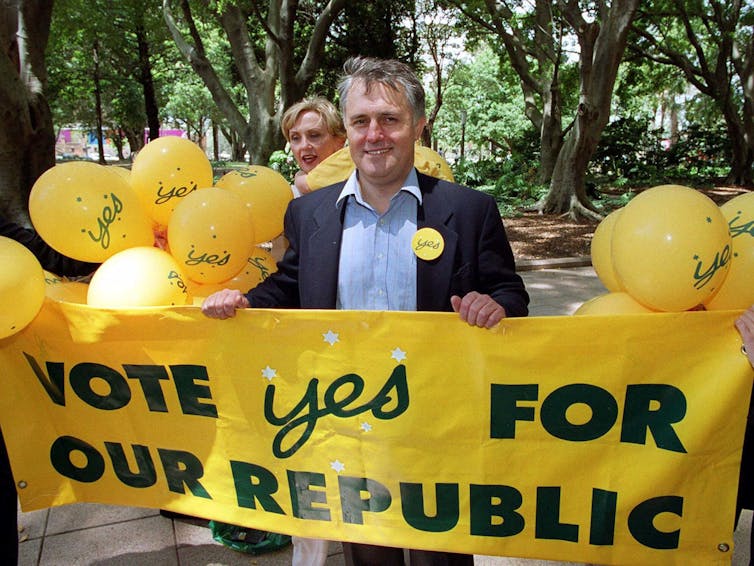
For supporters, this model guards against populism, or candidates using their wealth or celebrity to gain the position. However, critics argue a minimal model has already failed the ultimate test.
Malcolm Turnbull, who led the 1999 “yes” campaign, argued at a recent Australian Republic Movement event that support for direct election is a “mile wide but an inch deep”. In other words, people instinctively support it but often change their minds when they consider the consequences.
Minimal model supporters insist that the referendum failed because of constitutional ignorance and an effective scare campaign. They suggest a minimal model can succeed with much wider community consultation and public education.
Direct election
Direct electionists argue that without a popular vote, Australia would only have a “politicians’ republic”. Leading up to the 1999 referendum, former independent MPs Phil Cleary and Ted Mack, and former Brisbane lord mayor Clem Jones, among others, formed the Real Republic, urging people to vote “no”. Now led by chair of the Clem Jones Trust, David Muir, the group is still active on Facebook.
In theory, direct election means anyone could be the head of state. Critics argue it could actually reduce the pool of candidates. Winning an election generally requires substantial finances and resources. Direct election could mean that only the rich or famous can realistically run.
Supporters counter this by claiming a mature nation can make up its own mind. If the people democratically elect someone like Clive Palmer or Shane Warne, then so be it.
A hybrid model
The third option is a hybrid of minimalism and direct-election. Former Western Australia Premier Geoff Gallop put forward the Gallop Model at the Constitutional Convention in 1998. He proposed that the federal parliament select at least three suitable nominees who are then put to a popular vote.
Another hybrid is the 50-50 model created by government consultant Anthony Cianflone. Under this model, anyone can nominate. Then there is both a popular vote and a parliamentary vote, each worth 50%.
Previously, I have proposed a hybrid model, with each state and territory parliament selecting a nominee, and then those eight going to a popular vote. The logic behind this system was that it provided a double hurdle for candidates. Only an exceptional candidate would gain the confidence of both an elected parliament and the people.
Critics of hybrid models say they are not democratic enough. Under a 50-50 model, the problematic situation could arise where the most popular candidate with the people is effectively vetoed by parliament. Critics of the Gallop model or mine could say it is undemocratic to only let people vote from a pre-approved list.
Further, public confidence in our parliaments is at a low point. Explaining my model to a friend recently, he exclaimed, “why let politicians anywhere near it?”
Other considerations
The method for choosing the head of state is the most important element in any republican model but there are other considerations.
Should gender equality be written into the constitution? Australian National University professor Kim Rubenstein has argued the head of state should alternate between women and men. Similarly, Griffith University professor and Waanyi and Jaru man Gregory Phillips has argued for direct election, but every second term the nominees must be Indigenous.
As the 1975 Whitlam dismissal showed, the governor-general has great reserve powers, even if they are rarely used. As a republic, Australia could continue to rely on protocol and trust the head of state to treat the position as titular and ceremonial.
Another option is to codify the head of state’s powers and have strict rules outlining exactly when and how they can be used. Under direct election models especially, this may be an important safeguard. Without it, a head of state may see their election as a popular mandate for political interference. Under any model, only codification can guarantee the dismissal is never repeated.
A way forward?
It was only in 1973 with the passage of the Royal Style and Titles Act that the queen was given a unique Australian title, the “Queen of Australia”. Without constitutional change, Charles will become the first official “King of Australia”.
When coins bearing Charles’s face come into circulation, we can expect many will question the benefit of a foreign head of state living on the other side of the world. Nevertheless, the fate of an Australian republic does not rest with the next monarch.
Whichever model goes to a vote, the mathematics is simple. Republicans will either unite and probably win or divide and certainly fail.
Benjamin T. Jones, Lecturer in History, CQUniversity Australia
This article is republished from The Conversation under a Creative Commons license. Read the original article.







