

• Advertise
  • About us
  • Terms and Conditions
  • Contact us
Friday, December 19, 2025
Australian Times News
  • News
    • Weather
    • Sport
    • Technology
    • Business & Finance
      • Currency Zone
    • Lotto Results
      • The Lott
  • Lifestyle
    • Entertainment
    • Horoscopes
    • Health & Wellness
    • Recipes
  • Travel
  • Expat Life
  • Move to Australia
No Result
View All Result
  • News
    • Weather
    • Sport
    • Technology
    • Business & Finance
      • Currency Zone
    • Lotto Results
      • The Lott
  • Lifestyle
    • Entertainment
    • Horoscopes
    • Health & Wellness
    • Recipes
  • Travel
  • Expat Life
  • Move to Australia
No Result
View All Result
Australian Times News
No Result
View All Result
Home News

Even in a ‘water-rich’ country like New Zealand, some cities could face water shortages this summer

After eight months of drought rules, Auckland finally relaxed water restrictions last week, but as New Zealand heads into another La Niña summer, other cities can expect serious water shortages both now and in the future.

The Conversation by The Conversation
22-12-2020 09:17
in News
Looking ahead to warmer and drier summers

Looking ahead to warmer and drier summers Photo by Bradley Singleton on Unsplash

Julia Talbot-Jones, Te Herenga Waka — Victoria University of Wellington; Sophie O’Brien, Motu Economic and Public Policy Research, and Suzie Greenhalgh, Manaaki Whenua – Landcare Research

After eight months of drought rules, Auckland finally relaxed water restrictions last week, but as New Zealand heads into another La Niña summer, other cities can expect serious water shortages both now and in the future.

MNStudio/Shutterstock

Although this summer’s projected rainfall should keep Auckland’s water supply levels sustainable in the short term, Wellington could be running dry within the next six years.

For both cities, addressing the gap in water supply and demand is an immediate and ongoing problem. Growing populations and increasingly variable climate conditions, combined with ageing infrastructure, mean local authorities will have to think about how they can either increase supply or change patterns of consumption.

In a new working paper, we explore the merits and limitations of options available to policymakers to help navigate the changing water landscape.


Policy solutions to address water (short)falls

For two of New Zealand’s largest cities, Auckland and Wellington, curbing demand is likely to be a more cost-effective approach than increasing water supply. Building reservoirs or constructing desalination plants is costly compared with adopting a range of targeted policy instruments that could encourage a change in individual use.

The benefits of taking a multi-faceted policy approach to curbing demand is evident when comparing water consumption patterns in Auckland and Wellington.


AlsoRead...

How Turnkey Building Group Is Restoring Trust In An Industry Known For Customer Disappointment

How Turnkey Building Group Is Restoring Trust In An Industry Known For Customer Disappointment

17 December 2025
Ryan: Building real freedom through e-commerce

Ryan: Building real freedom through e-commerce

27 November 2025

Aucklanders had water meters installed in the 1990s and are charged per unit of water consumed. They use 30% less water per person than Wellington users, who don’t have meters and are charged a flat rate for use.

Coupled with this, Auckland Council has run targeted campaigns to educate users about ways to conserve water and household water bills include information about use patterns that are designed to “nudge” users towards conservation.

In other regions of New Zealand, the merits of a cost-driven approach are also clear. The Kāpiti Coast in the lower North Island has had a 26% reduction in water use since water meters, pricing and targeted education campaigns were introduced in 2014.

The evidence suggests that a policy approach that combines pricing incentives with education campaigns and regulation encourages users to conserve water.

Looking ahead to warmer and drier summers

However, even with the implementation of a range of water-saving policies, New Zealand city dwellers are not achieving the reductions needed to close the demand gap, particularly given the projections of warmer, drier summers. Most cities will need to adopt further policy changes.
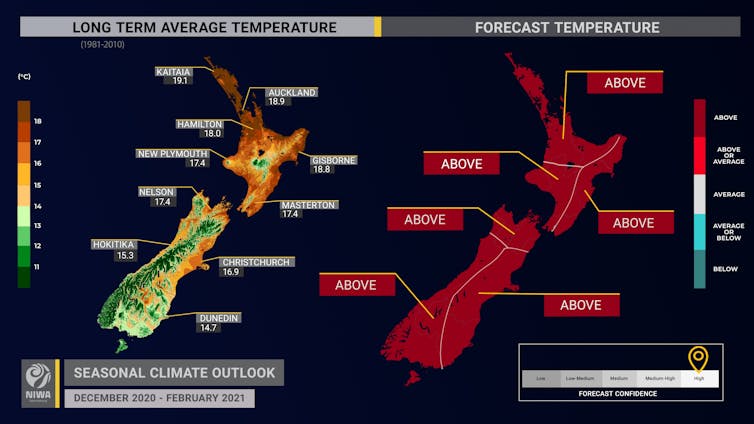
Map of expected temperatures this summer.
Warmer-than-usual temperatures are forecast for all of New Zealand this summer, and the warming trend is expected to continue. NIWA, CC BY-ND

The patterns of water consumption in Australia’s two largest cities, Melbourne and Sydney, provide some insight into how further behavioural changes could be achieved in New Zealand.

First, Australia’s arid climate leaves few in doubt about water’s value and its scarcity. Second, this is reinforced through higher price signals, some of which rise and fall with dam levels. The result is that Melburnians, who pay progressively more per litre the more water they use, use 150 litres per person per day. Sydneysiders, who until recently paid a flat price for residential water, use 210 litres per person per day.


For New Zealand policymakers, the challenge lies not only in bringing about changes in the choices water users make through prices that more accurately reflect scarcity, but also in engineering a shift in values around water consumption. For too long, New Zealanders have thought the country is water-rich, ignoring the fact this applies only to certain regions and seasons.

Achieving a long-term shift in behaviour will require an acknowledgement that values influence policy and vice versa. For most cities, the starting point in this transition will be identifying targeted policy options to reduce the growing supply-demand gap and engender a shift in values.

For Auckland, this might mean reviewing the pricing structures that determine patterns of water use. For Wellington, the most cost-effective approach is likely to be the introduction of meters and volumetric pricing.

For residents of all urban areas, internalising the fact that water is scarce can’t come soon enough.

Julia Talbot-Jones, Lecturer, Te Herenga Waka — Victoria University of Wellington; Sophie O’Brien, Research Analyst, Motu Economic and Public Policy Research, and Suzie Greenhalgh, Portfolio Leader (Society, Culture & Policy), Manaaki Whenua – Landcare Research

This article is republished from The Conversation under a Creative Commons license. Read the original article.


Tags: SB001
DMCA.com Protection Status

SUBSCRIBE to our NEWSLETTER

[mc4wp_form id=”2384248″]

Don't Miss

How Turnkey Building Group Is Restoring Trust In An Industry Known For Customer Disappointment

by Fazila Olla-Logday
17 December 2025
How Turnkey Building Group Is Restoring Trust In An Industry Known For Customer Disappointment
Business & Finance

Turnkey Building Group is changing the narrative in an industry often associated with missed deadlines and broken promises. By prioritizing...

Read moreDetails

Risk Awareness for International Travellers – What Australians Should Know Before Entering Multi-State Regions

by Fazila Olla-Logday
10 December 2025
Schengen
Travel

This guide helps Australian travellers understand cross-border requirements, assess political and environmental risks, manage health and safety considerations, and prepare...

Read moreDetails

The evolution of Aesthetic Surgery through the lens of Dr Kourosh Tavakoli

by Pauline Torongo
4 December 2025
The evolution of Aesthetic Surgery through the lens of Dr. Kourosh Tavakoli
Health & Wellness

As global interest in Australian cosmetic surgery continues to grow, the combination of regulation, research and emerging digital tools is...

Read moreDetails

Ryan: Building real freedom through e-commerce

by Pauline Torongo
27 November 2025
Ryan: Building real freedom through e-commerce
Business & Finance

Ryan’s greatest achievement isn’t any single business or revenue milestone — it’s the ecosystem he’s built through the Change community.

Read moreDetails

Design Australia Group: Redefining Drafting as the engine of housing growth

by Pauline Torongo
26 November 2025
Design Australia Group: Redefining Drafting as the engine of housing growth
Business & Finance

Australia is under pressure to build homes faster, but design bottlenecks slow progress. Design Australia Group is fixing this by...

Read moreDetails

Louis Guy Detata builds Global Trading Empires through autonomous systems and disciplined leadership

by Pauline Torongo
25 November 2025
Louis Guy Detata builds Global Trading Empires through autonomous systems and disciplined leadership
Business & Finance

The path from investment banking to leading a global trading platform has taught Louis Detata that sustainable success requires more...

Read moreDetails

Burning Eucalyptus Wood: Tips, Advantages, Disadvantages & Alternatives

by Fazila Olla-Logday
20 November 2025
Image Supplied
Enviroment

Learn about burning eucalyptus wood for stoves and fireplaces. Discover benefits, drawbacks, harvesting tips, and better alternative firewood options for...

Read moreDetails
Load More

Copyright © Blue Sky Publications Ltd. All Rights Reserved.
australiantimes.co.uk is a division of Blue Sky Publications Ltd. Reproduction without permission prohibited. DMCA.com Protection Status

  • About us
  • Write for Us
  • Advertise
  • Contact us
  • T&Cs, Privacy and GDPR
No Result
View All Result
  • News
    • Weather
    • Sport
    • Technology
    • Business & Finance
      • Currency Zone
    • Lotto Results
      • The Lott
  • Lifestyle
    • Entertainment
    • Horoscopes
    • Health & Wellness
    • Recipes
  • Travel
  • Expat Life
  • Move to Australia

Copyright © Blue Sky Publications Ltd. All Rights Reserved.
australiantimes.co.uk is a division of Blue Sky Publications Ltd. Reproduction without permission prohibited. DMCA.com Protection Status

No Result
View All Result
  • News
    • Weather
    • Sport
    • Technology
    • Business & Finance
      • Currency Zone
    • Lotto Results
      • The Lott
  • Lifestyle
    • Entertainment
    • Horoscopes
    • Health & Wellness
    • Recipes
  • Travel
  • Expat Life
  • Move to Australia

Copyright © Blue Sky Publications Ltd. All Rights Reserved.
australiantimes.co.uk is a division of Blue Sky Publications Ltd. Reproduction without permission prohibited. DMCA.com Protection Status





