

• Advertise
  • About us
  • Terms and Conditions
  • Contact us
Saturday, December 6, 2025
Australian Times News
  • News
    • Weather
    • Sport
    • Technology
    • Business & Finance
      • Currency Zone
    • Lotto Results
      • The Lott
  • Lifestyle
    • Entertainment
    • Horoscopes
    • Health & Wellness
    • Recipes
  • Travel
  • Expat Life
  • Move to Australia
No Result
View All Result
  • News
    • Weather
    • Sport
    • Technology
    • Business & Finance
      • Currency Zone
    • Lotto Results
      • The Lott
  • Lifestyle
    • Entertainment
    • Horoscopes
    • Health & Wellness
    • Recipes
  • Travel
  • Expat Life
  • Move to Australia
No Result
View All Result
Australian Times News
No Result
View All Result
Home News

Earth’s energy budget is out of balance – here’s how it’s warming the climate

Doubling of carbon dioxide would add 3.7 watts of heat to every square meter of the Earth. Imagine old-fashioned incandescent night lights spaced every 3 feet over the entire world, left on forever.

The Conversation by The Conversation
05-08-2021 09:17
in News
Photo by Artur D. on Unsplash

Photo by Artur D. on Unsplash

Scott Denning, Colorado State University

You probably remember your grade school science teachers explaining that energy can neither be created nor destroyed. That’s a fundamental property of the universe.

Energy can be transformed, however. When the Sun’s rays reach Earth, they are transformed into random motions of molecules that you feel as heat. At the same time, Earth and the atmosphere are sending radiation back into space. The balance between the incoming and outgoing energy is known as Earth’s “energy budget.”

Our climate is determined by these energy flows. When the amount of energy coming in is more than the energy going out, the planet warms up.

That can happen in a few ways, such as when sea ice that normally reflects solar radiation back into space disappears and the dark ocean absorbs that energy instead. It also happens when greenhouse gases build up in the atmosphere and trap some of the energy that otherwise would have radiated away.

Scientists like me have been measuring the Earth’s energy budget since the 1980s using instruments on satellites, in the air and oceans, and on the ground. You’ll be hearing more about those measurements and Earth’s energy budget when the United Nations Intergovernmental Panel on Climate Change report is released on Aug. 9.

Here’s a closer look at how energy flows and what the energy budget tells us about how and why the planet is warming.


AlsoRead...

Ryan: Building real freedom through e-commerce

Ryan: Building real freedom through e-commerce

27 November 2025
Design Australia Group: Redefining Drafting as the engine of housing growth

Design Australia Group: Redefining Drafting as the engine of housing growth

26 November 2025

Balancing energy from the Sun

Virtually all the energy in the Earth’s climate system comes from the Sun. Only a tiny fraction is conducted upward from the Earth’s interior.

On average, the planet receives 340.4 watts of sunshine per square meter. All sunshine falls on the daytime side, and the numbers are much higher at local noon.

Of that 340.4 watts per square meter:

  • 99.9 watts are reflected back into space by clouds, dust, snow and the Earth’s surface.
  • The remaining 240.5 watts are absorbed – about a quarter by the atmosphere and the rest by the surface of the planet. This radiation is transformed into thermal energy within the Earth system. Almost all of this absorbed energy is matched by energy emitted back into space. A tiny residual – 0.6 watts per square meter – accumulates as global warming. That may not sound like much, but it adds up.
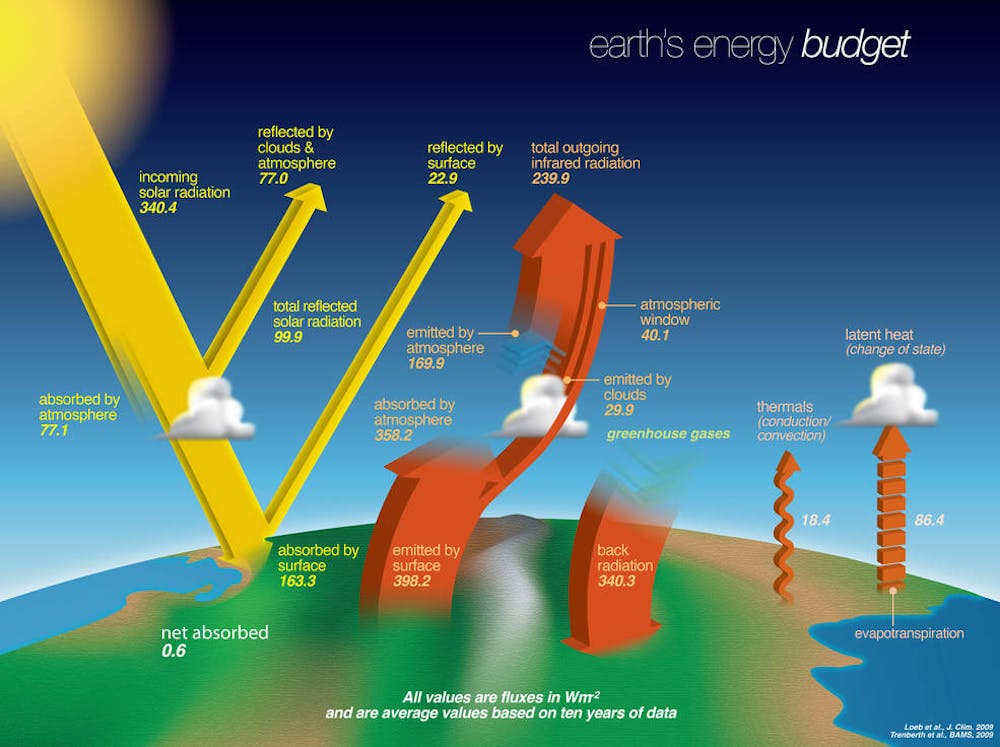
Illustration of how energy flows to Earth's surface and away from it.
Earth’s energy budget. NASA

The atmosphere absorbs a lot of energy and emits it as radiation both into space and back down to the planet’s surface. In fact, Earth’s surface gets almost twice as much radiation from the atmosphere as it does from direct sunshine. That’s primarily because the Sun heats the surface only during the day, while the warm atmosphere is up there 24/7.

Together, the energy reaching Earth’s surface from the Sun and from the atmosphere is about 504 watts per square meter. Earth’s surface emits about 79% of that back out. The remaining surface energy goes into evaporating water and warming the air, oceans and land.

The tiny residual between incoming sunshine and outgoing infrared is due to the accumulation of greenhouse gases like carbon dioxide in the air. These gases are transparent to sunlight but opaque to infrared rays – they absorb and emit a lot of infrared rays back down.

Earth’s surface temperature must increase in response until the balance between incoming and outgoing radiation is restored.

What does this mean for global temperatures?

Doubling of carbon dioxide would add 3.7 watts of heat to every square meter of the Earth. Imagine old-fashioned incandescent night lights spaced every 3 feet over the entire world, left on forever.

At the current rate of emissions, greenhouse gas levels would double from preindustrial levels by the middle of the century.

Climate scientists calculate that adding this much heat to the world would warm Earth’s climate by about 5 degrees Fahrenheit (3 C). Preventing this would require replacing fossil fuel combustion, the leading source of greenhouse gas emissions, with other forms of energy.

Earth’s energy budget is at the heart of the upcoming IPCC climate assessment, written by hundreds of scientists reviewing the latest research. With knowledge of what’s changing, everyone can make better choices to preserve the climate as we know it.

Scott Denning, Professor of Atmospheric Science, Colorado State University

This article is republished from The Conversation under a Creative Commons license. Read the original article.


Tags: SB001
DMCA.com Protection Status

SUBSCRIBE to our NEWSLETTER

[mc4wp_form id=”2384248″]

Don't Miss

The evolution of Aesthetic Surgery through the lens of Dr Kourosh Tavakoli

by Pauline Torongo
4 December 2025
The evolution of Aesthetic Surgery through the lens of Dr. Kourosh Tavakoli
Health & Wellness

As global interest in Australian cosmetic surgery continues to grow, the combination of regulation, research and emerging digital tools is...

Read moreDetails

Ryan: Building real freedom through e-commerce

by Pauline Torongo
27 November 2025
Ryan: Building real freedom through e-commerce
Business & Finance

Ryan’s greatest achievement isn’t any single business or revenue milestone — it’s the ecosystem he’s built through the Change community.

Read moreDetails

Design Australia Group: Redefining Drafting as the engine of housing growth

by Pauline Torongo
26 November 2025
Design Australia Group: Redefining Drafting as the engine of housing growth
Business & Finance

Australia is under pressure to build homes faster, but design bottlenecks slow progress. Design Australia Group is fixing this by...

Read moreDetails

Louis Guy Detata builds Global Trading Empires through autonomous systems and disciplined leadership

by Pauline Torongo
25 November 2025
Louis Guy Detata builds Global Trading Empires through autonomous systems and disciplined leadership
Business & Finance

The path from investment banking to leading a global trading platform has taught Louis Detata that sustainable success requires more...

Read moreDetails

Burning Eucalyptus Wood: Tips, Advantages, Disadvantages & Alternatives

by Fazila Olla-Logday
20 November 2025
Image Supplied
Enviroment

Learn about burning eucalyptus wood for stoves and fireplaces. Discover benefits, drawbacks, harvesting tips, and better alternative firewood options for...

Read moreDetails

Everything Parents Need to Know About Baby Soft Play and Why It’s a Game Changer

by Fazila Olla-Logday
11 November 2025
Everything Parents Need to Know About Baby Soft Play
Health & Wellness

Baby soft play is a fun, safe, and educational way for little ones to explore and grow. Discover the benefits...

Read moreDetails

WOMAD Sets Up a New Camp in Wiltshire – Australian festival fans take note!

by Kris Griffiths
11 November 2025
Kumbia Boruka brought their reggae and dancehall flavour to the Taste the World Stage at WOMAD 2024 - Credit - Mike Massaro
Entertainment

With its 2026 edition moving to Neston Park in England, WOMAD offers Aussie music lovers a chance to reconnect with global...

Read moreDetails
Load More

Copyright © Blue Sky Publications Ltd. All Rights Reserved.
australiantimes.co.uk is a division of Blue Sky Publications Ltd. Reproduction without permission prohibited. DMCA.com Protection Status

  • About us
  • Write for Us
  • Advertise
  • Contact us
  • T&Cs, Privacy and GDPR
No Result
View All Result
  • News
    • Weather
    • Sport
    • Technology
    • Business & Finance
      • Currency Zone
    • Lotto Results
      • The Lott
  • Lifestyle
    • Entertainment
    • Horoscopes
    • Health & Wellness
    • Recipes
  • Travel
  • Expat Life
  • Move to Australia

Copyright © Blue Sky Publications Ltd. All Rights Reserved.
australiantimes.co.uk is a division of Blue Sky Publications Ltd. Reproduction without permission prohibited. DMCA.com Protection Status

No Result
View All Result
  • News
    • Weather
    • Sport
    • Technology
    • Business & Finance
      • Currency Zone
    • Lotto Results
      • The Lott
  • Lifestyle
    • Entertainment
    • Horoscopes
    • Health & Wellness
    • Recipes
  • Travel
  • Expat Life
  • Move to Australia

Copyright © Blue Sky Publications Ltd. All Rights Reserved.
australiantimes.co.uk is a division of Blue Sky Publications Ltd. Reproduction without permission prohibited. DMCA.com Protection Status





