• Advertise
  • About us
  • Terms and Conditions
  • Contact us
Saturday, December 6, 2025
Australian Times News
  • News
    • Weather
    • Sport
    • Technology
    • Business & Finance
      • Currency Zone
    • Lotto Results
      • The Lott
  • Lifestyle
    • Entertainment
    • Horoscopes
    • Health & Wellness
    • Recipes
  • Travel
  • Expat Life
  • Move to Australia
No Result
View All Result
  • News
    • Weather
    • Sport
    • Technology
    • Business & Finance
      • Currency Zone
    • Lotto Results
      • The Lott
  • Lifestyle
    • Entertainment
    • Horoscopes
    • Health & Wellness
    • Recipes
  • Travel
  • Expat Life
  • Move to Australia
No Result
View All Result
Australian Times News
No Result
View All Result
Home News

COVID litter: we mapped discarded masks and gloves in 11 countries with the help of citizen science

If at some stage during the COVID pandemic you’ve had a face mask mysteriously disappear from your pocket, you’re not alone. From March 2020 countless discarded blue and white masks started appearing around the world.

The Conversation by The Conversation
12-12-2021 08:23
in News

Keiron Roberts, University of Portsmouth; Ian Williams, University of Southampton, and Simon Kolstoe, University of Portsmouth

If at some stage during the COVID pandemic you’ve had a face mask mysteriously disappear from your pocket, you’re not alone. From March 2020 countless discarded blue and white masks started appearing around the world.

While face masks are an important protective measure against COVID-19, it quickly became clear that face mask litter was going to be a by-product of the pandemic.

Keen to study the scale of this issue, but unable to travel far from our locked-down homes, we decided to use data gathered through a citizen science app called Litterati. This app asks people around the world to record any litter they find.

In our new study, published in the journal Nature Sustainability, we analysed data on mask and glove litter from September 2019 (before the pandemic) up to October 2020. We looked at 11 countries, including the UK, and compared the litter trends with each country’s approach to dealing with COVID-19.

While we expected to see a rise in mask litter, we were surprised by how much it rose. Across the 11 countries in our study there was an almost 9,000% increase in masks as a proportion of all litter from September 2019 to October 2020 (over 80 fold).

We also found strong links between mask litter and national laws or policies requiring mask wearing.


AlsoRead...

Ryan: Building real freedom through e-commerce

Ryan: Building real freedom through e-commerce

27 November 2025
Design Australia Group: Redefining Drafting as the engine of housing growth

Design Australia Group: Redefining Drafting as the engine of housing growth

26 November 2025
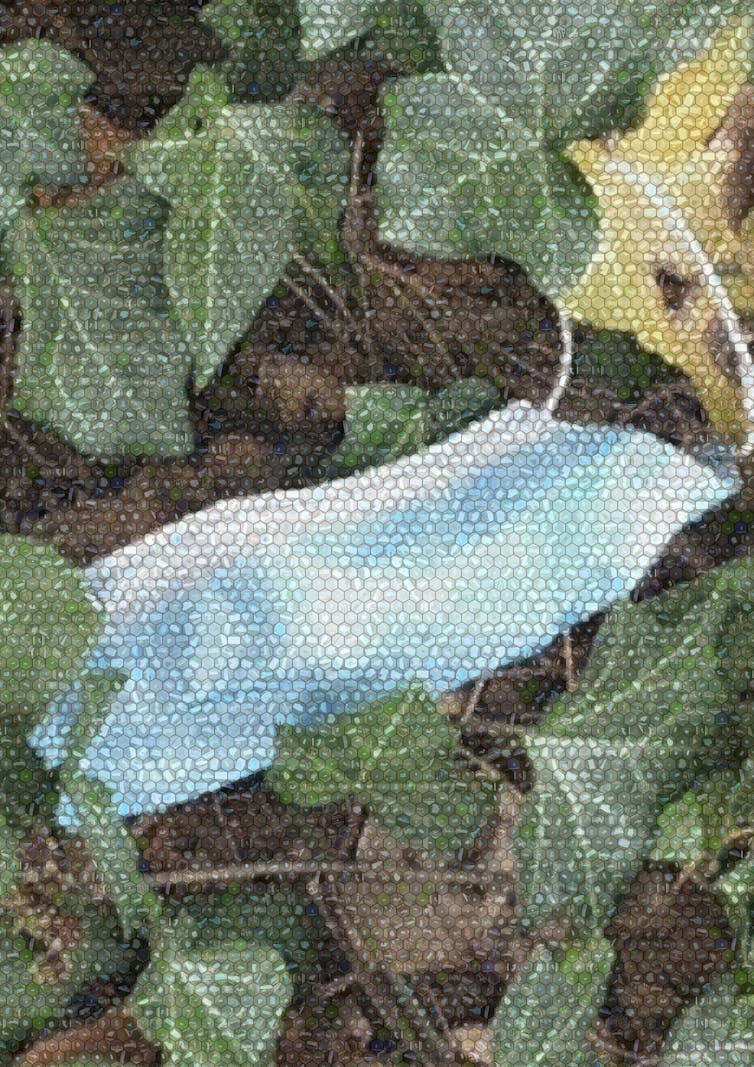
A mosaic image of a surgical mask lying among leaves.
In this mosaic, each polygon depicts a piece of mask or glove litter documented through Litterati. Keiron Roberts, Author provided

Our findings can perhaps be best understood if we consider three key periods.

January to March 2020

As countries grappled for adequate personal protective equipment, the most common guidance was to socially or physically distance from other people.

During this time mask and glove litter was low, but glove litter slowly started to rise first.

March to May 2020

On March 11 2020 the the World Health Organization (WHO) officially declared COVID-19 a global pandemic. This was also the period during which some of the the most severe lockdowns were implemented.

Mask litter started to increase as countries began to recommend, but often did not require, mask use in public. From March to April mask litter doubled, while glove litter jumped 12-fold during the same period. We think this is due to people associating touch with the spread of the virus, and masks not being widely accepted yet.

June to October 2020

The WHO officially recommended the use of masks in public on June 5 2020. This followed the relaxation of many of the most severe lockdown measures, and an increase in people getting out and about.

Mask litter increased dramatically during this time, but interestingly, glove litter began to decrease. This change was probably due to increasing public appreciation that the virus is spread by airborne droplets rather than touch, coupled with an increase in the social acceptability of wearing masks.

Compared to the other ten countries in our study, the UK had the greatest proportion of masks as litter, increasing from 0% in September 2019 to over 6% in August 2020. The UK also showed one of the longest sustained increases in glove litter from April to October 2020.

Nations less impacted by COVID-19 lockdowns, and which introduced mask laws later (such as New Zealand and Sweden), recorded the lowest proportion of mask and glove litter.
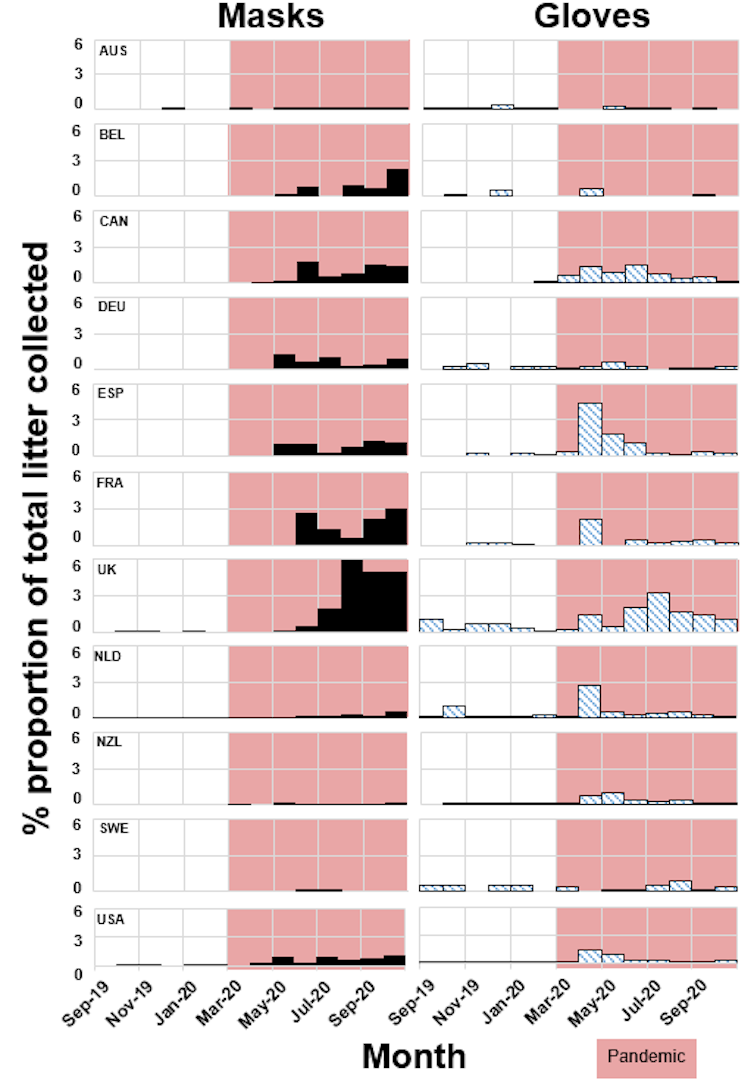
A graph showing the proportion of masks and gloves collected for the 11 countries studied from September 2019 to October 2020.
The 11 countries included were France, Germany, Belgium, the Netherlands, Spain, the UK, Sweden, the US, Canada, Australia and New Zealand. Nature Sustainability

Our COVID-19 litter fingerprint

Although masks and gloves only made up a small proportion of overall litter, our study (and others like it) have highlighted just how quickly new items like masks can add to substantial litter problems.

In addition to being an eyesore, face masks in particular can have more serious impacts when not disposed of properly. In the short term, for example, face mask litter can act as a potential viral vector, and therefore pose a risk for COVID transmission.

In the medium term mask litter can be eaten by animals, or entangle or choke them, certainly causing harm and potentially killing them. Masks and other litter can also smother smaller organisms and plant life.

In the long term, masks manufactured from plastic materials can persist in the environment for many years, breaking down into microplastics and potentially entering the food chain.

What now?

With the omicron variant forcing nations to reintroduce restrictions and enforce mask wearing again, the problem of pandemic-related litter is not behind us. For example, as part of England’s move to plan B, face masks are once again compulsory in most indoor public venues.

And although they were not previously a common feature in western nations, it’s likely that face masks will continue to be used even beyond the COVID-19 pandemic as people realise their role in preventing the spread of respiratory diseases.

There is therefore a dual responsibility falling to governments and individuals when it comes to masks and other pandemic-related litter. If governments require the use of masks, they need to ensure adequate education around disposal, as well as the availability of facilities like bins to help people dispose of litter appropriately.

At the same time, individuals need to take personal responsibility to dispose of waste. We can’t let one global problem (COVID-19) make another global problem (littering) worse.

Keiron Roberts, Lecturer in Sustainability and the Built Environment, University of Portsmouth; Ian Williams, Professor of Applied Environmental Science, University of Southampton, and Simon Kolstoe, Reader in Bioethics and University Ethics Advisor, University of Portsmouth

This article is republished from The Conversation under a Creative Commons license. Read the original article.


Tags: SB001
DMCA.com Protection Status

SUBSCRIBE to our NEWSLETTER

[mc4wp_form id=”2384248″]

Don't Miss

The evolution of Aesthetic Surgery through the lens of Dr Kourosh Tavakoli

by Pauline Torongo
4 December 2025
The evolution of Aesthetic Surgery through the lens of Dr. Kourosh Tavakoli
Health & Wellness

As global interest in Australian cosmetic surgery continues to grow, the combination of regulation, research and emerging digital tools is...

Read moreDetails

Ryan: Building real freedom through e-commerce

by Pauline Torongo
27 November 2025
Ryan: Building real freedom through e-commerce
Business & Finance

Ryan’s greatest achievement isn’t any single business or revenue milestone — it’s the ecosystem he’s built through the Change community.

Read moreDetails

Design Australia Group: Redefining Drafting as the engine of housing growth

by Pauline Torongo
26 November 2025
Design Australia Group: Redefining Drafting as the engine of housing growth
Business & Finance

Australia is under pressure to build homes faster, but design bottlenecks slow progress. Design Australia Group is fixing this by...

Read moreDetails

Louis Guy Detata builds Global Trading Empires through autonomous systems and disciplined leadership

by Pauline Torongo
25 November 2025
Louis Guy Detata builds Global Trading Empires through autonomous systems and disciplined leadership
Business & Finance

The path from investment banking to leading a global trading platform has taught Louis Detata that sustainable success requires more...

Read moreDetails

Burning Eucalyptus Wood: Tips, Advantages, Disadvantages & Alternatives

by Fazila Olla-Logday
20 November 2025
Image Supplied
Enviroment

Learn about burning eucalyptus wood for stoves and fireplaces. Discover benefits, drawbacks, harvesting tips, and better alternative firewood options for...

Read moreDetails

Everything Parents Need to Know About Baby Soft Play and Why It’s a Game Changer

by Fazila Olla-Logday
11 November 2025
Everything Parents Need to Know About Baby Soft Play
Health & Wellness

Baby soft play is a fun, safe, and educational way for little ones to explore and grow. Discover the benefits...

Read moreDetails

WOMAD Sets Up a New Camp in Wiltshire – Australian festival fans take note!

by Kris Griffiths
11 November 2025
Kumbia Boruka brought their reggae and dancehall flavour to the Taste the World Stage at WOMAD 2024 - Credit - Mike Massaro
Entertainment

With its 2026 edition moving to Neston Park in England, WOMAD offers Aussie music lovers a chance to reconnect with global...

Read moreDetails
Load More

Copyright © Blue Sky Publications Ltd. All Rights Reserved.
australiantimes.co.uk is a division of Blue Sky Publications Ltd. Reproduction without permission prohibited. DMCA.com Protection Status

  • About us
  • Write for Us
  • Advertise
  • Contact us
  • T&Cs, Privacy and GDPR
No Result
View All Result
  • News
    • Weather
    • Sport
    • Technology
    • Business & Finance
      • Currency Zone
    • Lotto Results
      • The Lott
  • Lifestyle
    • Entertainment
    • Horoscopes
    • Health & Wellness
    • Recipes
  • Travel
  • Expat Life
  • Move to Australia

Copyright © Blue Sky Publications Ltd. All Rights Reserved.
australiantimes.co.uk is a division of Blue Sky Publications Ltd. Reproduction without permission prohibited. DMCA.com Protection Status

No Result
View All Result
  • News
    • Weather
    • Sport
    • Technology
    • Business & Finance
      • Currency Zone
    • Lotto Results
      • The Lott
  • Lifestyle
    • Entertainment
    • Horoscopes
    • Health & Wellness
    • Recipes
  • Travel
  • Expat Life
  • Move to Australia

Copyright © Blue Sky Publications Ltd. All Rights Reserved.
australiantimes.co.uk is a division of Blue Sky Publications Ltd. Reproduction without permission prohibited. DMCA.com Protection Status