


Paul Hunter, University of East Anglia
Increasing the gap between COVID-19 vaccine doses (up to a maximum of 12 weeks) was one of the more controversial decisions made by the UK government during the pandemic. Medical experts came out for and against the plan when it was announced in January 2021. Faced with the new delta variant, experts are once again questioning if it was the right course of action.
By delaying the second dose – which tops up and lengthens the effect of the first – the aim was to bring forward the point at which people could get their initial vaccination, giving them some protection against the virus sooner. This was desirable because in early January, the UK was in a terrible position. Over 1,000 COVID-19 patients were dying each day and over 35,000 were in hospital. Future vaccine supplies were also not guaranteed.
However, delaying the second dose leaves people without the fullest possible protection against COVID-19 for longer, and the newly dominant delta variant appears to be less well managed by a single vaccine dose than previous forms of the virus. Nevertheless, I would argue that the decision to increase the gap between doses was still the right one to make at the time.
Research from Public Health England looking at over-70s – a group highly vulnerable to COVID-19 – has shown that single vaccine doses have been highly protective. This study found that protection against symptomatic illness after a single shot of the Pfizer vaccine was 61%, hitting this peak around 28-34 days after the shot was given and then plateauing. For the AstraZeneca vaccine, from 35 days onwards a single shot was 73% effective at preventing illness.
But even more importantly, in those who caught COVID, a single dose of the Pfizer vaccine reduced the risk of emergency admission to hospital by 43% and lowered the risk of death by 51%. And a single shot of the AstraZeneca vaccine reduced the risk of hospitalisation by 37% (there wasn’t enough time for follow-up for the study to estimate its effect on deaths).
Putting this all together, in the UK a single dose of either vaccine has been about 80% effective at reducing a person’s chance of being hospitalised with COVID-19 and 85% effective at reducing their chance of dying from it.


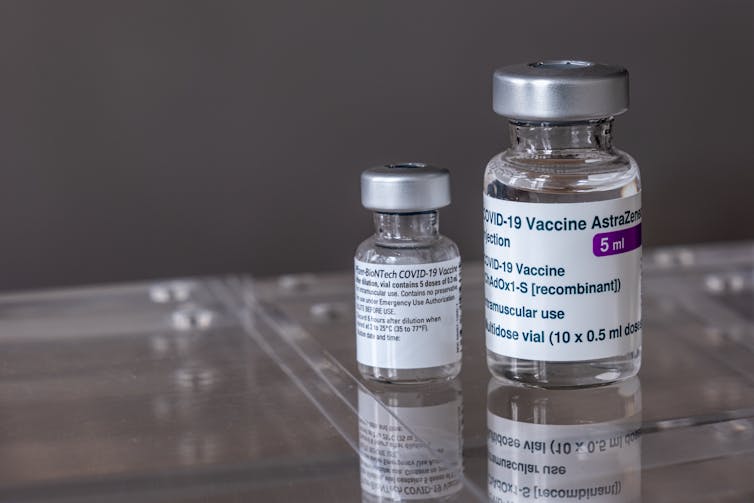
We also know that increasing the gap between the doses of the AstraZeneca vaccine leads to higher levels of immunity once both have been given – and this was known by the government when it decided to delay the second dose.
Early research suggests that the same could also be true for the Pfizer vaccine. A preprint – a research paper yet to be reviewed by other scientists – suggests that peak antibody levels after two Pfizer doses are 3.5-fold higher with an extended gap, with higher peak antibody levels likely to lead to longer-lasting protection.
Does delta change the picture?
But even if extending the gap between the doses was the right decision at the time, does it look like a mistake in retrospect, given the rise of the delta variant?
The first thing to point out is that vaccination strategies haven’t led to the initial genesis of any of the variants of concern. The alpha, beta, gamma and delta variants were all first detected in 2020, before mass vaccine rollout began. But could the rapid spread of the delta variant in the UK since early April be down to delaying second doses, as some have suggested?
Certainly there has been minimal growth so far in other countries that didn’t choose to delay second doses. And there is early evidence (yet to be reviewed by other scientists) that a single dose of either the Pfizer or AstraZeneca vaccine only offers relatively low protection: 33% against symptomatic COVID-19. Two doses of Pfizer (88%) and AstraZeneca (60%) offer much more protection. Leaving people with only a single dose for longer may have increased the population’s susceptibility to delta.
However, the rapid surge in infections in the UK was primarily driven by the hundreds – or possibly thousands – of cases of the delta variant arriving from India before the government put the country on the red list. This importation event was enough to drive the early growth of the variant in the UK, and it’s here where the criticism of the UK’s response should lie.
Other countries are now seeing increasing reports of the delta variant following it being imported, but are some weeks behind the UK experience. In the US, the delta variant will soon be dominant, especially in the mid-north-western states, where it is increasing as rapidly as it has previously in the UK.
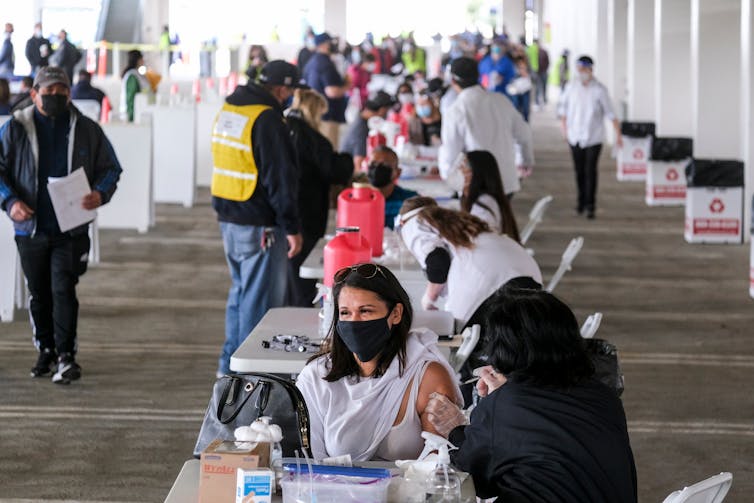
This even though in the US the Pfizer vaccine has been given at just three weeks apart, and that full vaccination coverage in areas where it’s rapidly spreading is higher than it was in the UK when the delta variant took hold. The European Centre for Disease Prevention and Control has also just issued a warning about the spread of the delta variant in Europe. It’s not clear that countries that didn’t delay second doses will fare much better than the UK at handling the delta variant.
Finally, we know that COVID-19 vaccines are often rather more effective at preventing severe disease than mild. So while leaving people for longer with only one dose may have raised cases, this doesn’t necessarily mean a corresponding rise in hospitalisations and deaths. Another piece of early research (again, still awaiting review by other scientists), suggests that a single dose of Pfizer is 94% effective at preventing hospitalisation when faced with the delta variant. The AstraZeneca vaccine is similarly 71% effective.
So while the delta variant has changed the equation of benefits somewhat, the high protection against hospitalisation offered by even a single vaccine shot means that the variant doesn’t undermine the correctness of the UK’s decision to delay second doses – which was the right call at the time.
Paul Hunter, Professor of Medicine, University of East Anglia
This article is republished from The Conversation under a Creative Commons license. Read the original article.







