
• Advertise
  • About us
  • Terms and Conditions
  • Contact us
Saturday, December 6, 2025
Australian Times News
  • News
    • Weather
    • Sport
    • Technology
    • Business & Finance
      • Currency Zone
    • Lotto Results
      • The Lott
  • Lifestyle
    • Entertainment
    • Horoscopes
    • Health & Wellness
    • Recipes
  • Travel
  • Expat Life
  • Move to Australia
No Result
View All Result
  • News
    • Weather
    • Sport
    • Technology
    • Business & Finance
      • Currency Zone
    • Lotto Results
      • The Lott
  • Lifestyle
    • Entertainment
    • Horoscopes
    • Health & Wellness
    • Recipes
  • Travel
  • Expat Life
  • Move to Australia
No Result
View All Result
Australian Times News
No Result
View All Result
Home News

Coronavirus: dangerous to suggest that we should bin the rule of six

To combat the sharp rise in coronavirus infections, the UK government and the devolved administrations have imposed the “rule of six”.

The Conversation by The Conversation
15-09-2020 18:05
in News
The rule of six

The rule of six Photo by Clem Onojeghuo on Unsplash

KK Cheng, University of Birmingham

To combat the sharp rise in coronavirus infections, the UK government and the devolved administrations have imposed the “rule of six”. The rule stipulates that no more than six people can meet socially – although a few exemptions apply.

MandriaPix/Shutterstock

The day before the rule came into force, Carl Heneghan, a professor of evidence-based medicine, and Tom Jefferson, a research fellow, both from the Centre for Evidence-Based Medicine at Oxford University, wrote an opinion piece for the Spectator, calling for the rule to be “binned”. The Daily Telegraph repeated Heneghan and Jefferson’s assertion that “life should return to as close as possible to normality”.

The number of COVID-19 cases has been rising rapidly in the last week. Unlike earlier in the summer when there were local outbreaks, the upsurge is now much more widespread. But hospital admissions and deaths are still relatively low, which prompted Heneghan and Jefferson to argue against tightening control measures. They might turn out to be right, but there are several reasons for not following the path they recommend.

Three good reasons

First, for much of the summer, most cases were in young people, who are at low risk of serious complications after infection. But there is now evidence that the rates of infection among older age groups are going up.

One thing we have learned in this pandemic is that even places held up as successful examples of pandemic control, such as Germany and Hong Kong, have not managed to shield the vulnerable when community transmissions rise above certain levels. Indeed, the UK Department of Health wrote to care homes on September 11 2020, warning them of signs of a rise in cases among care home staff.

Second, in the city of Leicester in the English midlands, where there was an outbreak in the summer, the increase of cases was reflected in hospital admissions and deaths. In July, there were 24 deaths in Leicester, more than any other local authority areas in the UK.


AlsoRead...

Ryan: Building real freedom through e-commerce

Ryan: Building real freedom through e-commerce

27 November 2025
Design Australia Group: Redefining Drafting as the engine of housing growth

Design Australia Group: Redefining Drafting as the engine of housing growth

26 November 2025

The city has a population of around 330,000 or about 1/200 that of the UK. If we crudely extrapolate its death rate in July to the entire UK, there would be 4,800 deaths in a month, or 160 daily. And this estimate is conditional on the epidemic curve not rising further since Leicester entered into a local lockdown. Is this a level that the society should accept as part of the “new normal”?

Spain and France have also seen a large upsurge of cases in recent weeks. That the number of deaths in these two countries is “limited” to several dozens a day properly emboldens commentators such as Heneghan and Jefferson, but they have forgotten that control measures have also been introduced there. They have probably forgotten also what happened in the spring in the UK.

Using Birmingham as an example, the level of community transmission now might be similar to the first week of March given the lack of testing then. A delay in introducing national lockdown then probably caused hundreds of extra deaths in Birmingham.

The chief executive of the local NHS Trust, which had the largest number of COVID-19 deaths in the UK during the first wave, said last week that there had been obvious surges in intensive-care admissions in the last two weeks. As a Birmingham resident whose office is 200m from the intensive care unit of this hospital, I can perhaps be forgiven for being less sanguine than Heneghan and Jefferson seem to be.
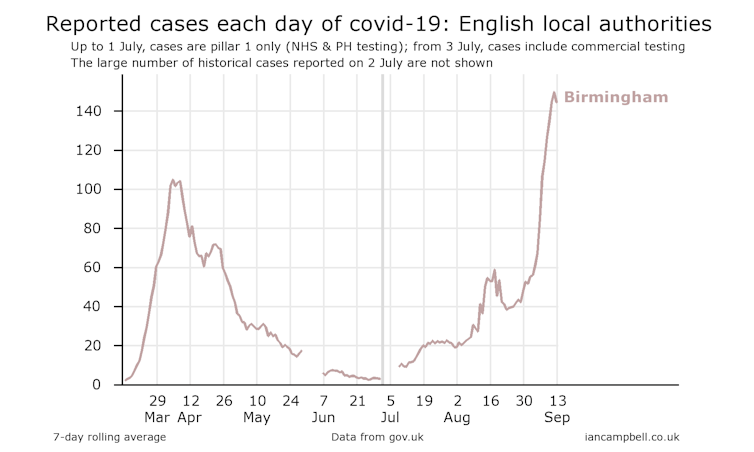
Graph showing reported cases of coronavirus in Birmingham, with recent upwards curve.
iancampbell.co.uk

Third, COVID-19 doesn’t just cause death. A substantial number of patients also suffer from what is now known as “long COVID”. It is irresponsible to discount the risk of exposing millions of people to the infection when so little is known about the long-term prognosis.

Simple instructions

Johnson’s rule of six may prove to be over-cautious, as Heneghan and Jefferson suggest. Interestingly, they included Chris Whitty, England’s chief medical officer, in the group of “little more than a Dad’s Army of highly paid individuals” who came up with the idea. However, several senior members of Sage (the government’s scientific advisory committee) have now issued stern warnings. Meanwhile, Anthony Fauci, the eminent US physician, cautioned against looking at the rosy side of things in a pandemic.

The rule of six is an attempt to halt the virus and to simplify instructions. One of its important objectives is for schools to remain open and for university students to return to campuses. That is, for life to return to some normality. It would also still allow catering venues to operate. If those senior scientists are wrong, I would be as ecstatic as anyone to see the rule binned in due course. But if we listen to Heneghan and Jefferson now, the damage may be irreversible.

KK Cheng, Professor of Public Health and Primary Care Director of the Institute of Applied Health Research, University of Birmingham

This article is republished from The Conversation under a Creative Commons license. Read the original article.


Tags: SB001
DMCA.com Protection Status

SUBSCRIBE to our NEWSLETTER

[mc4wp_form id=”2384248″]

Don't Miss

The evolution of Aesthetic Surgery through the lens of Dr Kourosh Tavakoli

by Pauline Torongo
4 December 2025
The evolution of Aesthetic Surgery through the lens of Dr. Kourosh Tavakoli
Health & Wellness

As global interest in Australian cosmetic surgery continues to grow, the combination of regulation, research and emerging digital tools is...

Read moreDetails

Ryan: Building real freedom through e-commerce

by Pauline Torongo
27 November 2025
Ryan: Building real freedom through e-commerce
Business & Finance

Ryan’s greatest achievement isn’t any single business or revenue milestone — it’s the ecosystem he’s built through the Change community.

Read moreDetails

Design Australia Group: Redefining Drafting as the engine of housing growth

by Pauline Torongo
26 November 2025
Design Australia Group: Redefining Drafting as the engine of housing growth
Business & Finance

Australia is under pressure to build homes faster, but design bottlenecks slow progress. Design Australia Group is fixing this by...

Read moreDetails

Louis Guy Detata builds Global Trading Empires through autonomous systems and disciplined leadership

by Pauline Torongo
25 November 2025
Louis Guy Detata builds Global Trading Empires through autonomous systems and disciplined leadership
Business & Finance

The path from investment banking to leading a global trading platform has taught Louis Detata that sustainable success requires more...

Read moreDetails

Burning Eucalyptus Wood: Tips, Advantages, Disadvantages & Alternatives

by Fazila Olla-Logday
20 November 2025
Image Supplied
Enviroment

Learn about burning eucalyptus wood for stoves and fireplaces. Discover benefits, drawbacks, harvesting tips, and better alternative firewood options for...

Read moreDetails

Everything Parents Need to Know About Baby Soft Play and Why It’s a Game Changer

by Fazila Olla-Logday
11 November 2025
Everything Parents Need to Know About Baby Soft Play
Health & Wellness

Baby soft play is a fun, safe, and educational way for little ones to explore and grow. Discover the benefits...

Read moreDetails

WOMAD Sets Up a New Camp in Wiltshire – Australian festival fans take note!

by Kris Griffiths
11 November 2025
Kumbia Boruka brought their reggae and dancehall flavour to the Taste the World Stage at WOMAD 2024 - Credit - Mike Massaro
Entertainment

With its 2026 edition moving to Neston Park in England, WOMAD offers Aussie music lovers a chance to reconnect with global...

Read moreDetails
Load More

Copyright © Blue Sky Publications Ltd. All Rights Reserved.
australiantimes.co.uk is a division of Blue Sky Publications Ltd. Reproduction without permission prohibited. DMCA.com Protection Status

  • About us
  • Write for Us
  • Advertise
  • Contact us
  • T&Cs, Privacy and GDPR
No Result
View All Result
  • News
    • Weather
    • Sport
    • Technology
    • Business & Finance
      • Currency Zone
    • Lotto Results
      • The Lott
  • Lifestyle
    • Entertainment
    • Horoscopes
    • Health & Wellness
    • Recipes
  • Travel
  • Expat Life
  • Move to Australia

Copyright © Blue Sky Publications Ltd. All Rights Reserved.
australiantimes.co.uk is a division of Blue Sky Publications Ltd. Reproduction without permission prohibited. DMCA.com Protection Status

No Result
View All Result
  • News
    • Weather
    • Sport
    • Technology
    • Business & Finance
      • Currency Zone
    • Lotto Results
      • The Lott
  • Lifestyle
    • Entertainment
    • Horoscopes
    • Health & Wellness
    • Recipes
  • Travel
  • Expat Life
  • Move to Australia

Copyright © Blue Sky Publications Ltd. All Rights Reserved.
australiantimes.co.uk is a division of Blue Sky Publications Ltd. Reproduction without permission prohibited. DMCA.com Protection Status