Karen Scott, University of Canterbury
The COP26 summit may come to be regarded as a failure or an important milestone, but it certainly failed to address the “other” climate change problem: ocean acidification.
With the exception of rising sea levels, climate change impacts on the oceans have been treated as a peripheral matter at global climate change negotiations. This marginalisation of the oceans largely continued at COP26.
But states, including New Zealand and Australia, nevertheless have an obligation to prevent and mitigate excess carbon dioxide (CO₂) from entering the ocean.
Almost four decades ago, 168 states signed up to the UN Convention on the Law of the Sea (UNCLOS). Under this treaty, they must address CO₂ in the oceans consistent with (but distinct from) their obligations under the climate regime.
Ocean acidification (OA) is caused by excess CO₂ in seawater. Atmospheric concentrations of CO₂ have now reached 414ppm (from about 280ppm in 1750) and the oceans are a major sink, having absorbed nearly half of all anthropogenic emissions since the beginning of the Industrial Revolution some two centuries ago.

But rising levels of CO₂ in the oceans change the acidity of seawater, measured as pH. Ocean acidity has remained remarkably stable for more than 800,000 years, but has increased by about 30% in the last 200 years.


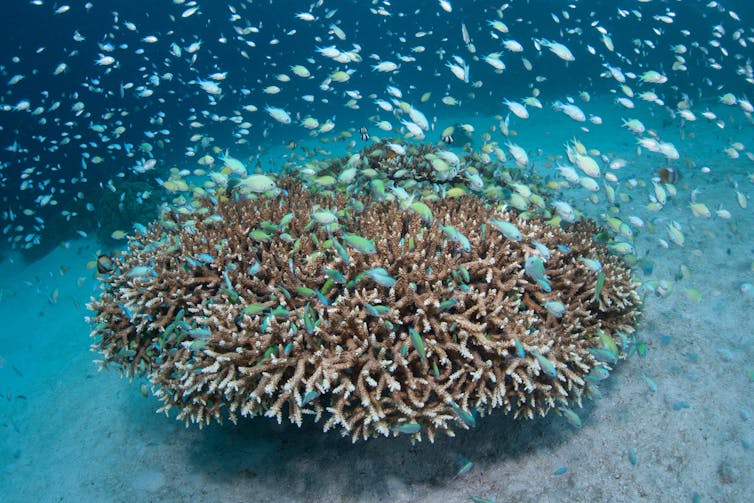
This has negative consequences for shell-forming organisms and coral reefs such as the Great Barrier Reef in Australia. Recent research suggests it may also affect the larvae of fish, including commercially important species such as yellow fin tuna.
Climate agreements and the oceans
The climate regime comprises the 1992 UN Framework Convention on Climate Change (UNFCCC), 1997 Kyoto Protocol and 2015 Paris Agreement.
It addresses CO₂ emissions, the primary cause of ocean acidification, but states have significant discretion over what action they take, and there is no explicit requirement to address CO₂ separately from other greenhouse gases.
Although the Paris Agreement sets a target of limiting average global warming to well below 2℃ above pre-industrial levels (and aims to keep it at 1.5℃), it does not set a target for limiting ocean pH change.
However, the Glasgow Climate Pact has, for the first time, explicitly set a target in respect of CO₂ emissions. It calls for a 45% cut relative to 2010 levels by 2030 and net zero by mid-century. This is a positive development in the context of addressing ocean acidification.
What the law of the sea says
Under part XII of UNCLOS, which has been accepted by all states as part of customary international law, states must take all measures necessary to “prevent, reduce and control” marine pollution from any source. States also have a general obligation to protect and preserve the marine environment.
Carbon dioxide can be classed as pollution under UNCLOS, and therefore states have an obligation to avoid or control it. UNCLOS requires states to prevent pollution from land-based sources and from the atmosphere.
Article 212 is particularly relevant to CO₂ pollution. It requires states to:
… adopt laws and regulations to prevent, reduce and control pollution of the marine environment from or through the atmosphere arising from their territory or vessels under their control.
However, this is a due diligence obligation: it relates to conduct (effort) rather than result. Article 212 does not specify what states must do to meet their obligation, but stipulates they should take into account internationally agreed rules and standards.
International standards
Apart from emissions from vessels, there is no agreement on what these internationally agreed rules and standards are.
It can be argued the climate regime constitutes these standards, and if states comply with their commitments under the Paris Agreement they have met their obligations under Article 212 of UNCLOS. Supporters of this position assert it is unreasonable to expect states to go beyond their commitments under climate agreements, particularly when UNCLOS provides no additional guidance.
On the other hand, if it can be shown that commitments under the Paris Agreement are clearly insufficient to “prevent, reduce and control” ocean acidification, it would be anachronistic to say compliance with those standards constitutes “due diligence” under UNCLOS.
I argue the latter — the due diligence obligation under Article 212 of UNCLOS is not met by compliance with climate regime commitments, except where those commitments expressly relate to ocean acidification or CO₂ reductions. This conclusion is arguably supported by the UN’s 2015 adoption of the Sustainable Development Goal 14: Life in the Oceans.
One of the goal’s targets calls for states to explicitly address ocean acidification. This recognises that commitments under the Paris Agreement do not adequately address the issue.
COP26 confirmed the climate regime is the main forum for addressing the consequences of climate change. But it is not the only game in town or the only legally relevant regime.
UNCLOS requires states to protect the oceans. These obligations must be expressly considered and incorporated into commitments made by states, including New Zealand and Australia, in international climate agreements and their actions to implement these at the domestic level.
COP27, to be held in Egypt next year, provides the next opportunity to address ocean acidification and to support a more integrated approach under both the climate change regime and the law of the seas.
Karen Scott, Professor in Law, University of Canterbury
This article is republished from The Conversation under a Creative Commons license. Read the original article.