


COP26, the recently concluded UN climate change conference in Glasgow, marked a critical turning point in global politics. From now on, the issue of climate justice will be unavoidable for rich countries.
The Glasgow Climate Pact “urges” rich countries like the US (referred to as “developed countries” in the text) to increase funding for poor countries like Bangladesh (“developing countries”) to around US$40 billion (£29.8 billion) annually by 2025, to help them adapt to mounting floods, droughts and other effects of climate change.
This is pretty strong language in UN speak and is welcome support. But the rich world has a history of failing to meet its financial promises. Only 80% of the US$100 billion promised annually by 2020 to help developing countries mitigate their emissions and adapt to climate change has been delivered.
The failure to meet the amount developing countries need to adapt to climate change means the world faces a life sentence of escalating climate impacts. Those impacts that we won’t be able to prevent or adapt to are referred to as “loss and damage” in the lingo of international climate policy and they are already beginning to bite in the most vulnerable countries. The failure of COP26 to commit to keeping warming below 1.5°C will mean more such loss and damage in future.
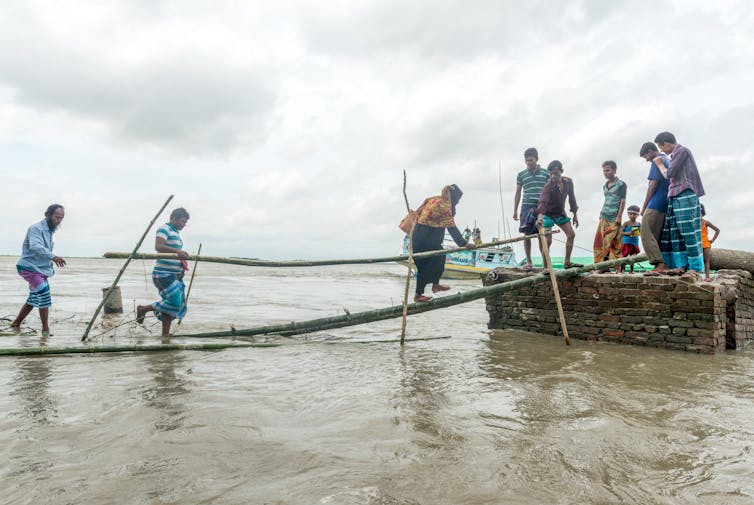
Some consider work on loss and damage to be a form of compensation for the harm rich countries have indirectly caused poor ones by disproportionately contributing to climate change with their greenhouse gas emissions. Others prefer the term “climate reparations”, and yet others talk about “solidarity funds”.
However you describe it, the fine print of the previous UN climate treaty, the 2015 Paris agreement, sought to squash any notion of developed countries being liable. But the outcome of COP26 shows that the issue of who is responsible and who should pay for the consequences of climate change can no longer be ignored. However, even the annual climate funding that has been pledged doesn’t include any money allocated for loss and damage.


Who should pay?
The idea of paying for loss and damage was introduced with the first UN climate treaty negotiations in 1991 as something owed to small island states. But over the years, other groups, including the poorest countries and others across Africa, have begun to champion the issue.
Thanks to major advances in the field of attribution science, there is growing understanding of the precise link between human-caused emissions and specific severe weather events. This relationship will intensify with every tonne of emissions, and for many of these climate-consequences, there is no turning back.
Loss and damage in Glasgow
Heading into the Glasgow summit, delegates were mindful of the growing adaptation needs of developing countries. Adapting to climate change isn’t straightforward: even the UK, for all its wealth and its relative lack of exposure, isn’t getting it right.
In the lead up to COP26, all countries were expected to update their climate action plans, known as NDCs. Recent analysis showed an increasing number were talking about loss and damage in their plans. This makes sense: as countries increasingly have to divert resources towards preparing for and responding to disasters like cyclones, or sea-level rise and melting glaciers, there will be less public financing available for them to cut their emissions and contribute to meeting the 1.5℃ goal.
More talk?
There was important progress in Glasgow. But much of this came from outside the negotiating rooms.
The negotiators working on loss and damage conducted their talks late into the night to flesh out what the Santiago Network – a new way of offering technical assistance to developing countries – should be doing to support countries in a practical way. But progress was slow and calls to set up a “Glasgow Loss and Damage Facility” which would have provided financial support for vulnerable countries went unheeded.
Agreed instead was the establishment of a “Glasgow Dialogue” to discuss funding arrangements over the coming years. This could be an important step to real, material support for vulnerable countries. But in some ways, this feels like deja vu.
COP23 in 2017 established a “Suva Expert Dialogue” – a two-day workshop which produced a technical paper – to explore information on finance for loss and damage. COP24 the following year and COP25 in 2019 pushed for the establishment of an expert group on loss and damage which was finally launched in early 2021.
Progress is incremental, but with all these dialogues it’s no wonder that young protesters decry this “blah, blah, blah” approach to climate action.
One surprise in Glasgow was the symbolic and material support for loss and damage which came from those outside the negotiating room. Scotland’s first minister, Nicola Sturgeon, promised £2 million of funding to alleviate the impacts of climate change. This was augmented by a US$3 million dollar pledge from philanthropists. Since then, a Belgian provincial climate minister has also committed €1 million.
This is a drop in the ocean. It nonetheless represents an interesting twist in terms of who is stepping up to take responsibility for the harm that climate change is already causing and looks set to cause in the future.
This story is part of The Conversation’s coverage on COP26, the Glasgow climate conference, by experts from around the world.
Amid a rising tide of climate news and stories, The Conversation is here to clear the air and make sure you get information you can trust. More.
Lisa Vanhala, Professor of Political Science, UCL
This article is republished from The Conversation under a Creative Commons license. Read the original article.







