• Advertise
  • About us
  • Terms and Conditions
  • Contact us
Saturday, December 20, 2025
Australian Times News
  • News
    • Weather
    • Sport
    • Technology
    • Business & Finance
      • Currency Zone
    • Lotto Results
      • The Lott
  • Lifestyle
    • Entertainment
    • Horoscopes
    • Health & Wellness
    • Recipes
  • Travel
  • Expat Life
  • Move to Australia
No Result
View All Result
  • News
    • Weather
    • Sport
    • Technology
    • Business & Finance
      • Currency Zone
    • Lotto Results
      • The Lott
  • Lifestyle
    • Entertainment
    • Horoscopes
    • Health & Wellness
    • Recipes
  • Travel
  • Expat Life
  • Move to Australia
No Result
View All Result
Australian Times News
No Result
View All Result
Home News

Britain’s betting on buses – but how far will boosting services reduce carbon emissions?

The national bus strategy proposes making services more appealing by giving buses priority over other traffic. Where separate bus lanes have been introduced in the UK – and especially guided busways, such as one in Cambridgeshire – the improved speed and reliability have made the services attractive to those with cars and led to higher passenger loadings.

The Conversation by The Conversation
04-04-2021 09:17
in News
Photo by David Bayliss on Unsplash

Photo by David Bayliss on Unsplash

Enrica Papa, University of Westminster and Peter White, University of Westminster

A move to “make buses the transport of choice, reducing the number of car journeys and improving quality of life for millions” has been launched as part of a national bus strategy in the UK. It seeks to make bus services more reliable and affordable to get people out of the cars that still dominate transport in the country.

But to what degree can such changes convince people to ditch their cars and rely on a sector that in many parts of the country has been neglected for years? Can boosting bus services reduce carbon emissions and help the UK achieve its environmental goals?

It’s difficult to convince drivers to choose public transport, as studies have shown. Increasing the reliability and frequency of bus services might attract people who rarely travel by bus, but it’s not always enough.

The national bus strategy proposes making services more appealing by giving buses priority over other traffic. Where separate bus lanes have been introduced in the UK – and especially guided busways, such as one in Cambridgeshire – the improved speed and reliability have made the services attractive to those with cars and led to higher passenger loadings. In the Cambridgeshire Busway case, about 25% of drivers left their cars and chose the bus along with 13% of car-share passengers, saving about 550,000 litres of fuel in a year.
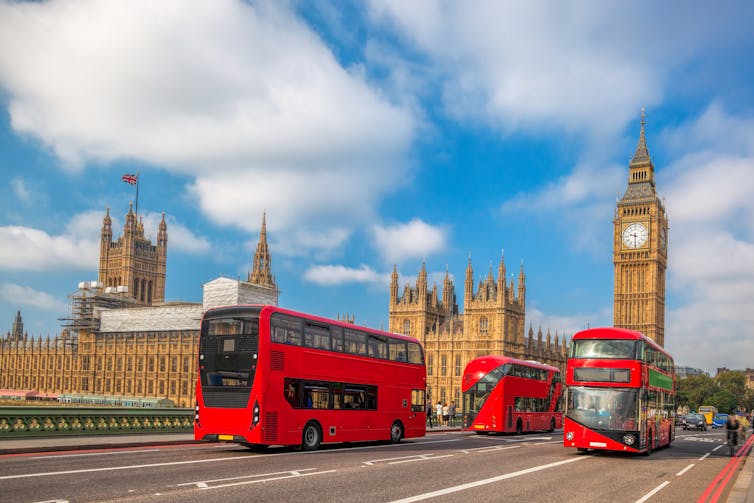
Three red buses drive on Westminster Bridge in London.
Bus ridership is much higher in London than elsewhere thanks to high service frequencies. Samot/Shutterstock

Redesigning road networks to give buses more priority also reduces their operating costs, which mostly derive from the time buses are running, rather than total distance travelled. The savings that providers and public authorities make can be reinvested to improve services further or passed onto passengers through lower fares, making services even more appealing and increasing loadings in a virtuous circle.

But while buses are more fuel efficient than cars, exactly how much more depends on several factors. In London, where high-frequency services mean people don’t have to rely on timetables, passenger loadings are higher on average than elsewhere, producing lower emissions and using less energy for each kilometre travelled per passenger than cars. In places where maximising ridership is not the main goal, but ensuring everyone has fair access to a bus route is, as in many rural areas, the emission savings of buses versus cars are less impressive.


AlsoRead...

How Turnkey Building Group Is Restoring Trust In An Industry Known For Customer Disappointment

How Turnkey Building Group Is Restoring Trust In An Industry Known For Customer Disappointment

17 December 2025
Ryan: Building real freedom through e-commerce

Ryan: Building real freedom through e-commerce

27 November 2025

U-turn on competition

The most striking aspect of the strategy is its proposed reform of how services are planned and delivered, which marks a sharp departure from the pro-competition policies the Conservatives have espoused since deregulating bus services in 1985. The shifting consensus is evident in Greater Manchester too, where the mayor, Andy Burnham, recently announced a new London-style franchise system to run the region’s buses by 2023.

At present, most services in Britain are planned and run by operators on a commercial basis, with local authorities filling gaps in the network through competitive tendering to private operators. The new strategy would see authorities coordinate services and fares with operators in “enhanced partnerships”, or contract them to run a planned network using a franchise model, as happens in London.

London has a very high level of bus use – 247 trips per head in 2018-19 compared with an average of 75 in the six English metropolitan areas. Car ownership per head in London has not risen since the early 1990s and the share of car travel has fallen substantially, in marked contrast to trends elsewhere in Britain.

Together with a shift to zero-carbon buses, running a national effort to reduce unnecessary competition between bus operators could repeat London’s successes and make services more efficient and attractive – all helpful for lowering emissions.


But the new strategy will have to overcome several challenges.

First, to continue receiving funds, local authorities will have to follow a franchising or partnership model, but on a very tight timescale. Managing this U-turn in Conservative policy may be particularly difficult for councils after years of cutbacks.

Local government will need more support to cover the difference between operating costs and passenger revenue in many areas, as well as investment in infrastructure and new vehicles. The government has promised £3 billion overall, but the overall timescale is unclear.

The second challenge regards the pandemic-induced slump the bus sector finds itself in. A year ago, Boris Johnson warned people to avoid bus travel to control the spread of COVID-19, and bus ridership is now running at about 40% of pre-pandemic levels. Recreating a positive and safe vision of bus travel will be necessary to make services more efficient.

The strategy prioritises rescuing the bus sector, which can be reshaped quicker – and cheaper – than rail could. But the bus sector’s recovery must be embedded in a longer-term vision that sees all transport modes working together to decarbonise the sector.

Enrica Papa, Reader in Transport Planning, University of Westminster and Peter White, Emeritus Professor of Public Transport Systems, University of Westminster

This article is republished from The Conversation under a Creative Commons license. Read the original article.


Tags: SB001
DMCA.com Protection Status

SUBSCRIBE to our NEWSLETTER

[mc4wp_form id=”2384248″]

Don't Miss

How Turnkey Building Group Is Restoring Trust In An Industry Known For Customer Disappointment

by Fazila Olla-Logday
17 December 2025
How Turnkey Building Group Is Restoring Trust In An Industry Known For Customer Disappointment
Business & Finance

Turnkey Building Group is changing the narrative in an industry often associated with missed deadlines and broken promises. By prioritizing...

Read moreDetails

Risk Awareness for International Travellers – What Australians Should Know Before Entering Multi-State Regions

by Fazila Olla-Logday
10 December 2025
Schengen
Travel

This guide helps Australian travellers understand cross-border requirements, assess political and environmental risks, manage health and safety considerations, and prepare...

Read moreDetails

The evolution of Aesthetic Surgery through the lens of Dr Kourosh Tavakoli

by Pauline Torongo
4 December 2025
The evolution of Aesthetic Surgery through the lens of Dr. Kourosh Tavakoli
Health & Wellness

As global interest in Australian cosmetic surgery continues to grow, the combination of regulation, research and emerging digital tools is...

Read moreDetails

Ryan: Building real freedom through e-commerce

by Pauline Torongo
27 November 2025
Ryan: Building real freedom through e-commerce
Business & Finance

Ryan’s greatest achievement isn’t any single business or revenue milestone — it’s the ecosystem he’s built through the Change community.

Read moreDetails

Design Australia Group: Redefining Drafting as the engine of housing growth

by Pauline Torongo
26 November 2025
Design Australia Group: Redefining Drafting as the engine of housing growth
Business & Finance

Australia is under pressure to build homes faster, but design bottlenecks slow progress. Design Australia Group is fixing this by...

Read moreDetails

Louis Guy Detata builds Global Trading Empires through autonomous systems and disciplined leadership

by Pauline Torongo
25 November 2025
Louis Guy Detata builds Global Trading Empires through autonomous systems and disciplined leadership
Business & Finance

The path from investment banking to leading a global trading platform has taught Louis Detata that sustainable success requires more...

Read moreDetails

Burning Eucalyptus Wood: Tips, Advantages, Disadvantages & Alternatives

by Fazila Olla-Logday
20 November 2025
Image Supplied
Enviroment

Learn about burning eucalyptus wood for stoves and fireplaces. Discover benefits, drawbacks, harvesting tips, and better alternative firewood options for...

Read moreDetails
Load More

Copyright © Blue Sky Publications Ltd. All Rights Reserved.
australiantimes.co.uk is a division of Blue Sky Publications Ltd. Reproduction without permission prohibited. DMCA.com Protection Status

  • About us
  • Write for Us
  • Advertise
  • Contact us
  • T&Cs, Privacy and GDPR
No Result
View All Result
  • News
    • Weather
    • Sport
    • Technology
    • Business & Finance
      • Currency Zone
    • Lotto Results
      • The Lott
  • Lifestyle
    • Entertainment
    • Horoscopes
    • Health & Wellness
    • Recipes
  • Travel
  • Expat Life
  • Move to Australia

Copyright © Blue Sky Publications Ltd. All Rights Reserved.
australiantimes.co.uk is a division of Blue Sky Publications Ltd. Reproduction without permission prohibited. DMCA.com Protection Status

No Result
View All Result
  • News
    • Weather
    • Sport
    • Technology
    • Business & Finance
      • Currency Zone
    • Lotto Results
      • The Lott
  • Lifestyle
    • Entertainment
    • Horoscopes
    • Health & Wellness
    • Recipes
  • Travel
  • Expat Life
  • Move to Australia

Copyright © Blue Sky Publications Ltd. All Rights Reserved.
australiantimes.co.uk is a division of Blue Sky Publications Ltd. Reproduction without permission prohibited. DMCA.com Protection Status