• Advertise
  • About us
  • Terms and Conditions
  • Contact us
Saturday, December 6, 2025
Australian Times News
  • News
    • Weather
    • Sport
    • Technology
    • Business & Finance
      • Currency Zone
    • Lotto Results
      • The Lott
  • Lifestyle
    • Entertainment
    • Horoscopes
    • Health & Wellness
    • Recipes
  • Travel
  • Expat Life
  • Move to Australia
No Result
View All Result
  • News
    • Weather
    • Sport
    • Technology
    • Business & Finance
      • Currency Zone
    • Lotto Results
      • The Lott
  • Lifestyle
    • Entertainment
    • Horoscopes
    • Health & Wellness
    • Recipes
  • Travel
  • Expat Life
  • Move to Australia
No Result
View All Result
Australian Times News
No Result
View All Result
Home News

Ban on toxic mercury looms in sugar cane farming, but Australia still has a way to go

Mercury is a toxic element that damages human health and the environment, even in low concentrations.

The Conversation by The Conversation
22-06-2020 21:31
in News
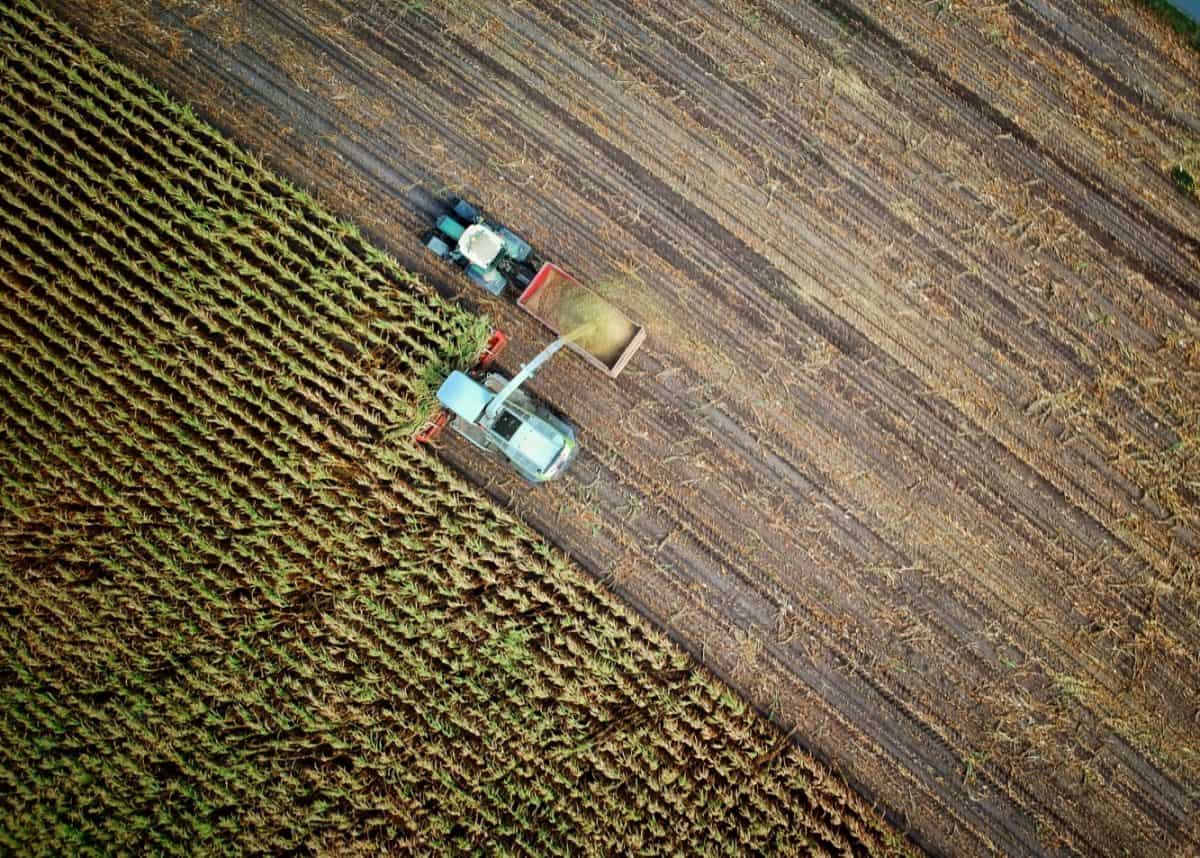
Ban on toxic mercury looms in sugar cane farming

Ban on toxic mercury looms in sugar cane farming Photo by no one cares on Unsplash

Larissa Schneider, Australian National University; Cameron Holley, UNSW; Darren Sinclair, University of Canberra, and Simon Haberle, Australian National University

This month, federal authorities finally announced an upcoming ban on mercury-containing pesticide in Australia. We are one of the last countries in the world to do so, despite overwhelming evidence over more than 60 years that mercury use as fungicide in agriculture is dangerous.
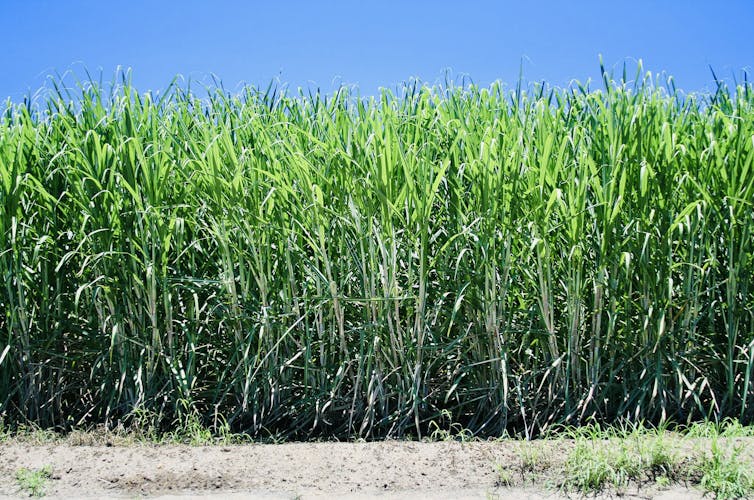
Phil / CC BY (https://creativecommons.org/licenses/by/2.0)

Mercury is a toxic element that damages human health and the environment, even in low concentrations. In humans, mercury exposure is associated with problems such as kidney damage, neurological impairment and delayed cognitive development in children.

The ban will prevent about 5,280 kilograms of mercury entering the Australian environment each year.

But Australia is yet to ratify an international treaty to reduce mercury emissions from other sources, such as the dental industry and coal-fired power stations. This is our next challenge.
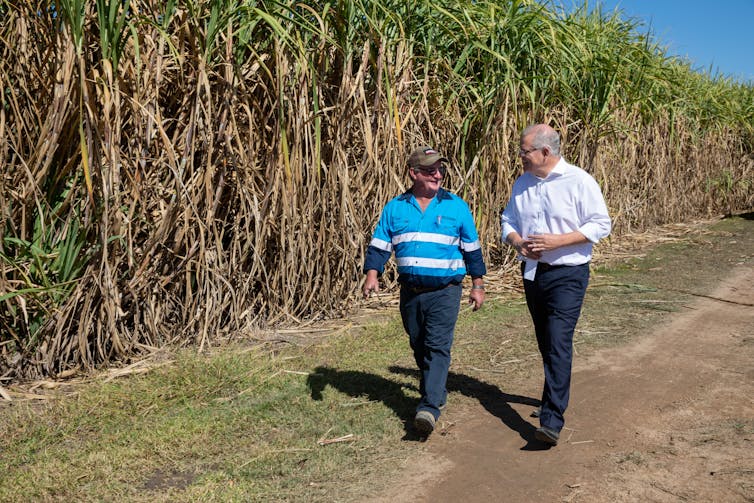
Prime Minister Scott Morrison visiting a sugar cane farm in 2019. Mercury-containing pesticides will be banned. Cameron Laird/AAP

A mercury disaster

Mercury became a popular pesticide ingredient for agriculture in the early 1900s, and a number of poisoning events ensued throughout the world.

They include the Iraq grain disaster in 1971-72, when grain seed treated with mercury was imported from Mexico and the United States. The seed was not meant for human consumption, but rural communities used it to make bread, and 459 people died.


AlsoRead...

Ryan: Building real freedom through e-commerce

Ryan: Building real freedom through e-commerce

27 November 2025
Design Australia Group: Redefining Drafting as the engine of housing growth

Design Australia Group: Redefining Drafting as the engine of housing growth

26 November 2025

In the decades since, most countries have banned the production and/or use of mercury-based pesticides on crops. In 1995 Australia discontinued their use in most applications, such as turf farming.
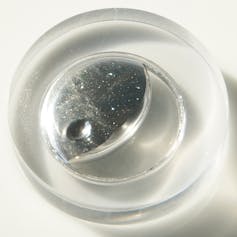
Emissions of the element mercury are a threat to human health and the environment. Wikimedia

Despite this, authorities exempted a fungicide containing mercury known as Shirtan. They restricted its use to sugar cane farming in Queensland, New South Wales, Western Australia and the Northern Territory.

According to the sugar cane industry, about 80% of growers use Shirtan to treat pineapple sett rot disease.

But this month, the Australian Pesticides and Veterinary Medicines Authority cancelled the approval of the mercury-containing active ingredient in Shirtan, methoxyethylmercuric chloride. The decision was made at the request of the ingredient’s manufacturer, Alpha Chemicals.

Shirtan’s registration was cancelled last week. It will no longer be produced in Australia, but existing supplies can be sold to, and used by, sugar cane farmers for the next year until it is fully banned.

Workers and nature at risk

Over the past 25 years, Australia’s continued use of Shirtan allowed about 50,000 kilograms of mercury into the environment. The effect on river and reef ecosystems is largely unknown.

What is known is that mercury can be toxic even at very low concentrations, and research is needed to understand its ecological impacts.

The use of mercury-based pesticide has also created a high risk of exposure for sugar cane workers. At most risk are those not familiar with safety procedures for handling toxic materials, and who may have been poorly supervised. This risk has been exacerbated by the use itinerant workers, particularly those from a non-English speaking background.
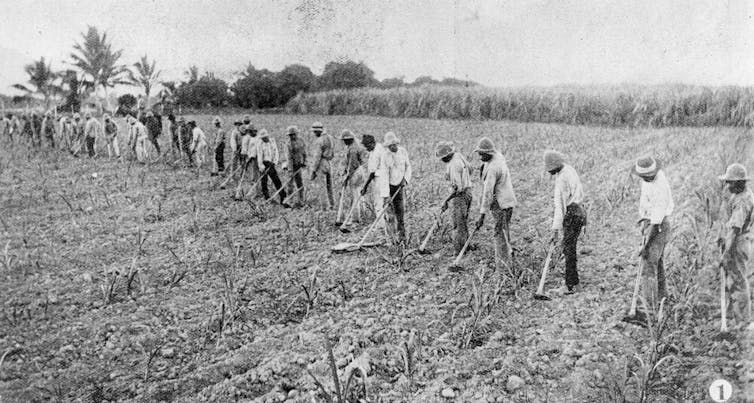
South Sea Islanders hoeing a cane field in Queensland, 1902. Cane workers have long been exposed to mercury. State Library of Queensland

Further, in the hot and humid conditions of Northern Australia, it has been reported that workers may have removed protective gloves to avoid sweating. Again, research is needed to determine the implication of these practices for human health.

To this end, Mercury Australia, a multi-disciplinary network of researchers, has formed to address the environmental, health and other issues surrounding mercury use, both contemporary and historical.

Australia is yet to ratify

The Minamata Convention on Mercury is a global treaty to control mercury use and release into the environment. Australia signed onto the convention in 2013 but is yet to ratify it.

Until the treaty is ratified, Australia is not legally bound to its obligations. It also places us at odds with more than 100 countries that have ratified it, including many of Australia’s developed-nation counterparts.

Australia’s outlier status in this area is shown in the below table:
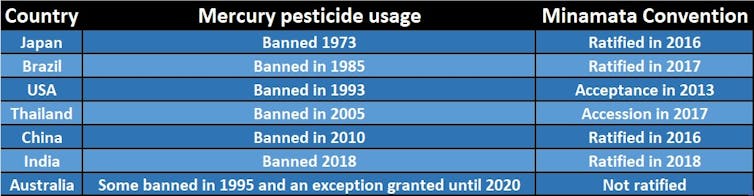
Accession, acceptance or ratification have the same legal effect, where parties follow legal obligations under international law.

Mercury-based pesticide use was one of Australia’s largest sources of mercury emissions. But if Australia ratifies the convention, it would be required to control other sources of mercury emissions, such as dental amalgam and the burning of coal in power stations.

The three active power stations in the Latrobe Valley, for example, together emit about 1,200 kilograms of mercury each year.
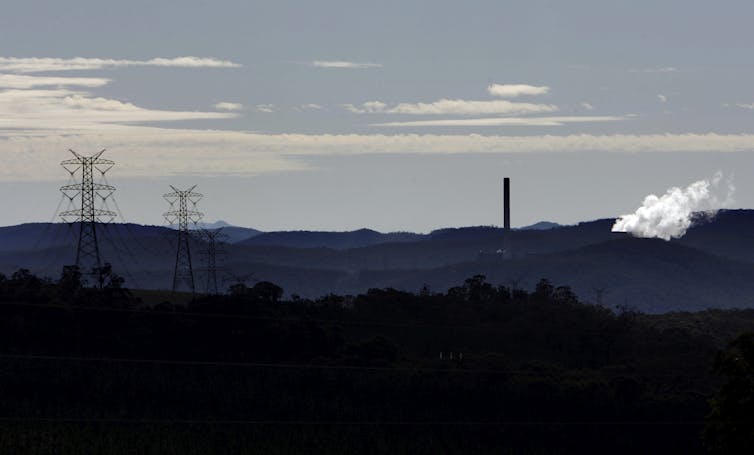
The coal-burning Mount Piper Power station near Lithgow in NSW. Government efforts to reduce mercury emissions should focus on coal plants. David Gray/Reuters

Time to look at coal

If Australia ratified the Minamata Convention, it would provide impetus for a timely review and, if necessary, update of mercury regulations across Australia.

Emissions from coal-fired power stations in Australia are regulated by the states through pollution control licences. Some states would likely have to amend these licences if Australia ratified the convention. For example, Victorian licences for coal-fired power stations currently do not include limits on mercury emissions.

Pollution control technologies were introduced at Australian coal plants in the early 1990s. But they do not match state-of-the-art technologies applied to coal plants in North America and Europe.

Australian environment authorities have been examining the implications of ratifying the convention. But progress is slow.

The issue of mercury emissions does not attract significant public or political attention. But there is a global scientific consensus that coordinated international action is needed.

The pesticide phase-out and ban is an important step. But Australia still has a way to go.

Larissa Schneider, DECRA fellow, Australian National University; Cameron Holley, Professor, UNSW; Darren Sinclair, Professor, University of Canberra, and Simon Haberle, Professor, Australian National University

This article is republished from The Conversation under a Creative Commons license. Read the original article.


Tags: SB001
DMCA.com Protection Status

SUBSCRIBE to our NEWSLETTER

[mc4wp_form id=”2384248″]

Don't Miss

The evolution of Aesthetic Surgery through the lens of Dr Kourosh Tavakoli

by Pauline Torongo
4 December 2025
The evolution of Aesthetic Surgery through the lens of Dr. Kourosh Tavakoli
Health & Wellness

As global interest in Australian cosmetic surgery continues to grow, the combination of regulation, research and emerging digital tools is...

Read moreDetails

Ryan: Building real freedom through e-commerce

by Pauline Torongo
27 November 2025
Ryan: Building real freedom through e-commerce
Business & Finance

Ryan’s greatest achievement isn’t any single business or revenue milestone — it’s the ecosystem he’s built through the Change community.

Read moreDetails

Design Australia Group: Redefining Drafting as the engine of housing growth

by Pauline Torongo
26 November 2025
Design Australia Group: Redefining Drafting as the engine of housing growth
Business & Finance

Australia is under pressure to build homes faster, but design bottlenecks slow progress. Design Australia Group is fixing this by...

Read moreDetails

Louis Guy Detata builds Global Trading Empires through autonomous systems and disciplined leadership

by Pauline Torongo
25 November 2025
Louis Guy Detata builds Global Trading Empires through autonomous systems and disciplined leadership
Business & Finance

The path from investment banking to leading a global trading platform has taught Louis Detata that sustainable success requires more...

Read moreDetails

Burning Eucalyptus Wood: Tips, Advantages, Disadvantages & Alternatives

by Fazila Olla-Logday
20 November 2025
Image Supplied
Enviroment

Learn about burning eucalyptus wood for stoves and fireplaces. Discover benefits, drawbacks, harvesting tips, and better alternative firewood options for...

Read moreDetails

Everything Parents Need to Know About Baby Soft Play and Why It’s a Game Changer

by Fazila Olla-Logday
11 November 2025
Everything Parents Need to Know About Baby Soft Play
Health & Wellness

Baby soft play is a fun, safe, and educational way for little ones to explore and grow. Discover the benefits...

Read moreDetails

WOMAD Sets Up a New Camp in Wiltshire – Australian festival fans take note!

by Kris Griffiths
11 November 2025
Kumbia Boruka brought their reggae and dancehall flavour to the Taste the World Stage at WOMAD 2024 - Credit - Mike Massaro
Entertainment

With its 2026 edition moving to Neston Park in England, WOMAD offers Aussie music lovers a chance to reconnect with global...

Read moreDetails
Load More

Copyright © Blue Sky Publications Ltd. All Rights Reserved.
australiantimes.co.uk is a division of Blue Sky Publications Ltd. Reproduction without permission prohibited. DMCA.com Protection Status

  • About us
  • Write for Us
  • Advertise
  • Contact us
  • T&Cs, Privacy and GDPR
No Result
View All Result
  • News
    • Weather
    • Sport
    • Technology
    • Business & Finance
      • Currency Zone
    • Lotto Results
      • The Lott
  • Lifestyle
    • Entertainment
    • Horoscopes
    • Health & Wellness
    • Recipes
  • Travel
  • Expat Life
  • Move to Australia

Copyright © Blue Sky Publications Ltd. All Rights Reserved.
australiantimes.co.uk is a division of Blue Sky Publications Ltd. Reproduction without permission prohibited. DMCA.com Protection Status

No Result
View All Result
  • News
    • Weather
    • Sport
    • Technology
    • Business & Finance
      • Currency Zone
    • Lotto Results
      • The Lott
  • Lifestyle
    • Entertainment
    • Horoscopes
    • Health & Wellness
    • Recipes
  • Travel
  • Expat Life
  • Move to Australia

Copyright © Blue Sky Publications Ltd. All Rights Reserved.
australiantimes.co.uk is a division of Blue Sky Publications Ltd. Reproduction without permission prohibited. DMCA.com Protection Status