


By Chris Clarkson, The University of Queensland; Ben Marwick, University of Washington; Lynley Wallis, University of Notre Dame Australia; Richard Fullagar, University of Wollongong, and Zenobia Jacobs, University of Wollongong
___________________________
The question of when people first arrived in Australia has been the subject of lively debate among archaeologists, and one with important consequences for the global story of human evolution. Australia is the end point of early modern human migration out of Africa, and sets the minimum age for the global dispersal of humans.
This event was remarkable on many fronts, as it represented the largest maritime migration yet undertaken, the settlement of the driest continent on Earth, and required adaptation to vastly different flora and fauna.
Although it is well known that anatomically modern humans were in Africa before 200,000 years ago and China around 80,000 years ago, many archaeologists believe that Australia was not occupied until 47,000 years ago.
But our research, published today in Nature, pushes back the timing of this event to at least 65,000 years ago.
A difficult age
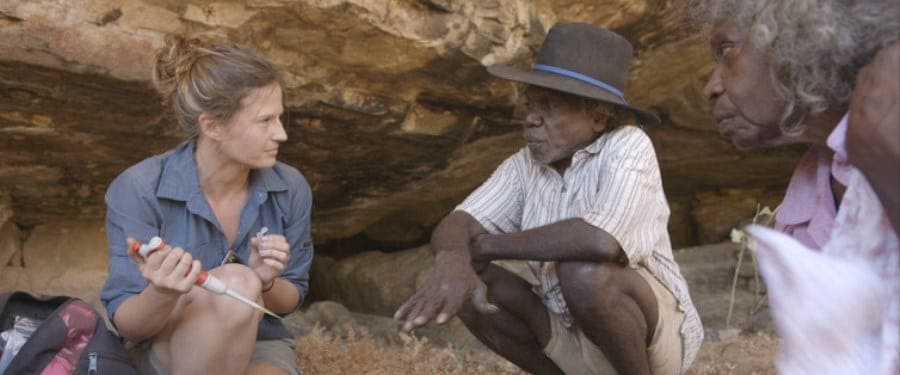
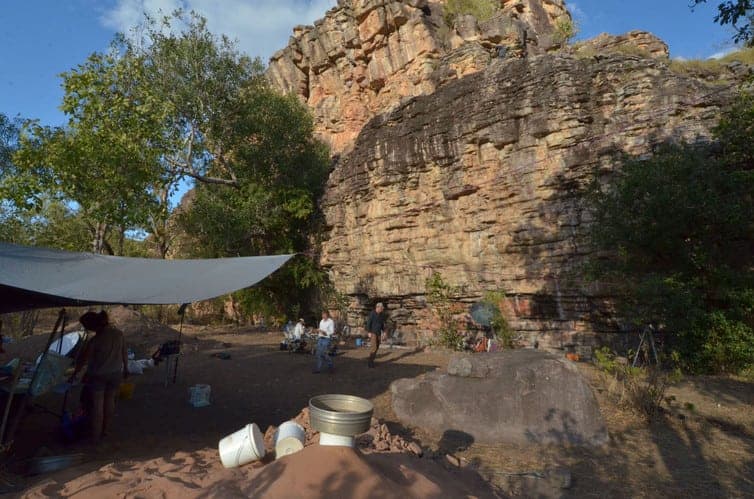
Together with the Mirrar Aboriginal people, our team excavated the Madjedbebe rockshelter in Kakadu, near Jabiru in Australia’s Northern Territory. A small excavation in 1989 at this site had proposed evidence for human activity in Australia at 60,000-50,000 years ago.
But some archaeologists have been reluctant to accept this age. Some pointed to the sandy deposit at the site and argued that the artefacts may have been easily moved down into older layers by trampling or burrowing animals.


Others said the measured ages for the archaeological sediments were not precise enough to support a date of 50,000 years, rather than 45,000 years ago.
Since those excavations in the 1980s, the debate has intensified. Analysis of DNA from the hair of an Aboriginal man who lived 100 years ago suggests that Aboriginal Australians separated from early Asian populations some times between 62,000 and 75,000 years ago.
On the other hand, climate records have implicated humans in megafaunal population collapse at 45,000 to 43,100 years ago, a time frame that had been presumed to correlate with humans’ arrival in Australia.
To make new research possible, a landmark agreement was reached between the University of Queensland (and associated researchers) and the Gundjeihmi Aboriginal Corporation representing the Mirarr traditional owners of the site.
The agreement gave ultimate control over the excavation to the Mirarr senior custodians, with oversight of the excavation and curation of the material. The Mirarr were interested to support new research into the age of the site and to know more about the early evidence of technologies thought to be present there.
New digs, new dates
In 2012 and 2015 our team excavated an area of 20 square metres at Madjedbebe. We found artefacts in three distinct layers of occupation.
Among the artefacts in the lowest levels we found many pieces used for seed grinding and ochre “crayons” that were used to make pigments. Our large excavation area allowed us to pick up very rare items, such as the world’s oldest known edge-ground hatchets and world’s oldest known use of reflective pigment.
During the excavations we recorded the three-dimensional coordinates of more than 10,000 stone artefacts using a laser total station. This device sits on a tripod and uses a laser and prism to record the location of artefacts and other features at millimetre accuracy, thus giving a very precise record of artefact position and layering.
We analysed these coordinates to test previous criticisms that artefacts may have moved a lot in the sand. We found some broken artefacts that we could fit back together, and by measuring the distance between these pieces we can understand how far artefacts have moved.
We also conducted an experiment to observe the movement of artefacts on the ground when people walked over them. These results allow us to respond to the earlier critics with data that point to a relatively small amount of movement, not enough to mix artefacts between the three distinct layers of occupation that we found in our excavations.
During the excavation we collected many kinds of samples for specialised analyses, including more than 100 samples for dating. We used both radiocarbon dating and Optically Stimulated Luminescence (OSL) methods to find the ages of the artefacts. Because radiocarbon dating is limited to samples younger than 50,000 years ago, we relied on OSL to help us find the ages of the lower part of the site.
OSL methods estimate the time elapsed since sand grains were last exposed to sunlight. Australian archaeologists have been wary of OSL methods because often in the past OSL involved sand grains measured together in a little group, resulting in ages that were not very accurate.
To get more precise ages, we measured thousands of sand grains individually, rather than in a group. We also had another lab analyse some samples to make sure our results were reliable. The result is that we have a convincing age for the settlement of Madjedbebe, and Australia, of 65,000 years ago.
The global story of human evolution
These new dates throw light on a few puzzles in the overall picture of human evolution.
Our ages suggest that modern humans and Homo floresiensis in eastern Indonesia may have co-existed for 15,000 years. This means that the arrival of modern humans did not necessarily cause other ancient human-like species to become extinct.
If it’s the case that people have lived in Australia since 65,000 years ago, it may also be true that humans and megafauna co-existed for 20,000 years before megafauna went extinct across the continent.
Until now we knew very little about the technology and lifestyles of the first Aboriginal people. The oldest artefacts from Madjedbebe help to tell this story. They indicate that the earliest Aboriginal inhabitants of Australia were innovative people who – like humans everywhere on earth – developed solutions to new problems and engaged in symbolic and artistic expression.
We found evidence for the mixing of ochre with reflective powders made from ground mica to make a vibrant paint. Currently the oldest known rock art in the world is dated to 40,000 years ago in Sulawesi (a possible stepping stone to Australia). But the abundant ground ochre and use of mica indicates that artistic expression took place in the region much earlier.
We also found new forms of stone tools such as edge ground hatchet heads (and even the grinding stones used to sharpen them), useful in cutting bark and wood, shaping wooden tools and extracting difficult to obtain foods from trees.
The grinding stones from the site indicate a range of fruits, seeds, animals and other plants were ground up for food. These are the oldest known examples of seed grinding stones found in Australia, if not the world.
In ancient fireplaces from the site we also recovered pieces of burnt pandanus nuts, fruit seeds and yams, which give us clues as to the earliest plant foods consumed at the site. Some of these foods continue to be eaten today by Mirarr and other Aboriginal people in the Top End.
Our new ages suggest that Australia was settled well before modern humans entered Europe about 45,000 years ago. This means that the earliest art and symbolism in Europe is of limited relevance to understanding modern technology and symbolic expression in South and Southeast Asia and Oceania.
 Our results help to show the unique place of the Eastern hemisphere, and Australia in particular, in understanding how and where modern humans appeared.
______________________________
By Chris Clarkson, Associate Professor in Archaeology, The University of Queensland; Ben Marwick, Associate Professor of Archaeology, University of Washington; Lynley Wallis, Senior research fellow, University of Notre Dame Australia; Richard Fullagar, Professorial Research Fellow, University of Wollongong, and Zenobia Jacobs, Professor, University of Wollongong
This article was originally published on The Conversation. Read the original article.
TOP IMAGE: Scientists Dr Elspeth Hayes (left) with Mark Djandjomerr (centre) and May Nango (right) at the dig site. (Dominic O Brien/Gundjeihmi Aboriginal Corporation, Author provided)







