



Monika Schmid, University of Essex; Amanda Cole, University of Essex, and Ella Jeffries, University of Essex
“It is impossible for an Englishman to open his mouth without making some other Englishman despise him,” George Bernard Shaw wrote in the preface to Pygmalion in 1913. Recent headlines suggest that accent prejudice (or “accentism”) is no relic of the past but continues to blight the university experience of many students. Even at northern universities, students from the north of England face commentary and ridicule for their accents.

There is a hierarchy of accents in Britain which has changed little over the years. The accents of Britain’s highest classes are seen as neutral, “accentless” and correct, while others are seen as divergent or inferior and are often stigmatised. As such, those who have “non-standard” accents are seen as legitimate and admissible targets for comment and judgement. They are also saddled with an apparent responsibility to change how they sound.
The higher-class standard accent – “received pronunciation” – is consistently rated the highest on scales such as prestige and perceived intelligence. Such judgments continually reproduce and reaffirm social inequalities.
The association between the ability to speak in a certain way and being intelligent is especially relevant in the university context, where this particular trait is most valued. Being able to sound intelligent in a classroom translates directly into gaining recognition and respect amongst peers and teachers. The repercussions of accentism in the job market are a further consequence for students.
Stereotyping
Five years ago, then employment minister Esther McVey made a plea for employers to look beyond an applicant’s accent. This is all very well, but with MPs themselves being shamelessly mocked for their accents (including the deputy opposition leader Angela Rayner), it is difficult to reconcile the best wishes of policymakers with the realities of our prejudices. While it is illegal under UK law to discriminate against a person based on protected characteristics such as gender, race, religion or disability, accent is not recognised in this list.
Addressing these prejudices may be an uphill battle. We start to become aware of accent distinctions from a very early age, with children as young as five months demonstrating a preference for a familiar accent over an unfamiliar one. Children from three years old have shown the ability to group speakers according to regional accent distinctions.



This process of categorisation lays the building blocks for the social judgements. Once group membership is perceived based on accent, it is no longer solely a mark of regional origin but linked with broader stereotypes. Accents thus become associated with being lazy, incorrect, effeminate, friendly, standoffish and so on – and these character traits are then ascribed to anyone who speaks in that way.
Such judgements have nothing to do with linguistic characteristics – no English dialect is inherently better, more beautiful or more correct – but represent a form of classism. As such, accentism often reflects camouflaged prejudices. When we judge someone’s characteristics based on their accent, we are not judging them on their own merit but making assumptions about their social class, education and ethnicity because of how they speak. Needless to say, these assumptions are often false.
The Cockney diaspora
A recent Guardian investigation rightly called out accentism faced by students from the north of England at elite universities across the country. Discrimination against northern accents is a frequent topic in the news, but in research, accentism cannot be reduced to “south good, north bad”. In fact, research has consistently shown that some of the most stigmatised accents in Britain are, in fact, spoken in south-east England – particularly in Essex.
This is a fairly recent development, brought about by large-scale relocation of working-class Cockney speakers to the outskirts of London, the home counties and Essex in the so-called “Cockney diaspora” since the turn of the 20th century. In the 1980s these communities in Essex, which had predominantly been working class, began to be transformed through more widespread educational attainment, employment and home ownership. This lead to an association of the Essex accent with upstarts and the nouveau riche.
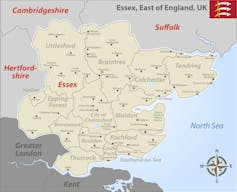
The derisive tropes of the gaudy, flashy and materialistic “Essex man” and “Essex girl” and their often mocked and mimicked accents reflect middle-class gatekeeping towards social status. For those from Essex, their home, accent and background have become at best a humorous anecdote and at worst, a burden. Indeed, based solely on accent, young people (18-33) in south-east England consistently evaluate east London and southern Essex speakers more negatively and consider them less intelligent.
University is a place and a time where people come together from all over the country and all over the world. This can have very interesting effects on students’ accents as they might naturally start to change the way that they speak due to their new surroundings. This is a completely normal process known as accommodation. It is not the same thing as the enforced undermining of credibility and intelligence through the mockery and stereotyping of someone’s regional accent.
There are many interesting things to learn about how someone from another part of the country has a different way of pronouncing a word or uses a different word for the same thing. For instance, have you ever seen how many different words there are for a bread roll? We need to counteract our biases by understanding and celebrating such diversity, instead of mocking those who don’t conform to an ideological standard rooted in discrimination from the outset.
Monika Schmid, Professor of Linguistics, University of Essex; Amanda Cole, Postdoctoral Research Fellow (Institute for Analytics and Data Science) Department of Language and Linguistics, University of Essex, and Ella Jeffries, Lecturer in linguistics, University of Essex
This article is republished from The Conversation under a Creative Commons license. Read the original article.







