



Allan Saul, Burnet Institute; Margaret Hellard, Burnet Institute; Michael Toole, Burnet Institute; Nick Scott, Burnet Institute, and Romesh Abeysuriya, Burnet Institute
Residents in Sydney, the NSW Central Coast, Blue Mountains and Wollongong today received confirmation their lockdown would be extended to at least 30 July.
But our modelling suggests it may take until the end of the year to get case numbers close to zero, unless more stringent measures are introduced.
NSW health authorities increased restrictions on Friday. These limit outdoor gatherings to two people, exercise to within 10km from your home, and shopping to one person from a household each day, with no browsing.
These restrictions are similar to Victoria’s Stage 3 and came on top of existing rules, which began on June 23, to only leave your home for four reasons: work/education, care/compassion, shopping for essential supplies, and exercise.
But additional measures – at least as strong as in Melbourne’s Stage 4 – are needed to get the greater Sydney outbreak under control.
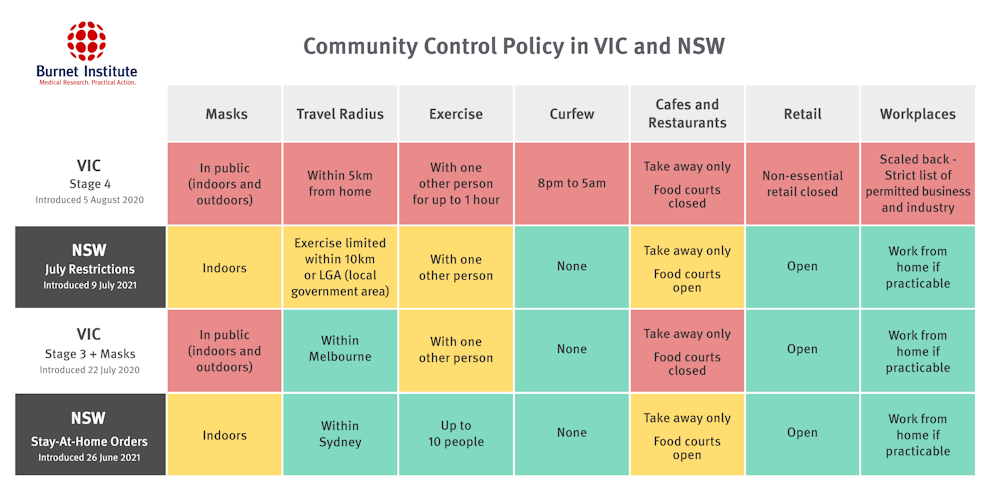
For Melbourne’s second wave, this included closing non-essential retail, restricting movements to 5km from home and within the hours of 8pm to 5am, and mask-wearing outdoors.


COVID case numbers will fall if Victorian Stage 4 measures are applied in greater Sydney, for at least a month.
Our predictions
Our modelling shows that without the initial stay-at-home orders, the results would have been catastrophic (red line).
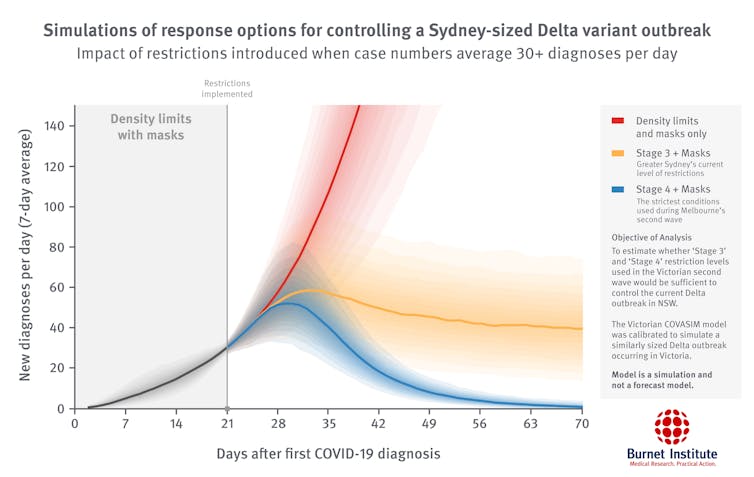
NSW’s updated level of restrictions (orange line, similar to Victoria’s Stage 3 + masks) would prevent daily case numbers from increasing further. But it’s not enough to eliminate community transmission before the end of the year.
But if Stage 4 restrictions were applied now (blue line), the epidemic curve would decline sharply.
It’s difficult to estimate the time to return case numbers from current levels to a seven-day average of less than five per day, but it’s likely to take at least a month.
So how did we reach these conclusions? We use two complementary modelling approaches to generate information about the measures needed to get case numbers under control.
Simulating people’s decisions
The first model, COVASIM, simulates individual people who reflect the diversity of the population. Individuals are allocated different numbers of daily contacts and can participate in various activities (for example going to school, work, bars/cafes, shopping, playing sport), which affect their risk of transmission.
People respond differently to COVID-19: whether they get tested, how long they wait before being tested, and how compliant they are with quarantine. For infected people, their infectiousness and disease prognoses also depend on their age and vaccine status.
COVASIM includes interventions such as testing, contact tracing and quarantine, and public health restrictions that can reduce transmission risk, such as masks and density limits, or the number of contacts.
We calibrated this model using extensive data from Melbourne’s second wave, then simulated a theoretical Delta variant outbreak. We wanted to know whether previous restrictions would be likely to contain the Delta variant, given improved contact tracing and limited vaccine coverage.
To produce a “Sydney-sized” outbreak, we ran the model with light restrictions until it reached a seven-day average of 30 diagnoses a day. We then applied three policy packages: no additional restrictions, restrictions similar to Melbourne’s Stage 3 + masks, and Stage 4 restrictions.
Looking at the whole city
Our second model, MACROMOD, takes the opposite view to COVASIM: it models what happens at the city level, instead of building up from the outcomes of many individual behaviours.
It assumes the epidemic proceeds as a series of periods of exponential growth or decline and is being updated daily as new daily case data becomes available.
MACROMOD was successful in describing Melbourne’s second wave (June to November 2020) and accurately predicted the time to reach zero cases in Melbourne under Stage 4 restrictions.
What does it predict for Sydney?
We modelled Sydney’s current outbreak with MACROMOD for 21 days from June 23, when stay-at-home orders began, to July 13.
The impact of the stay-at-home orders was expected to start by July 1. But we couldn’t detect any decrease in the exponential growth in COVID case numbers.
This tells us that despite the fine work done by contact tracers and the NSW public, the high transmissibility of the Delta variant requires a much more vigorous response.
We then projected the model forward to predict the impact of the extended controls on July 9, and a further hypothetical increase similar to Melbourne’s Stage 4 restrictions.
The model suggests that the extended controls may be enough to “flatten the curve”, but are unlikely to contain the outbreak.
Thankfully NSW still has public health levers it could use to get the outbreak under control. We found if Stage 4 restrictions were applied now, the epidemic curve would decline sharply.
Allan Saul, Senior Principal Research Fellow (Honorary), Burnet Institute; Margaret Hellard, Deputy Director (Programs), Burnet Institute; Michael Toole, Professor of International Health, Burnet Institute; Nick Scott, Econometrician, Burnet Institute, and Romesh Abeysuriya, Senior Research Officer – Computational Epidemic Modelling, Burnet Institute
This article is republished from The Conversation under a Creative Commons license. Read the original article.







