


• Advertise
  • About us
  • Terms and Conditions
  • Contact us
Saturday, December 6, 2025
Australian Times News
  • News
    • Weather
    • Sport
    • Technology
    • Business & Finance
      • Currency Zone
    • Lotto Results
      • The Lott
  • Lifestyle
    • Entertainment
    • Horoscopes
    • Health & Wellness
    • Recipes
  • Travel
  • Expat Life
  • Move to Australia
No Result
View All Result
  • News
    • Weather
    • Sport
    • Technology
    • Business & Finance
      • Currency Zone
    • Lotto Results
      • The Lott
  • Lifestyle
    • Entertainment
    • Horoscopes
    • Health & Wellness
    • Recipes
  • Travel
  • Expat Life
  • Move to Australia
No Result
View All Result
Australian Times News
No Result
View All Result
Home News

What are the technologies the UK could use for a national road pricing system – and would they work?

To recoup the around £34bn a year currently collected through fuel and vehicle excise duty, one report has recommended that the most equitable way would be a national road pricing system.

The Conversation by The Conversation
17-09-2021 22:17
in News
Photo by Denys Nevozhai on Unsplash

Photo by Denys Nevozhai on Unsplash

James Dixon, University of Strathclyde

Within the next two decades the UK is set for a total switch from petrol and diesel cars to electric cars, which pay virtually no tax.

To recoup the around £34bn a year currently collected through fuel and vehicle excise duty, one report has recommended that the most equitable way would be a national road pricing system. This would charge drivers for using the roads to help cover the costs of infrastructure as well as driving down air pollution and encourage the use of lower carbon options such as car-sharing and public transport. But how would such a system work?

There are four ways in which road pricing might operate: the first is a flat rate per mile, where drivers are charged according to their driving distance. The second is a flat rate per minute, where drivers are charged according to their driving time. The third is geographic, where drivers are charged at different rates according to the road they are driving on and the fourth way is dynamic, where charges vary according to location, day of the week or time of day.

Here are some of the ways these systems could be introduced:

Manual and paper-based road pricing

This includes toll plazas and paper permits authorising cars to drive within a certain area, such as the scheme used in Singapore between 1975 and 1998.

This could also be used when drivers are billed annually based on their mileage or time spent driving if cars were also fitted with timers.


AlsoRead...

Ryan: Building real freedom through e-commerce

Ryan: Building real freedom through e-commerce

27 November 2025
Design Australia Group: Redefining Drafting as the engine of housing growth

Design Australia Group: Redefining Drafting as the engine of housing growth

26 November 2025

Automatic Number Plate Recognition

ANPR combines a camera with image recognition software to read number plates. It is already widely used in the UK for motorway speed cameras and the London congestion charge.

While ANPR requires no extra hardware in the car, a national roll-out would require cameras to be installed on all included roads – not just motorways and A-roads where most of them currently are. That would be expensive.

Short-range radio

Dedicated short-range communications (DSRC) is a specific band of radio reserved for transportation applications. In a DSRC-based road pricing scheme, data regarding vehicle position is exchanged via radio waves in the specific DSRC band between an in-vehicle communications device and a suitable roadside unit, typically a gantry spanning the width of the road. DSRC supports the current Singaporean electronic road pricing scheme.
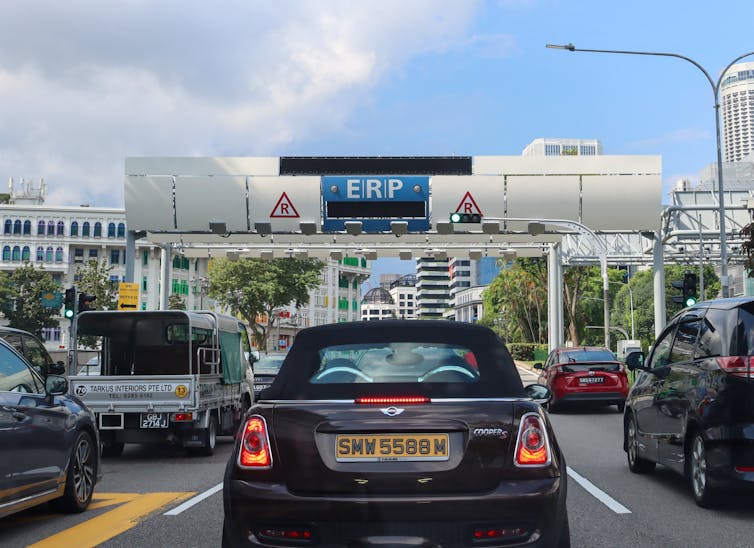
A car using Singapore's road-pricing system
A car using Singapore’s road-pricing system. David Sing/Shutterstock

DSRC works well in a small area: the Singapore scheme reports drivers responding to changing prices, including shifts of up to 20% to buses in rush hours following a marginal S$1 (around £0.54) increase to the toll for a particularly congested road. However, a UK equivalent would require the installation of costly gantries across the country.

GPS and cellular

GPS uses satellites that orbit the Earth to triangulate a user’s location, whereas cellular locating technologies use relative network signals between towers in a network to do the same thing.

These technologies can monitor the position of cars equipped with tracking equipment in the same way that smartphone users get directions through map-based apps. Cellular and GPS have relative trade-offs: GPS location accuracy suffers in urban areas, cellular network coverage doesn’t work as well in rural areas. Hybrid technologies are routinely used to get the best of both worlds, which could potentially support a national road pricing scheme with lane-by-lane accuracy.

A GPS/cellular road pricing system could work through drivers’ smartphones. But it would obviously require all drivers to have a smartphone and they would need to be turned on, with location services enabled, whenever the driver took a trip. A workable GPS/cellular road pricing system would require a tracking unit to be fitted to every vehicle. In 2023, the Singaporean system is due to be upgraded to use GPS communications, so it can cover more roads without the need for more gantries.
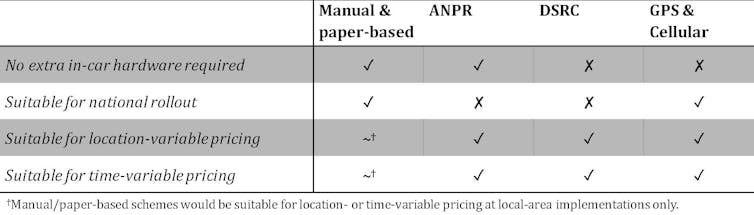
Table showing different road pricing technology options
How road pricing technologies compare. James Dixon, Author provided

What is the best option?

Technology for a national UK road pricing system would need to be able to work over a wide area, including remote parts of the UK. So the only workable options are either manual/paper or GPS/cellular.

A manual or paper-based system where drivers are billed annually according to their mileage would be less intrusive, as no in-car hardware would be required, and could be simpler to understand. But, it would not address – as the current car tax system does not – the variability in the “external costs” of driving.

External costs are those which affect the rest of society and are based on the contribution cars make to climate change, congestion, air pollution, noise pollution, infrastructure costs and the limits to regional economic development that result from car dependency.


UK drivers currently pay only 49% of these costs. Analysis suggests that they vary enormously by location, from 1.3p per/km (cost to society) on rural minor roads to 93.1p per/km on London A-roads. They also vary by time, from 9.5p per/km during weekday off-peak times to 29.5p per/km during the weekday morning peak.

The best option for a national scheme with variable prices to reflect the true costs of driving appears to be GPS/cellular. Such a system would be the most equitable way of funding the future of motoring: while encouraging us to shift towards alternatives to cars in cities as is so desperately needed. It could also ease the burden on those with less access to alternatives.

James Dixon, Research fellow in transport & energy systems, University of Strathclyde

This article is republished from The Conversation under a Creative Commons license. Read the original article.


Tags: SB001
DMCA.com Protection Status

SUBSCRIBE to our NEWSLETTER

[mc4wp_form id=”2384248″]

Don't Miss

The evolution of Aesthetic Surgery through the lens of Dr Kourosh Tavakoli

by Pauline Torongo
4 December 2025
The evolution of Aesthetic Surgery through the lens of Dr. Kourosh Tavakoli
Health & Wellness

As global interest in Australian cosmetic surgery continues to grow, the combination of regulation, research and emerging digital tools is...

Read moreDetails

Ryan: Building real freedom through e-commerce

by Pauline Torongo
27 November 2025
Ryan: Building real freedom through e-commerce
Business & Finance

Ryan’s greatest achievement isn’t any single business or revenue milestone — it’s the ecosystem he’s built through the Change community.

Read moreDetails

Design Australia Group: Redefining Drafting as the engine of housing growth

by Pauline Torongo
26 November 2025
Design Australia Group: Redefining Drafting as the engine of housing growth
Business & Finance

Australia is under pressure to build homes faster, but design bottlenecks slow progress. Design Australia Group is fixing this by...

Read moreDetails

Louis Guy Detata builds Global Trading Empires through autonomous systems and disciplined leadership

by Pauline Torongo
25 November 2025
Louis Guy Detata builds Global Trading Empires through autonomous systems and disciplined leadership
Business & Finance

The path from investment banking to leading a global trading platform has taught Louis Detata that sustainable success requires more...

Read moreDetails

Burning Eucalyptus Wood: Tips, Advantages, Disadvantages & Alternatives

by Fazila Olla-Logday
20 November 2025
Image Supplied
Enviroment

Learn about burning eucalyptus wood for stoves and fireplaces. Discover benefits, drawbacks, harvesting tips, and better alternative firewood options for...

Read moreDetails

Everything Parents Need to Know About Baby Soft Play and Why It’s a Game Changer

by Fazila Olla-Logday
11 November 2025
Everything Parents Need to Know About Baby Soft Play
Health & Wellness

Baby soft play is a fun, safe, and educational way for little ones to explore and grow. Discover the benefits...

Read moreDetails

WOMAD Sets Up a New Camp in Wiltshire – Australian festival fans take note!

by Kris Griffiths
11 November 2025
Kumbia Boruka brought their reggae and dancehall flavour to the Taste the World Stage at WOMAD 2024 - Credit - Mike Massaro
Entertainment

With its 2026 edition moving to Neston Park in England, WOMAD offers Aussie music lovers a chance to reconnect with global...

Read moreDetails
Load More

Copyright © Blue Sky Publications Ltd. All Rights Reserved.
australiantimes.co.uk is a division of Blue Sky Publications Ltd. Reproduction without permission prohibited. DMCA.com Protection Status

  • About us
  • Write for Us
  • Advertise
  • Contact us
  • T&Cs, Privacy and GDPR
No Result
View All Result
  • News
    • Weather
    • Sport
    • Technology
    • Business & Finance
      • Currency Zone
    • Lotto Results
      • The Lott
  • Lifestyle
    • Entertainment
    • Horoscopes
    • Health & Wellness
    • Recipes
  • Travel
  • Expat Life
  • Move to Australia

Copyright © Blue Sky Publications Ltd. All Rights Reserved.
australiantimes.co.uk is a division of Blue Sky Publications Ltd. Reproduction without permission prohibited. DMCA.com Protection Status

No Result
View All Result
  • News
    • Weather
    • Sport
    • Technology
    • Business & Finance
      • Currency Zone
    • Lotto Results
      • The Lott
  • Lifestyle
    • Entertainment
    • Horoscopes
    • Health & Wellness
    • Recipes
  • Travel
  • Expat Life
  • Move to Australia

Copyright © Blue Sky Publications Ltd. All Rights Reserved.
australiantimes.co.uk is a division of Blue Sky Publications Ltd. Reproduction without permission prohibited. DMCA.com Protection Status





