



M. K. Chin, Indiana University
There’s a growing rift between corporate America and the GOP – two groups that have long been bedfellows.
The latest incident involves a restrictive voting law passed in Georgia – with dozens of other states working on their own measures meant to limit voting. Over 300 companies, CEOs and other executives signed a statement printed in The New York Times to “defend the right to vote and oppose any discriminatory legislation,” while Major League Baseball moved its All-Star Game from Atlanta to Denver.
Republicans reacted furiously and warned of retribution, including eliminating tax breaks for companies taking a stand on the issue. Texas’ governor backed out of throwing the ceremonial first pitch at the Texas Rangers’ home opener. And Senate Minority Leader Mitch McConnell bluntly warned companies to “stay out of politics” – though he later softened his tone.
Meanwhile, Democrats are trying to capitalize on the fracture.
As a management professor, I study how corporate executives’ values and political views affect the decisions they make on behalf of their companies. While I believe CEOs are partly responsible for the growing business-GOP divide, it’s not the only factor driving it.
A tight relationship loosens up
The close relationship between corporate America and the Republican Party dates back to the 1970s. Companies provided financial support to conservative war chests and in return received business-friendly policies like reduced corporate taxes and regulations.


The alliance has arguably been quite a success for Big Business. Corporate taxes as a share of U.S. gross domestic product are only about 1%, the lowest since the 1930s and down from 4.1% in 1967.
But this union has become increasingly strained in recent years over a range of social issues, particularly regarding LGBTQ rights.
For example, in 2015 many companies including Apple and Walmart denounced so-called religious freedom laws like one passed in Indiana that would allow businesses to discriminate against LGBTQ customers. The following year there was a similar corporate backlash over North Carolina’s ban on transgender individuals using public bathrooms. Boycotts by several companies, including PayPal and the NCAA, led to a partial repeal in 2017.
Companies were also vocal during former President Donald Trump’s presidency over such matters as his travel ban from Muslim-majority countries and his comments following the white supremacist rally in Charlottesville, Virginia. For some, it seemed like the role he and other Republicans played in laying the ground for the Jan. 6, 2021, insurrection at the Capitol may have been the last straw, as dozens of companies including AT&T and Marriott said they would cut off donations to the 147 Republicans who voted against certifying President Joe Biden’s election.
The push for more restrictive voter laws continues the battle over the election. Republicans in states across the country cite alleged fraud in the 2020 election – despite no evidence that any occurred – as the impetus behind their push.
Why have companies become more outspoken in recent years and willing to upset an alliance that has helped them reduce their tax bills and regulatory hurdles?
My research suggests there are three driving forces for this trend.
CEOs doing ‘what we think is right’
The CEO is the corporation’s top decider, which means his or her political leanings can filter into business decisions.
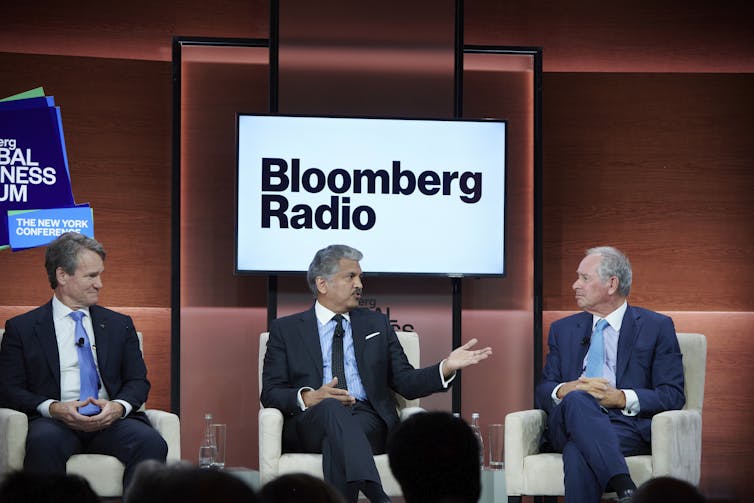
And in recent years, CEOs of some of the largest U.S. companies have cited their own personal values as their reason for speaking out on social issues. As Bank of America CEO Brian Moynihan told The Wall Street Journal in 2016, “Our jobs as CEOs now include driving what we think is right.”
In my own research, I’ve found a CEO’s political affiliation can affect how a company spends money. CEOs who mostly donate to Democrats tend to spend more on their employees, community activities and environmental issues, regardless of their company’s profitability. That is, they seem to believe it’s simply the right thing to do.
Republican CEOs, on the other hand, tend to tie spending on outside issues to financial performance, reflecting the notion that companies are responsible to shareholders first and foremost.
More recent research also demonstrates that liberal executives tend to pay more attention to gender diversity inside their companies and are less likely to reduce their workforce when economic conditions deteriorate, consistent with the values that liberals prioritize.
But relatively few CEOs are staunchly liberal, so the impact of the CEO on this trend may be limited. A recent study found that only about 18% of the more than 3,500 people who served as CEOs of companies in the Standard & Poor’s 1500 from 2000 to 2017 donated primarily to Democratic candidates, while 58% gave mostly to Republicans.
Growing worker activism
Employees also play an important role driving corporate activism.
Recent management research shows that companies with more liberal employees spend more resources on improving gender and race diversity and sustainability issues. Similarly, a 2019 study found that companies are more likely to concede to activists’ demands over issues like reducing carbon emissions and increasing front-line workers’ pay when they have a more liberal workforce.
Companies may be responding to research showing the benefits of listening to their employees and showing their voices matter. For example, workers tend to show more trust and commitment toward a company when they feel it shares their values, which leads to higher productivity. A 2017 survey found that 89% of employees said they’d accept a reduced salary to work at a company whose values match their own.
Other research shows engagement in social activities like protecting the environment leads to less employee turnover.
In my own research, which tracked companies’ engagement on same-sex marriage issues in the 2000s and 2010s, I found that the likelihood of CEOs speaking out on same-sex marriage significantly increased when there were more employees who donated to Democrats – which was true even when the CEO leaned conservative.
Tracking popular opinion
Public opinion is another factor likely driving the growing rift with the GOP.
Corporate executives tend to follow public sentiment, as they want to minimize the risk of losing customers for their products and services.
The debate over same-sex marriage is a good case in point. Public support for allowing gay people to marry surpassed 50% for the first time in 2011 – it’s now at 67%. Until then, very few CEOs had made a public statement on the issue, according to my same-sex marriage research. Once popular opinion hit the halfway point, however, a lot more companies – including ones led by conservative CEOs – begin speaking out in favor. Interestingly, even liberal CEOs said very little until 2011, including those who already provided employees with domestic partner benefits.
And more recently, it has become even more critical for companies to consider public sentiment when deciding whether to take a stand on a hot-button issue. That’s because their younger customers, especially millennials, increasingly say CEOs have a responsibility to speak out and they would be more likely to buy products if they do.
On the voting laws, a recent poll found that most people favor legislation that makes it easier to vote, not harder.
[Get the best of The Conversation, every weekend. Sign up for our weekly newsletter.]
Who’s leaving whom
But corporate America isn’t necessarily moving away from the Republican Party and toward the Democrats.
Instead, businesses are trying to make clear that their concerns are not partisan in nature. The 100-plus companies that signed a statement supporting voter rights and against bills that would restrict access emphasized this point.
I believe a closer look at the three main factors – especially the role of workers and the public – behind the growth in corporate activism suggests something else. Companies aren’t drifting away from the Grand Old Party. Rather, the GOP seems to be doing the drifting, not only from corporate America, but the American public as well.
M. K. Chin, Assistant Professor of Management, Indiana University
This article is republished from The Conversation under a Creative Commons license. Read the original article.







