



Matthew James, Queen’s University Belfast
We often assume that viral infections are caused by individual virus types. But in reality, we’re exposed to many viruses on a day to day basis, and co-infection – where someone is simultaneously infected by two or more virus types – is quite common.
The cells lining our throat and lower airways are exposed to the environment around us, making them a prime target for co-infection by respiratory viruses. These range from common-cold-causing rhinoviruses to the more serious influenza viruses, which are often the cause of global pandemics.
One of the most frequent outcomes of co-infection is viral interference, a phenomenon where one virus out-competes and suppresses the replication of the other co-infecting viruses. Interestingly, a growing body of evidence suggests rhinoviruses may interfere with the replication of other respiratory viruses that tend to be more serious. They may even offer the host temporary protection from them.
The good news is that this appears to include SARS-CoV-2 – the virus responsible for COVID-19. In a new study, rhinoviruses have been shown to suppress the replication of this virus.
Rhinoviruses
The majority of respiratory viruses that infect humans are rhinoviruses (from the Greek “rhino” for “of the nose”). First identified in 1953, rhinoviruses are extremely small respiratory viruses that are present all over the world. As far as we know, they are only capable of infecting humans.
Rhinovirus infections can be serious in some cases. However, they usually infect us to cause the common cold, a relatively mild disease. In response to such an infection, our immune system produces virus-killing molecules called interferons.


Interferons are produced in response to infections by all types of viruses, but they’re produced much faster and in greater quantities in response to rhinovirus compared to other respiratory viruses. Despite this, rhinoviruses have evolved complex mechanisms that allow them to evade interferons and replicate efficiently. It’s widely accepted that the rhinovirus-induced interferon response is what produces the symptoms of the common cold, rather than the virus itself.
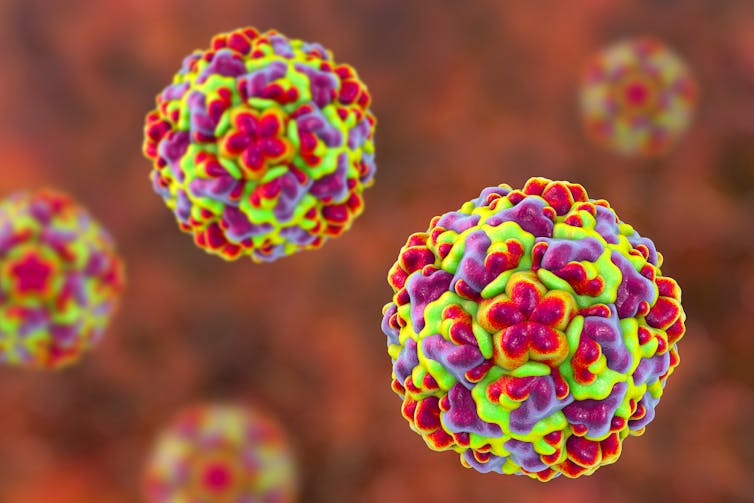
While rhinoviruses are pretty resistant to interferons, some other respiratory viruses are extremely sensitive to them. Influenza viruses, for example, can’t replicate properly in the presence of interferons.
Since rhinovirus infections trigger such a huge interferon response, researchers had the idea that they might offer protection against infection by more deadly, interferon-sensitive viruses, such as influenza.
In recent years, several research groups have investigated this phenomenon in the lab. They found that when cells are infected with rhinovirus, it triggers an interferon response which prevents them from being infected with the influenza virus.
If rhinovirus infections block the replication of other respiratory viruses, this could affect their spread and patterns of distribution. For instance, evidence suggests that rhinovirus may have interrupted the spread of the H1N1, or “swine flu”, influenza virus during the 2009 global pandemic.
The cold and COVID-19
If rhinovirus infections can interfere with the replication and spread of pandemic influenza viruses, could it do the same for interferon-sensitive coronaviruses, such as SARS-CoV-2?
A team of scientists at the University of Glasgow recently set out to answer this question. They infected lab-grown layers of cells that replicates the conditions in the human respiratory tract with rhinovirus, SARS-CoV-2 and both viruses simultaneously.
Interestingly, SARS-CoV-2 replicated much slower in the co-infection scenario. But rhinovirus replication didn’t change in the presence or absence of SARS-CoV-2.
To better replicate real-life conditions, the authors also infected the cells with either rhinovirus or SARS-CoV-2 24 hours prior to co-infecting them with the other virus. Rhinovirus was able to suppress the replication of SARS-CoV-2 regardless of whether it was added before or after SARS-CoV-2, suggesting that rhinovirus infection actively protects the cells from SARS-CoV-2.
Next, the authors wanted to confirm that the inhibitory effect on SARS-CoV-2 replication was specifically caused by a rhinovirus-induced interferon response. They co-infected cells with both rhinovirus and SARS-CoV-2 in the presence of a drug which blocks the virus-killing properties of interferons, called BX795.
In this part of the experiment, BX795 allowed SARS-CoV-2 to replicate at a level comparable to that of a single SARS-CoV-2 infection. This confirmed that a rhinovirus-induced interferon response is indeed responsible for the block in SARS-CoV-2 replication seen in the co-infection experiments without BX795.
Using mathematical simulations, the authors also found that more frequent rhinovirus infections among the population would result in a reduced rate of SARS-CoV-2 infection. Taken together, these results confirm that rhinovirus infections suppress the replication of SARS-CoV-2, which may in turn reduce the number of new cases among the population.
So, can rhinoviruses protect us from infection by SARS-CoV-2? The short answer is yes. However, it’s essential to note that the rhinovirus-induced interferon response is an example of innate immunity, meaning that its effect only lasts as long as the invading rhinovirus is in your body.
If you recover from a cold and then come into contact with SARS-CoV-2 a week later, it’s unlikely you will have enough interferons to successfully block the SARS-CoV-2 infection. Long-term immunity, which involves the production of highly specific antibodies, is only obtained by coming into direct contact with the virus in question – either in the wild or by vaccination.
So, if you’re someone who has not yet had COVID-19 or are unvaccinated, you’ll only be protected if you are lucky enough to be infected at the same time that you’re experiencing a cold. Rhinoviruses may play a critical role in controlling the spread of SARS-CoV-2 among the human population. The most effective way, however, probably remains vaccination.
Matthew James, Research Assistant, Wellcome-Wolfson Institute for Experimental Medicine, Queen’s University Belfast
This article is republished from The Conversation under a Creative Commons license. Read the original article.







