



William Webster, University of Stirling
Renewed concern about the safety of public streets, especially for women, has prompted the UK government to announce the doubling of a “Safer Streets” fund to £45 million, with planned measures including more CCTV in public places such as parks.
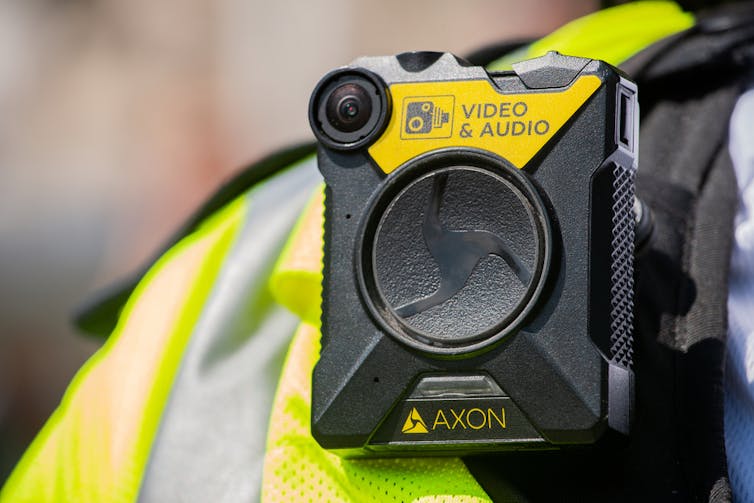
This would be to add to a street surveillance ecosystem that is already extensive in the UK – often referred to as the most surveilled nation on Earth. The first wave of surveillance cameras went in 30 years ago, and by 2013 an estimated 5.9 million units were watching UK streets. That figure is likely far higher today, driven in part by the new availability of compact cameras like dashcams, bodycams and doorbell cameras.
But the overall picture of the UK’s street surveillance ecosystem is muddled, with some cameras too old to produce quality images, others aimed at entryways rather than streets, and some smaller cameras, like those attached to bodies and vehicles, not suited to general public safety.
Enlarging that ecosystem still further may be a seductive policy solution to street safety concerns, but there’s limited evidence of their effectiveness at reducing and deterring crime. And, as women’s groups have recently pointed out, the focus on street surveillance neglects the wider societal change required in order to make women feel safer in public places.
CCTV ecosystem
Most CCTV cameras in the UK are actually privately owned – either put up by businesses looking to protect their premises, or attached to private residencies for security. According to some estimates, just 1 in 70 CCTV cameras are state-owned, and many of these are placed in and around public buildings.
This has resulted in a disparate and fragmented CCTV ecosystem, with cameras concentrated in commercial districts rather than in residential neighbourhoods. This disparity has led to concerns that cameras may serve to displace crime from central, surveilled areas into residential ones.


Even in commercial areas, many cameras were initially installed to monitor entryways into buildings – not to enhance street safety – and the angle at which they’re positioned reflects this function. Meanwhile, a certain proportion of cameras are broken and out of use – some are too old to offer reliable footage in criminal prosecutions, while others are actually switched off too due to funding issues. There are concerns that such cameras merely offer the illusion of safety and security, without the capacity to record crime on our streets.
Public support for CCTV, which is still relatively strong, is based on the premise that cameras work – and that they can be used in the public interest. While there are millions of cameras watching UK streets, they’re only watching select parts of them in what is a fragmented patchwork that may have little effect on street safety.
New cameras
But the CCTV ecosystem is also evolving. Old cameras have been replaced by new digital ones with significantly improved surveillance capabilities. Sharper recordings now offer clearer pictures that could used as trustworthy evidence in legal proceedings. And the growing profusion of internet-connected “smart cameras”, offer a new way to analyse footage via Artificial Intelligence (AI), both in real-time or via recordings after incidents have occurred.
Such AI, in use across some CCTV ecosystems, can be used to automatically analyse unfolding situations, potentially enhancing public safety. These systems are proving useful for identifying objects on train tracks, monitoring crowd size, recognising unusual behaviour, and identifying known suspects in a dragnet of recordings from a certain area.
But new, AI-driven surveillance technology is fiercely contested. For instance, facial recognition software, which is seen as desirable for policing, has been criticised for being unreliable and racially biased. Police access to personal surveillance footage, like that from a doorbell camera which records everyone who visits your home, could also become a contentious privacy issue in the near future.
Governing CCTV
New technology within and behind cameras has the potential to enhance the reliability of street surveillance. If it’s leveraged correctly, it could deter crime and facilitate the successful prosecution of criminals caught on CCTV. But to operate effectively and legally, this new ecosystem will require new forms of governance and coordination that weren’t needed a decade ago.
Earlier this month, the UK government appointed a new Surveillance Camera Commissioner, who has been tasked with governing the fast-moving world of surveillance cameras. Noticeably, this office has been combined with that of the Biometrics Commissioner – a possible indicator of the direction of travel for the UK’s CCTV ecosystem, which may be set to merge with biometrics and advanced surveillance software.
Still, the UK’s Safer Streets initiative does also look beyond CCTV: funding improved street lighting and increased street patrols. This points to a recognition that CCTV technology is no silver bullet solution for public safety issues – even within the limited scope of urban design.
In this context, and given existing flaws in the UK’s patchy CCTV ecosystem, faith in street surveillance as an effective public safety provision may be misplaced. Real street safety, extending far beyond the reach of CCTV cameras, won’t be achieved by technology – it’ll be achieved by social change.
William Webster, Professor and Director, Centre for Research into Information, Surveillance and Privacy, University of Stirling
This article is republished from The Conversation under a Creative Commons license. Read the original article.







