
• Advertise
  • About us
  • Terms and Conditions
  • Contact us
Saturday, December 6, 2025
Australian Times News
  • News
    • Weather
    • Sport
    • Technology
    • Business & Finance
      • Currency Zone
    • Lotto Results
      • The Lott
  • Lifestyle
    • Entertainment
    • Horoscopes
    • Health & Wellness
    • Recipes
  • Travel
  • Expat Life
  • Move to Australia
No Result
View All Result
  • News
    • Weather
    • Sport
    • Technology
    • Business & Finance
      • Currency Zone
    • Lotto Results
      • The Lott
  • Lifestyle
    • Entertainment
    • Horoscopes
    • Health & Wellness
    • Recipes
  • Travel
  • Expat Life
  • Move to Australia
No Result
View All Result
Australian Times News
No Result
View All Result
Home News

Keating is right. The Reserve Bank should do more. It needs to aim for more inflation

For years now, the bank has chronically undershot its inflation target of 2% to 3% per year. This has to stop.

The Conversation by The Conversation
24-09-2020 22:01
in News
The Reserve Bank should do more

The Reserve Bank should do more Photo by Markus Winkler on Unsplash

Chris Edmond, University of Melbourne and Bruce Preston, University of Melbourne

Former prime minister Paul Keating isn’t alone in wanting the Reserve Bank to do much more to ensure economic recovery.

Ashwin/Shutterstock

In an opinion piece for major newspapers he has said it ought to be directly funding government spending rather than indirectly by buying government bonds from third parties.

But we think there’s something else the Reserve Bank can do.

Governor Philip Lowe is right to call on governments to spend more, creating “fiscal stimulus”.

But we don’t think that absolves the Reserve Bank of the need to provide more “monetary stimulus”.

Simply put, the Reserve Bank needs to create more inflation. Quite a lot more.

AlsoRead...

Ryan: Building real freedom through e-commerce

Ryan: Building real freedom through e-commerce

27 November 2025
Design Australia Group: Redefining Drafting as the engine of housing growth

Design Australia Group: Redefining Drafting as the engine of housing growth

26 November 2025

For years now, the bank has chronically undershot its inflation target of 2% to 3% per year. This has to stop.


Consumer price inflation since the Reserve Bank’s 2-3% target
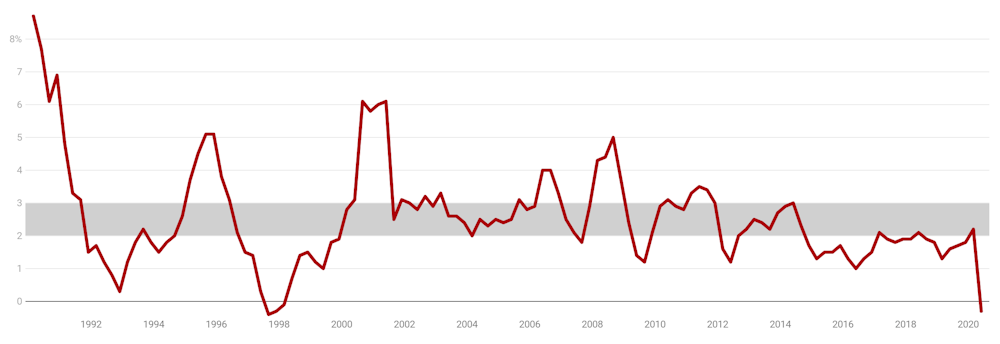
ABS Consumer Price Index, Australia

Inflation plays a vital role in government finances, through its influence on nominal income growth. Higher nominal income growth lowers outstanding debt as a fraction of income.

To appreciate the size of the effect, if average inflation runs at 1.5% per year rather than 2.5% per year (the bank’s central target), after a decade prices will be roughly 10% lower.

As a consequence, public debt as a fraction of national income will be 10% higher, and that’s before taking into account the revenue implications of lower inflation.

Too much inflation creates its own problems, but so does too little.

Of course, the Reserve Bank’s options are limited right now. Short term interest rates are effectively zero and can’t go much lower without turning negative, an idea the bank has so far resisted.

The bank needs to commit to “too much” inflation

But there are things the bank can do, and they involve making clear its plans for when inflation recovers.

When economic growth revives, be it in 12 or 24 months, the bank will face a choice between raising rates to more normal levels, or continuing to keep them extraordinarily low.

The RBA should do the latter and promise serious inflation, more than it is comfortable with, for some time to come.

Promising to overshoot its target band will raise inflation expectations and then inflation itself, lowering the real interest rate.

This will buttress the recovery, supporting economic growth. It will also greatly improve the state of government finances.

How much inflation should the RBA generate?

It should aim for average inflation of 2-3% over a long window, at least ten years.

This will place a clear upper bound on how much inflation is appropriate over the long term, while requiring substantial inflation for some time to make up for the sustained undershooting of its target.

It’s being tried in the United States

Such a policy might sound unusual. And there would be protests about credibility and the risks of changing institutional arrangements during a crisis.

But the United States Federal Reserve recently adopted such a policy after an extensive review.

There’s no reason Australia’s Reserve Bank couldn’t do the same.

As it happens, hardly any formal change is required. Its Statement on the Conduct of Monetary Policy says its goal is 2 to 3% inflation “on average, over time.”

So there’s no need to change the wording, merely the interpretation.

It could make clear that a practical change had taken place by referring to the new regime as a “price-level target”, since targeting inflation over a long time is equivalent to targeting a path for the overall level of prices.

It’d hold the bank to account

Regardless of the label, such a clearly enunciated approach would make monetary policy more effective and help the government with its finances.

And that’s not all. An average inflation target would provide a clearer benchmark against which to assess the bank’s performance and thus strengthen the accountability of one of our most important institutions.

Too often in the past the bank has excused its failure to hit its inflation target by appeals to a vague and shifting list of factors outside of its control.

While some excuses may have merit, the existing regime does not well communicate how such undershooting determines what the bank will do in the future.

By contrast, an average inflation target would clearly communicate that whatever the excuses for undershooting, future policy will be set to overshoot until average inflation is back on target.

It’s appropriate for fiscal policy to take the lead right now. But monetary policy has to be ready to do its job too.

Chris Edmond, Professor of Economics, University of Melbourne and Bruce Preston, Professor of Economics, University of Melbourne

This article is republished from The Conversation under a Creative Commons license. Read the original article.


Tags: SB001
DMCA.com Protection Status

SUBSCRIBE to our NEWSLETTER

[mc4wp_form id=”2384248″]

Don't Miss

The evolution of Aesthetic Surgery through the lens of Dr Kourosh Tavakoli

by Pauline Torongo
4 December 2025
The evolution of Aesthetic Surgery through the lens of Dr. Kourosh Tavakoli
Health & Wellness

As global interest in Australian cosmetic surgery continues to grow, the combination of regulation, research and emerging digital tools is...

Read moreDetails

Ryan: Building real freedom through e-commerce

by Pauline Torongo
27 November 2025
Ryan: Building real freedom through e-commerce
Business & Finance

Ryan’s greatest achievement isn’t any single business or revenue milestone — it’s the ecosystem he’s built through the Change community.

Read moreDetails

Design Australia Group: Redefining Drafting as the engine of housing growth

by Pauline Torongo
26 November 2025
Design Australia Group: Redefining Drafting as the engine of housing growth
Business & Finance

Australia is under pressure to build homes faster, but design bottlenecks slow progress. Design Australia Group is fixing this by...

Read moreDetails

Louis Guy Detata builds Global Trading Empires through autonomous systems and disciplined leadership

by Pauline Torongo
25 November 2025
Louis Guy Detata builds Global Trading Empires through autonomous systems and disciplined leadership
Business & Finance

The path from investment banking to leading a global trading platform has taught Louis Detata that sustainable success requires more...

Read moreDetails

Burning Eucalyptus Wood: Tips, Advantages, Disadvantages & Alternatives

by Fazila Olla-Logday
20 November 2025
Image Supplied
Enviroment

Learn about burning eucalyptus wood for stoves and fireplaces. Discover benefits, drawbacks, harvesting tips, and better alternative firewood options for...

Read moreDetails

Everything Parents Need to Know About Baby Soft Play and Why It’s a Game Changer

by Fazila Olla-Logday
11 November 2025
Everything Parents Need to Know About Baby Soft Play
Health & Wellness

Baby soft play is a fun, safe, and educational way for little ones to explore and grow. Discover the benefits...

Read moreDetails

WOMAD Sets Up a New Camp in Wiltshire – Australian festival fans take note!

by Kris Griffiths
11 November 2025
Kumbia Boruka brought their reggae and dancehall flavour to the Taste the World Stage at WOMAD 2024 - Credit - Mike Massaro
Entertainment

With its 2026 edition moving to Neston Park in England, WOMAD offers Aussie music lovers a chance to reconnect with global...

Read moreDetails
Load More

Copyright © Blue Sky Publications Ltd. All Rights Reserved.
australiantimes.co.uk is a division of Blue Sky Publications Ltd. Reproduction without permission prohibited. DMCA.com Protection Status

  • About us
  • Write for Us
  • Advertise
  • Contact us
  • T&Cs, Privacy and GDPR
No Result
View All Result
  • News
    • Weather
    • Sport
    • Technology
    • Business & Finance
      • Currency Zone
    • Lotto Results
      • The Lott
  • Lifestyle
    • Entertainment
    • Horoscopes
    • Health & Wellness
    • Recipes
  • Travel
  • Expat Life
  • Move to Australia

Copyright © Blue Sky Publications Ltd. All Rights Reserved.
australiantimes.co.uk is a division of Blue Sky Publications Ltd. Reproduction without permission prohibited. DMCA.com Protection Status

No Result
View All Result
  • News
    • Weather
    • Sport
    • Technology
    • Business & Finance
      • Currency Zone
    • Lotto Results
      • The Lott
  • Lifestyle
    • Entertainment
    • Horoscopes
    • Health & Wellness
    • Recipes
  • Travel
  • Expat Life
  • Move to Australia

Copyright © Blue Sky Publications Ltd. All Rights Reserved.
australiantimes.co.uk is a division of Blue Sky Publications Ltd. Reproduction without permission prohibited. DMCA.com Protection Status