


• Advertise
  • About us
  • Terms and Conditions
  • Contact us
Wednesday, August 12, 2026
Australian Times News
  • News
    • Weather
    • Sport
    • Technology
    • Business & Finance
      • Currency Zone
    • Lotto Results
      • The Lott
  • Lifestyle
    • Entertainment
    • Horoscopes
    • Health & Wellness
    • Recipes
  • Travel
  • Expat Life
  • Move to Australia
No Result
View All Result
  • News
    • Weather
    • Sport
    • Technology
    • Business & Finance
      • Currency Zone
    • Lotto Results
      • The Lott
  • Lifestyle
    • Entertainment
    • Horoscopes
    • Health & Wellness
    • Recipes
  • Travel
  • Expat Life
  • Move to Australia
No Result
View All Result
Australian Times News
No Result
View All Result
Home News

You’ve got (less) mail: COVID-19 hands Australia Post a golden opportunity to end daily letter delivery

Federally legislated service standards oblige Australia Post to deliver a letter within the country in no more than four days at a fixed rate (currently A$1.10).

The Conversation by The Conversation
27-06-2020 06:39
in News
to end daily letter delivery

To end daily letter delivery Photo by sue hughes on Unsplash

Paul Alexander, Curtin University

Australia Post delivered more than 3.3 billion items last financial year. That’s almost 14 million deliveries a day (not counting weekends and public holidays).

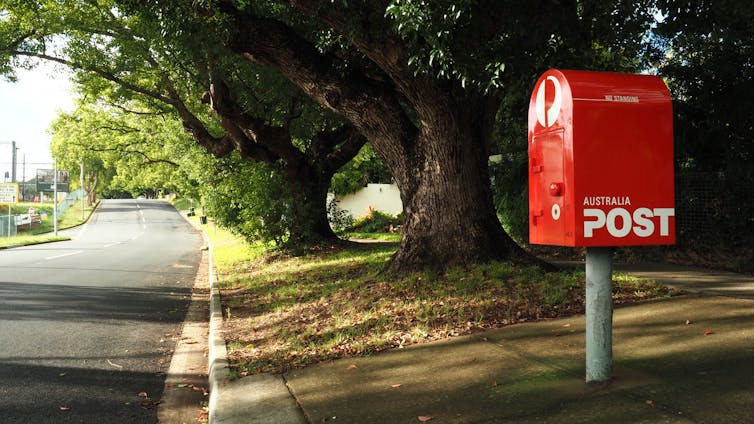
Its 2019 annual report itemises the massive logistical network required: 15,037 street post boxes, 4,343 post offices, 461 sorting and distribution facilities, 4,845 delivery vans, 2,600 trucks, six airline freighters, rail assets, and 8,992 motorbikes and electric delivery vehicles.
Shutterstock

Letters and parcels move in “waves” to 12.1 million addresses daily. Federally legislated service standards oblige Australia Post to deliver a letter within the country in no more than four days at a fixed rate (currently A$1.10). And to do so every week day to 98% of all delivery points.

Or at least Australia Post did so until late April. That’s when the federal government granted a temporary suspension of the services standards, allowing it to deliver letters every second business day in metropolitan areas.

The rationale was to enable Australia Post to divert resources from letter delivery – the part of its business in decline for at least a decade – to the booming demand for parcel delivery driven by COVID-19.

In May, with support from the Senate crossbench, the government passed amendments extending the suspension to June 2021.


AlsoRead...

Managing Aussie Share Portfolios Abroad: Tips for Growth

Managing Aussie Share Portfolios Abroad: Tips for Growth

2 July 2026
The New Meaning of Luxury: Lessons from Entrepreneur Chloe Hardy

The New Meaning of Luxury: Lessons from Entrepreneur Chloe Hardy

2 July 2026

That move is not universally supported. Unions fear postal workers will lose jobs. Federal opposition leader Anthony Albanese has signalled Labor Party support for a Senate motion to overturn the changes.

These cuts are to jobs, these cuts are to services that are absolutely essential […] In particular, older Australians really rely upon their postal services.

It’s true Australia Post provides an indispensable service. But its revenues tell a story of people relying on postal services less and less.

Lost letters

The decline of the letter business over the past decade has been relentless.

In 2009 Australia Post made a profit before interest and income tax of A$384.5 million. Of this its letter business generated A$52 million. Parcels and logistics made A$187 million. Other business (such as agency services and merchandise) made about A$146 million.

In 2019 its net profit was down to a razor-thin A$41 million. Profit before interest and tax for its non-letters businesses was almost A$259 million. Its letters business lost almost A$192 million.

Australia Post can still make profits delivering letters in major cities and regional centres, where population density is high and distances short. But not in in rural areas, where per-delivery costs skyrocket. Its commercial competitors, meanwhile, can cherry-pick the most lucrative market segments and avoid the loss-making ones.

Parsing parcels

Australia Post has long yearned to be freed from its obligation to deliver letters daily. In 2015 then chief executive Ahmed Fahour declared letter posting “in terminal and structural decline” and that Australia Post “is a parcels company more than a letters company”.

In March, current chief executive Christine Holgate told a Senate estimates committee:

Our most significant challenge is managing the tipping point of that transformation from letters for our delivery network, which is about 70% of our costs, which is actually now in need really of a significant transformation.

The cost of delivering a $1.10 letter is not much less than a $10 parcel. It makes no commercial sense to utilise resources on loss-making activities at the expense of profitable ones.

But Australia Post is not just another corporation. Profits are not its only measure of success. It is owned by the nation. Its services are essential, particularly to rural communities.

Fingal Post Office, in north-east Tasmania. Shuttterstock

At this time, a strong case can be made it is a better social service to ensure timely parcel delivery.

In the longer term, the issue for policy makers is whether the social good is best served by keeping Australia Post to its historical obligations, or allowing it to meet burgeoning parcel demand and return a bigger dividend to the federal government to help fund other public services.

While opinions will vary, the numbers make a compelling case. They show a mail delivery system designed before the advent of the internet doesn’t need to be daily any more – just as the telephone last century helped end the importance of mail being delivered twice a day.

Paul Alexander, Associate Professor, Network analysis, Procurement,Supply Chains, Curtin University

This article is republished from The Conversation under a Creative Commons license. Read the original article.


Tags: SB001
DMCA.com Protection Status

SUBSCRIBE to our NEWSLETTER

[mc4wp_form id=”2384248″]

Don't Miss

Why Smarter Fleet Management Is For All Modern Business Options

by Fazila Olla-Logday
29 July 2026
Smarter Fleet Management
Motoring

Operating a business that relies on vehicles is harder than ever.

Read moreDetails

Animal Communication Goes Beyond What Science Can Currently Measure: Zoologist and Spiritual teacher Artemis, the heart whisperer on what the textbooks don’t teach

by Australian Times
7 July 2026
Animal Communication Goes Beyond What Science Can Currently Measure
Lifestyle

Animal communication classes and formal training can be valuable, providing tools, structure, and guidance.

Read moreDetails

Managing Aussie Share Portfolios Abroad: Tips for Growth

by Fazila Olla-Logday
2 July 2026
Managing Aussie Share Portfolios Abroad: Tips for Growth
at

Unlock the secrets to optimizing your Aussie share portfolios abroad. Discover essential tips for growth and navigate the global market...

Read moreDetails

The New Meaning of Luxury: Lessons from Entrepreneur Chloe Hardy

by Pauline Torongo
2 July 2026
The New Meaning of Luxury: Lessons from Entrepreneur Chloe Hardy
Business & Finance

Chloe Hardy, the founder and CEO of Dupes & Co established an Australian-made beauty brand focused on affordability and product...

Read moreDetails

Excel Funding Group emerges as Specialist in SMSF Property Lending amid growing demand

by Pauline Torongo
26 June 2026
Excel Funding Group emerges as Specialist in SMSF Property Lending amid growing demand
Business & Finance

Excel Funding Group has hit a new milestone, tripling its SMSF loan settlement volumes compared to Q1 2025.

Read moreDetails

Svitla Systems acquires Australia’s Kiandra IT to expand Global Engineering Footprint and Accelerate AI-Driven delivery

by Pauline Torongo
11 May 2026
Svitla Systems
Business & Finance

Acquisition marks Svitla’s entry into the Australian market and strengthens capabilities in low-code, Microsoft technologies, and enterprise software engineering.

Read moreDetails

Residential Healthcare Practices: Revolution or Evolution?

by Pauline Torongo
11 May 2026
Residential Healthcare Practices: Revolution or Evolution?
Lifestyle

President Bill Lutz’s "revolution" was born from his background in fine dining, which instilled a disciplined, customer-focused approach.

Read moreDetails
Load More

Copyright © Blue Sky Publications Ltd. All Rights Reserved.
australiantimes.co.uk is a division of Blue Sky Publications Ltd. Reproduction without permission prohibited. DMCA.com Protection Status

  • About us
  • Write for Us
  • Advertise
  • Contact us
  • T&Cs, Privacy and GDPR
No Result
View All Result
  • News
    • Weather
    • Sport
    • Technology
    • Business & Finance
      • Currency Zone
    • Lotto Results
      • The Lott
  • Lifestyle
    • Entertainment
    • Horoscopes
    • Health & Wellness
    • Recipes
  • Travel
  • Expat Life
  • Move to Australia

Copyright © Blue Sky Publications Ltd. All Rights Reserved.
australiantimes.co.uk is a division of Blue Sky Publications Ltd. Reproduction without permission prohibited. DMCA.com Protection Status

No Result
View All Result
  • News
    • Weather
    • Sport
    • Technology
    • Business & Finance
      • Currency Zone
    • Lotto Results
      • The Lott
  • Lifestyle
    • Entertainment
    • Horoscopes
    • Health & Wellness
    • Recipes
  • Travel
  • Expat Life
  • Move to Australia

Copyright © Blue Sky Publications Ltd. All Rights Reserved.
australiantimes.co.uk is a division of Blue Sky Publications Ltd. Reproduction without permission prohibited. DMCA.com Protection Status





