


Andrew Dawson, University of Melbourne and Jennifer Day, University of Melbourne
Motorists and cyclists are akin to ethnic groups, our research shows. This means we might want to look to multiculturalism in managing relations on the roads.
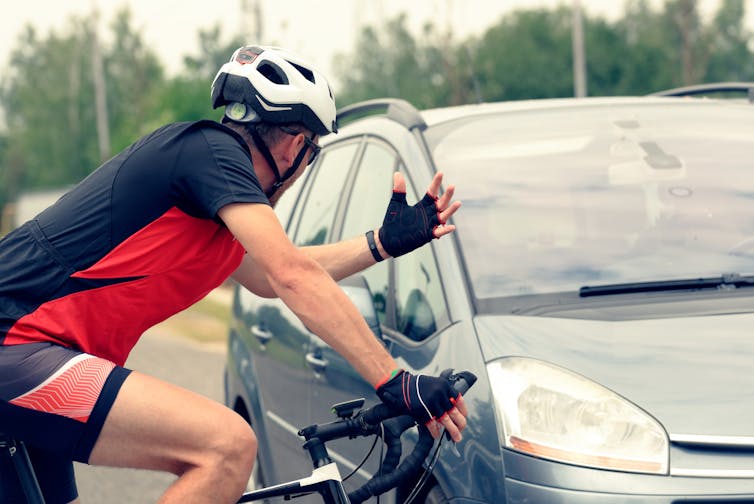
As we exit lockdown, car and bicycle use will increase greatly. Commuters may be swapping one risk for another – an increased risk of traffic accidents and congestion for the risk of coronavirus infection on public transport. Cities overseas are increasingly turning to segregated car and bicycle lanes as a solution.
Segregation isn’t a panacea
However, segregation can be difficult to implement. Its construction may be costly and increase traffic congestion.
In addition, when many motorists incorrectly view car licensing as the main means of financing roads, it can be a politically risky project. Simply, there are many more motorist than cyclist voters.
Claims that segregation is a panacea are debatable anyway. Vehicle segregation in Australia dates to the 19th century. Its purpose then was to designate roads as being mainly for “car-riages”, to the exclusion of activities such as walking and trading. In turn, cars came to be viewed as the “natural” vehicles of the road.
This engendered a sense of road entitlement and aggressive driving. So segregation, the very thing designed to protect cyclists from motorists, lies at the root of why some motorists are a danger in the first place.


Research also suggests motorists’ conduct towards cyclists becomes less responsible in mixed traffic settings as segregation increases elsewhere. Basically, danger is displaced to the suburbs.
Why is aggression on roads so common?
Given this, segregation must surely be complemented by promoting safety in mixed traffic settings too. This requires an understanding of behaviour on the roads and how to promote good behaviour.
It is not enough to put motorists’ aggression towards cyclists down to “road rage”. Aggression on the roads is more common in some places than others, in the Antipodes more than in the UK for example.
We would not conceive of aggression in other contexts, such as ethnic conflict, as being the result of a universally aberrant state of mind. We would take social and cultural circumstances into account. So why do otherwise in the case of roads?
What does this have to do with ethnic conflict?
The ethnic conflict analogy is not coincidental. Ethnicity is a useful point of reference for thinking about the identities and relations of drivers and cyclists.
Much like disability and LGBTQI activists, a growing body of cycling activists see cyclists as having characteristics like those of an ethnic minority. In these terms, one could argue segregated car and bicycle lanes perpetuate a form of historical domination: driving is the equivalent of “whiteness” and segregation a form of infrastructural “apartheid”.
However, we do not want to take the analogy that far. Cyclists do not meet cultural criteria of minority status. And so, in times when ethnic minority status is an increasingly influential advocacy discourse, the cyclist-equals-oppressed ethnic-group equation can be exposed as purely tactical.
What we do observe, however, is that identity formation among motorists and cyclists mirrors that of ethnic group formation. Our research analyses what several hundred respondents had to say in online public forums about motorist-cyclist relations in Melbourne.
Our analysis reveals motorists and cyclists have distinct identities, involving both their sense of themselves and of the other group of road users. There is also a widespread sense, even among cyclists, that cars are the “natural” vehicles of the road.

Our analysis also reveals an array of derogatory ethnic-like stereotypes that motorists and cyclists hold about one another. Interestingly, like some Bosnian former Yugoslavs who deny their ambiguous ethnic status by declaring militant Bosniac (Muslim), Croat or Serb patriotism and hatred of the ethnic other, cyclists who also drive often express the most extreme views.
Drawing on multicultural tolerance
If ethnicity is a useful point of comparison for thinking about the identities and relations of drivers and cyclists, then it makes sense to go a step further. It may also, à la multiculturalism, offer pointers to how to manage relations between drivers and cyclists.
At the heart of multiculturalism is a politics of “recognition”. We see it in a range of practices such as cross-cultural awareness training. Likewise, vehicle use education could pay more attention to increasing awareness of the capacities and limitations of other vehicles.
There is also recognition in the legal practice of “cultural defence”. Crime and punishment are not determined solely by a universal standard, but also with regard to a defendant’s cultural background.
Likewise, a shared code of conduct could govern conduct on the road, tempered sensitively to the unique capacities of particular vehicles. The “Idaho stop”, for example, permits cyclists in that state to treat stop signs as yield or give way signs if conditions are safe to do. Research has shown this increases safety on the roads. Versions of this law have been passed in Delaware, Colorodo, Arkansas and Oregon since 2017.
Practices such as these might lead to greater “tolerance” between different road users. Putting this another way, we argue for the road to be reconceived as a “multiautocultural” space.
Andrew Dawson, Professor and Chair of Anthropology, University of Melbourne and Jennifer Day, Senior Lecturer in Urban Planning, University of Melbourne
This article is republished from The Conversation under a Creative Commons license. Read the original article.







