

I imagine that for most of you, your charming Australian accents, bright smiles and warm g’days will help you glide through UK life and smooth out any social bumps along the way. However, a handful of you may just decide to stay here a bit longer and, who knows, even venture into our world of the Anglo-Australian marriage and family life.
Australia might not be perfect but I don’t think Aussies have so many issues with the words you use. My Aussie will tell you ten years of marriage is a breeze compared to understanding that invitation to tea.
First of all, if you haven’t worked it out already, in the UK the word ‘country’ itself carries a very different connotation to the dusty, fly-blown, flanno wearing, hard-yakka lifestyle of rural Australia. Here in Britain, think manors and Range Rovers. More Mr Darcy than Mr Snowy River.
So, let’s say you’re invited to his/her parents’ house in the country. Can you imagine if the whole room went quiet when you said “pardon?”? Or your daughter was told she couldn’t use that word in her friend’s house.
Remember these essentials to ensure a pleasant weekend in the British countryside:
Words Aussies should and shouldn’t use on a trip to country Britain
1. When you haven’t heard what your host or their butler said, never ever say ‘pardon?’. ‘Sorry?’, ‘What?’ or even a grumble are safer than this 6-letter word. For the Brits with the country houses and children in private school uniforms, this is the one word that tells them whether you’re one of them or not – whether you’re British or Aussie. A safe bet is to avoid any French-sounding words (pardon means ‘excuse me’ and ‘sorry’ in French). Apparently we Brits still have a chip on our shoulder over the Norman invasion just the other day – in the 11th Century.
2. It’s ‘napkin’ not ‘serviette’. Serviette might sound fancy and French but as you’ve now learnt with ‘pardon’, that upper crust of British society don’t like it one bit. The fact that some French expressions like ‘déja vu’ and, quite appropriately here, ‘creme de la creme’ are acceptable is the subject of another article.


3. You sit on a ‘sofa’, not a ‘settee’, and it’s in the ‘living room’ (or the ‘drawing room’ if the relos have that big house in Devon) – not ‘lounge’ or the ‘front room’.
4. If you need to go to the dunny, it’s the ‘loo’, not the ‘lavatory’, not the ‘WC’ and certainly never ever the ladies or God forbid, the ‘bog’.
Those words are pretty easy. Now down to those meal invitations which still confuse the hell out of your average Aussie hubby. If we were only ever invited to breakfast or brunch, we’d be fine.
When tea is supper but not dinner
Starting with the simplest; some people say ‘supper’ (the ones who say don’t say ‘pardon?’) and if they do, don’t call it ‘dinner’.
When you’re invited to ‘tea’, it can either mean:
a) Actual cups of tea with scones and cakes at 4 o’clock precisely. Timing is a good clue.
b) The evening meal for people who don’t say ‘supper’ or ‘dinner’.
c) If you have kids – a children-only, early evening meal. NB: This means no food for you – my husband was caught tucking into the kids’ sausages to the horror of the host. You’ve been warned.
At this point, if you think I am going completely crazy, just take a look at Debretts.com. Debrett’s describe themselves as: “originally founded as the expert on the British aristocracy, today Debrett’s is the trusted source on British social skills, etiquette and style.” Yep, this is all actually still taken seriously by some people in this fair green land called Britain. I particularly like the pages on ‘Personal Space’ and ‘Communicating with the Queen’.
And a last word: The supper-eating, loo-going, sofa-sitting Brits do not eat dessert, only pudding.
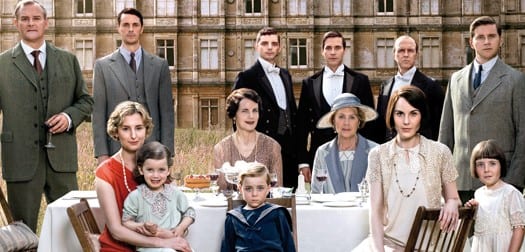
IMAGE: Downton Abbey (BBC)